Timing Is Everything, And This Timing Was Bizarre
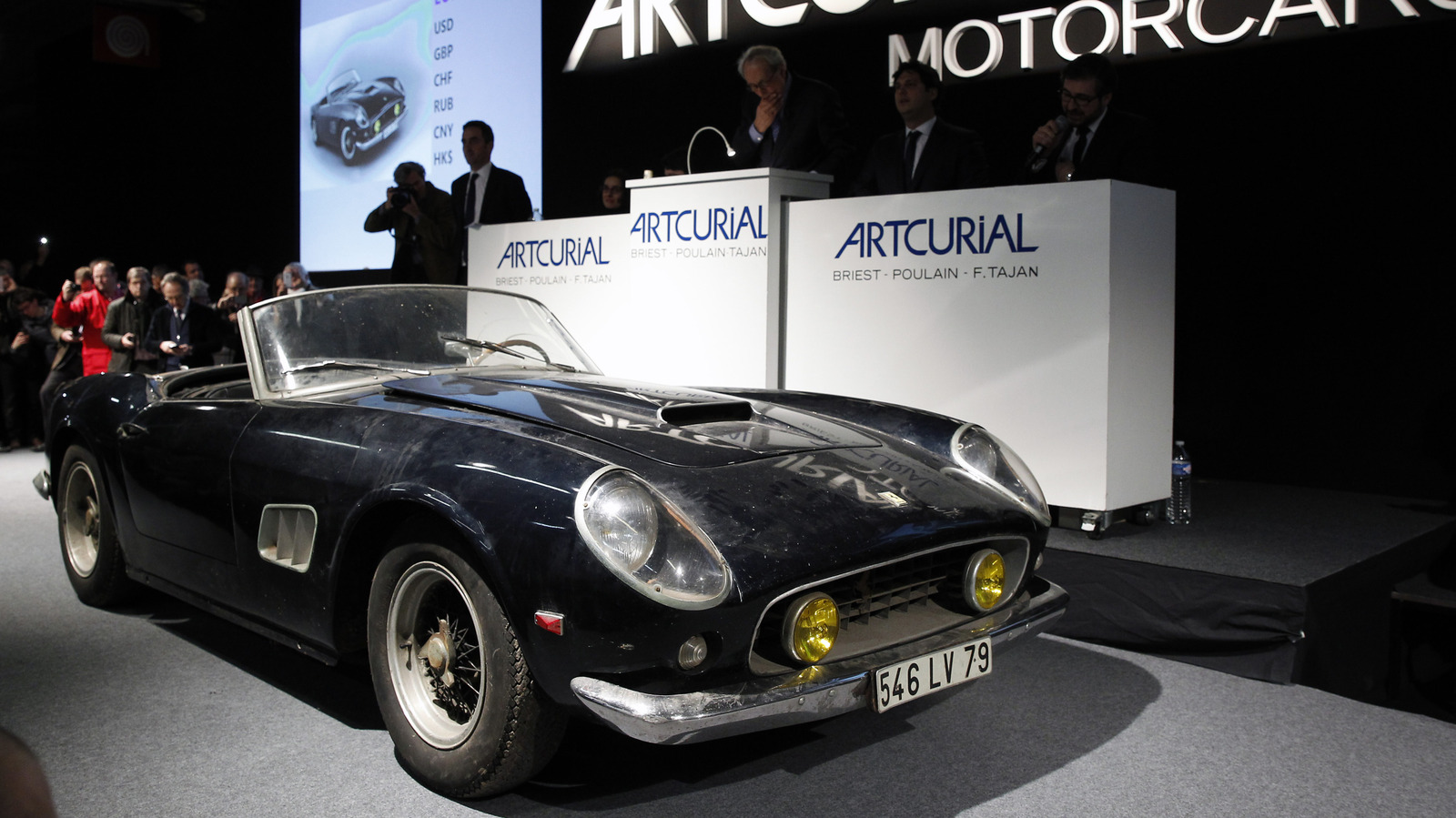
May 2008 was not a moment when most people were contemplating eight-figure collectibles. Mortgage defaults were cascading through the global financial system, the Great Recession was gathering force, and households everywhere were recalculating what their futures might look like. Yet in the rarefied air of top-tier collector car auctions, a black 1961 Ferrari 250 SWB California Spyder found a buyer willing to hand over $10.9 million — a number that seemed to belong to an entirely different planet.
The sale, conducted by RM Sotheby's in Maranello, Italy, did more than generate headlines. It ended a record that had stood since 1987 and, by most accounts, became the first eight-figure auction result for an automobile. In hindsight it marks the moment the modern era of extraordinary Ferrari values began.
The Car: A 1-Of-51 Convertible With Star Power
What the California Spyder actually was
Ferrari built only 51 examples of the short-wheelbase 250 GT California Spyder, which makes it rare even by Maranello's standards. Motivation came from a 2.9-liter naturally aspirated V12, an engine layout that defined the company's road cars of the period, and the entire package rode on a compact 94.5-inch wheelbase — proportions widely credited with giving the car its celebrated balance and stance.
The example that crossed the block in 2008 added provenance on top of specification. It had belonged at one point to James Coburn, the American actor remembered for "The Magnificent Seven," "The Great Escape" and many other films. Celebrity ownership is not an automatic value multiplier, but in the upper reaches of the Ferrari market it is rarely a neutral factor either.
- Model: 1961 Ferrari 250 GT SWB California Spyder
- Production: one of only 51 built
- Engine: 2.9-liter naturally aspirated V12
- Wheelbase: 94.5 inches
- Prior owner: actor James Coburn
- Result: $10.9 million at RM Sotheby's, Maranello
The Record It Broke Had Lived Since 1987
The mark the Ferrari displaced belonged to a very different kind of machine. It was a Bugatti Royale, one of just six built, wearing "Kellner Coach" bodywork. That car changed hands in November 1987 at a Christie's auction staged at London's Royal Albert Hall, bringing £5,500,000 — roughly $9,867,000 at the exchange rates of the day, according to Classic and Sports Car.
The Royale had been constructed in 1930, in the depths of the Great Depression, a detail that invites an obvious observation: extraordinary automobiles have a habit of setting financial landmarks during periods of economic misery. The Bugatti held its title for 23 years, an unusually long reign in a market that normally churns through records quickly.
Currency complicates any direct comparison. The Ferrari's $10.9 million translated to something in the region of 5.7 million 1987 dollars, so on a like-for-like basis the Bugatti still looks formidable. Nominal figures, however, are what auction records are built on, and by that measure the Spyder took the crown.
Not Quite The Biggest Number Ever Paid
One nuance is worth keeping in mind. The California Spyder's $10.9 million was not the largest sum ever attached to a car at that point. In 1990, a 1962 Ferrari 250 GTO reportedly sold for about $10.7 million including commission — with the notable complication that the buyer is said never to have actually paid.
The 250 GTO lineage has since become the benchmark for the entire hobby. A similar 1962 GTO was at one point valued at an eye-watering $70 million, and one of those cars famously caught fire at Goodwood a few years ago. In 2018, another 1962 250 GTO changed hands for $48.4 million at RM Sotheby's Monterey sale — a figure that would have seemed absurd in 2008.
The heat has spread well beyond the holy grail cars. Even the much newer, still scarce GTO from the 1980s fetched $11.5 million at Monterey earlier this year, outpacing the record-setting California Spyder of nearly two decades before.
What The Numbers Say Now
Reading the sequence of landmark results in order makes the trajectory plain. What looked like a bubble in 2008 turned out to be the opening chapter of a long expansion, at least at the very top of the market.
- 1987: Bugatti Royale Kellner Coach — £5,500,000, approximately $9,867,000, Christie's at Royal Albert Hall
- 1990: Ferrari 250 GTO — about $10.7 million with commission, reportedly never paid
- 2008: Ferrari 250 GT SWB California Spyder — $10.9 million, RM Sotheby's, Maranello
- 2018: Ferrari 250 GTO — $48.4 million, RM Sotheby's, Monterey
- Recent: 1980s-era Ferrari GTO — $11.5 million, Monterey
Why This Sale Still Matters
A precedent, not just a price
What makes the 2008 Maranello result significant is not the number itself but the template it established. It demonstrated that a well-documented, low-production Ferrari with V12 power and a compelling ownership story could command eight figures in a public sale. That had not previously been established, at least not in a transaction that completed as reported.
Everything that followed — the stratospheric GTO results, the multi-million-dollar prices for limited-run 1980s supercars, the way Ferrari nameplates carrying "GT" in the badge became the default trophy assets of the collector world — traces a line back to that evening in Italy.
There is also a cultural point buried in the economics. The California Spyder occupies a specific place in popular imagination, helped along by its Hollywood associations and by the enduring romance of open-top Italian V12 motoring. Rarity explains the floor beneath its value; the story explains why it keeps climbing above it.
For anyone watching the collector market today, the lesson is fairly plain. Scarcity, specification and narrative compound on one another. When all three line up — as they did for a black 1961 California Spyder with a movie star's name in its history file — the price can outrun the wider economy by an enormous margin, even in the worst imaginable year to be selling anything at all.
That the car did so against the backdrop of 2008 makes the result both a curiosity and a milestone. It was, at the time, an outlier that looked out of touch with reality. Nearly two decades later, it looks more like a signpost.
This article is based on reporting by Jalopnik. Read the original article.
Originally published on jalopnik.com