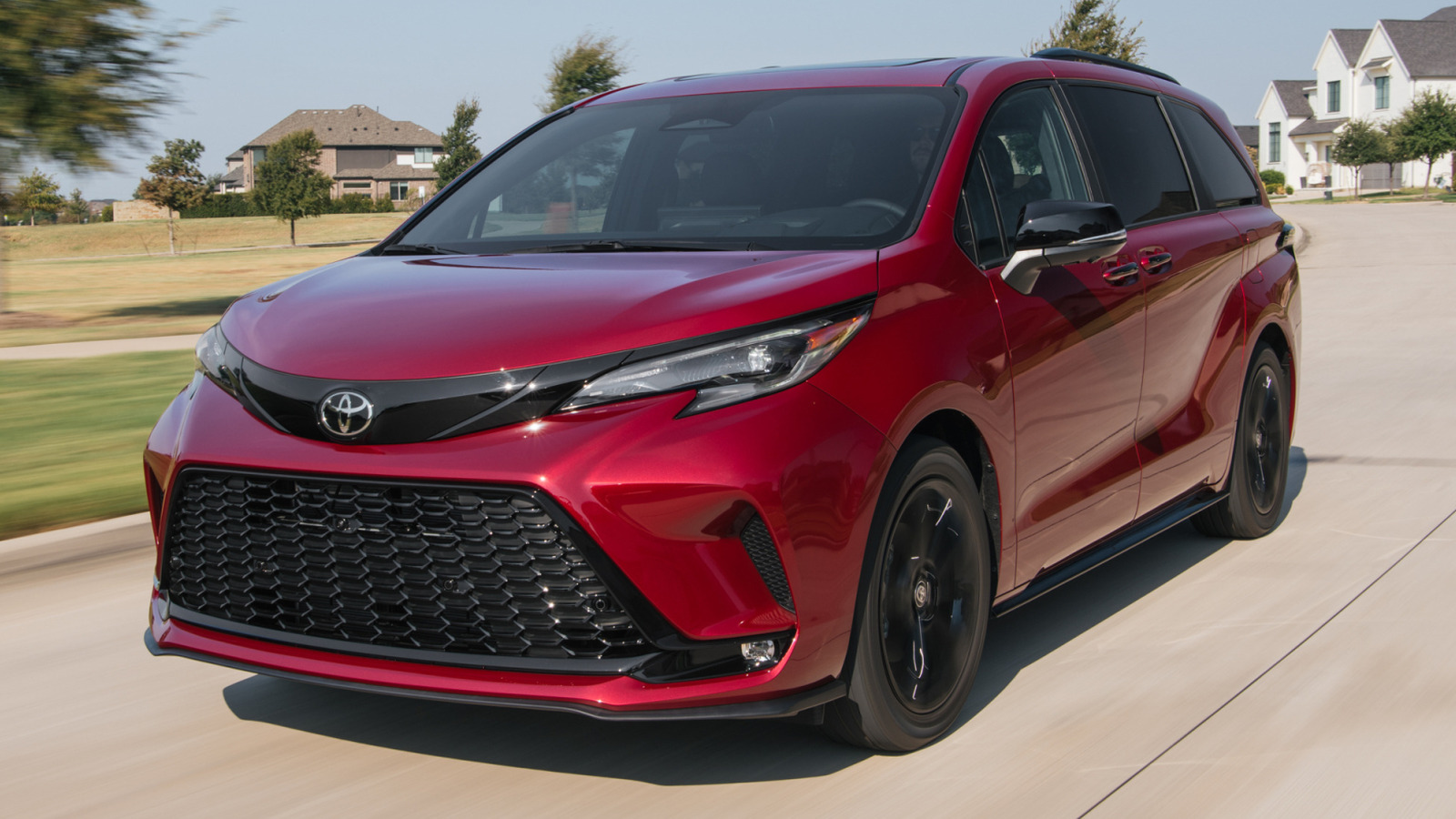
Toyota is updating its hybrid-only Sienna minivan for 2027 with a revised hybrid powertrain, higher efficiency estimates and a broader set of standard technology and safety equipment. The exterior is unchanged, but the mechanical and cabin updates are intended to make the Sienna slightly quicker, more efficient and easier to operate.
The headline figure is an estimated 37 mpg combined for both front-wheel-drive and all-wheel-drive versions. Toyota estimates 39 mpg in the city and 35 mpg on the highway. According to Jalopnik, that represents a three-mpg combined improvement for front-wheel-drive models and a four-mpg improvement for all-wheel-drive versions.
A revised hybrid system
The 2027 Sienna uses Toyota’s sixth-generation hybrid system. Its 2.5-liter four-cylinder engine has been retuned to run at lower engine speeds during low- and mid-range acceleration. Toyota also fits a 1.15-kWh lithium-ion battery and a 166-horsepower electric motor.
Total system output is 251 horsepower, six horsepower more than in the previous model year. Toyota estimates the front-wheel-drive Sienna will reach 60 mph in 7.5 seconds, a 0.3-second improvement. All-wheel drive remains available and adds a rear-mounted 54-horsepower electric motor, although Toyota’s quoted 0-to-60 time for that version is one-tenth of a second slower than for front-wheel drive.
Those figures point to a familiar hybrid engineering trade-off. The update is not positioned as a wholesale reinvention of the Sienna, but as a set of improvements in efficiency, responsiveness and everyday drivability. The model remains focused on carrying people and cargo while using electrification to reduce fuel consumption.
Changes aimed at daily driving
Toyota has also changed the steering system, including the steering gear box, motor control unit and torque sensor. The company says the result is more direct steering and better on-center feel, while lower-speed steering effort has been reduced to make parking easier.
The brakes receive a new electronic control system that Toyota says improves pedal feel and response. The company also says the changes reduce body roll. Together, the steering and brake revisions target characteristics that matter most in routine use: placing a large vehicle accurately on the road, maneuvering it in confined areas and maintaining predictable responses during stops.
Minivans are often evaluated primarily on space and practicality, but Toyota’s revisions show how hybrid-system updates are being paired with chassis and control-system changes. The goal is not simply a better fuel-economy label; it is to make the vehicle’s efficiency gains work alongside more refined driving behavior.
More standard technology
Every 2027 Sienna receives a 12.3-inch infotainment display and a 12.3-inch digital gauge cluster as standard equipment. Toyota is also adding a redesigned steering wheel and column, new LED interior lighting and an integrated dash camera.
The dash camera is a notable addition because it puts a recording capability into the vehicle rather than requiring a separately installed accessory. Meanwhile, making the larger displays standard brings the cabin interface into the core offering across the range instead of reserving it for higher trims.
Updated safety hardware
The 2027 Sienna also receives Toyota Safety Sense 4.0, the latest version of the company’s active-safety suite. Toyota says the system has upgraded sensors and hardware intended to improve obstacle-detection capabilities.
Active-safety systems are increasingly tied to the quality of sensors, processing and the vehicle’s ability to recognize conditions around it. Toyota’s description does not establish how the updated system will perform in every situation, but it does signal that the Sienna’s refresh includes new hardware as well as the expanded standard displays and revised hybrid components.
An incremental, broad-based refresh
The 2027 model is visually very close to the 2026 Sienna, but the changes beneath the body are substantial enough to affect daily ownership. Drivers get an updated hybrid system, a higher combined fuel-economy estimate, modestly higher power, revised steering and braking hardware, and new standard cabin equipment.
For buyers considering a hybrid family vehicle, the figures make the Sienna’s proposition clearer. Both drivetrain configurations are estimated at 37 mpg combined, while all-wheel drive retains an additional rear electric motor. Toyota is pairing that efficiency claim with technology and safety updates rather than presenting the change as a single-feature refresh.
The result is a 2027 Sienna that keeps its existing exterior design while concentrating its changes on propulsion, driving controls and standard equipment. Toyota’s approach suggests that the next iteration of the minivan will compete on the practical details that shape its use every day: fuel consumption, maneuverability, driver information and active-safety capability.
This article is based on reporting by Jalopnik. Read the original article.

Originally published on jalopnik.com