Young Stars Are Not Passive Residents of Galaxies
A new observational study highlighted in the candidate source text argues that star formation does more than populate galaxies with new light sources. It also changes galactic structure by reshaping the gas and dust around stellar nurseries. Researchers working with the PHANGS survey examined 18,000 star-forming regions in nearby spiral galaxies and found evidence that feedback from young stars plays a meaningful role in how galaxies evolve over time.
The idea is straightforward but consequential. Galaxies are often discussed in terms of major events such as mergers, collisions, and black hole activity. Those processes remain important, but this study points to a more local and continuous mechanism. As stars are born, especially massive young stars, they emit intense radiation and drive material outward into the surrounding interstellar medium. That feedback affects whether star-forming regions expand, stall, or disperse, and those local outcomes can accumulate across an entire galaxy.
The research cited in the source text was led by Ohio State University graduate student Debosmita Pathak. The team used observations from the Hubble Space Telescope, the James Webb Space Telescope, and the Atacama Large Millimeter/Submillimeter Array as part of the Physics at High Angular resolution in Nearby GalaxieS, or PHANGS, survey. By combining these observatories, the researchers were able to probe star-forming regions at different wavelengths and trace the interplay between gas, radiation, and galactic structure.
What “Stellar Feedback” Means
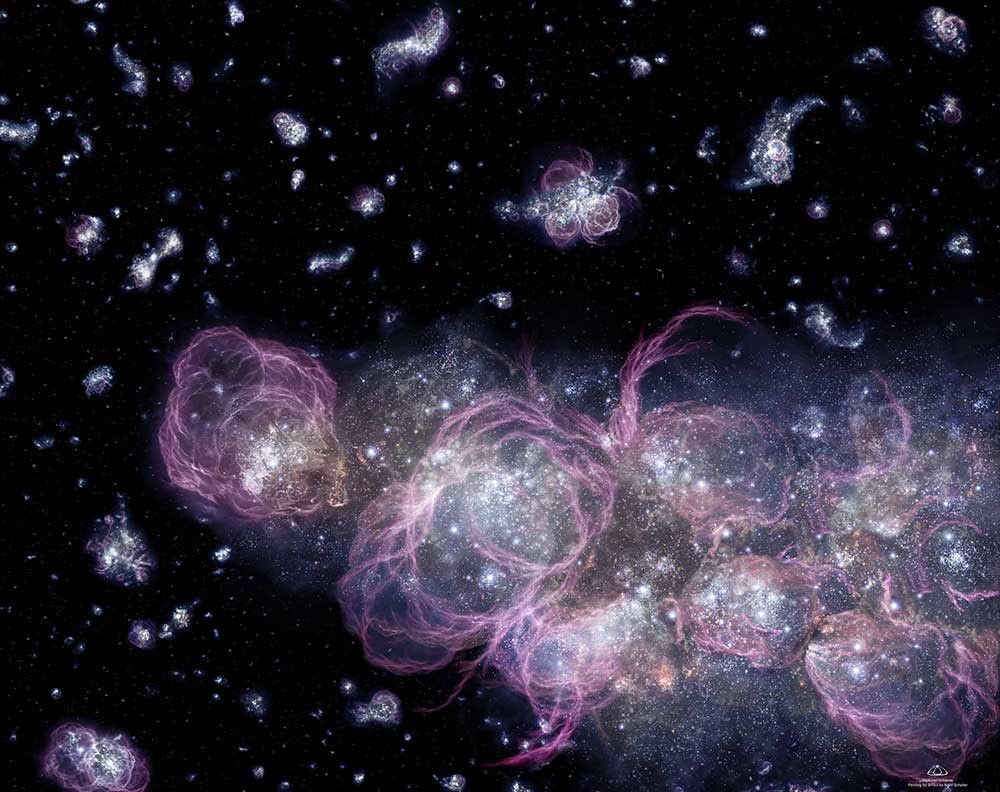
Stars form within hydrogen-rich clouds known as HII regions. Under gravity, denser parts of those clouds collapse, forming protostars that later ignite. Once that happens, the surrounding environment can change quickly. Hot young stars emit radiation that ionizes nearby gas, while winds and outflows push on the material around them. In some cases, later stellar explosions can intensify those effects even further.
This cluster of processes is generally referred to as stellar feedback. The term matters because it captures a two-way relationship. Gas clouds create stars, but newly formed stars then push back on the clouds that made them. That feedback can compress nearby gas, disperse it, heat it, or carve cavities through it. The source text describes this as a mechanism that can disrupt local environments and drive interstellar material out of an area.
According to the candidate material, the PHANGS analysis found that in normal galaxies, pressure from star-ionized gas helps drive the expansion of young star-forming regions. But the source also says expansion is not uniform. Whether a given region keeps growing or remains relatively stagnant depends strongly on its surrounding environment. That is an important nuance. It suggests there is no single universal pathway for starbirth regions. Instead, local conditions within a galaxy shape how feedback unfolds.

Why This Matters for Galaxy Evolution
Galaxy evolution is often explained through the largest visible transformations: galaxies merging, interactions disturbing spiral arms, or central black holes regulating gas over huge scales. Those mechanisms remain central, but they do not tell the whole story. A galaxy is also the sum of countless smaller events happening across its disk. If feedback from young stars changes how gas is distributed and how future star formation proceeds, then stellar nurseries become part of a long-term self-regulating system.
That has consequences for how astronomers interpret galactic appearance and history. Spiral arms, gas density, and the patchy distribution of bright star-forming regions are not merely snapshots of where stars happen to be forming. They may also record how previous generations of stars have already modified the environment. In other words, a galaxy can bear the imprint of feedback across multiple timescales.
The use of Hubble, Webb, and ALMA is especially significant because each observatory contributes a different piece of the picture. Hubble can resolve structure in visible and ultraviolet light, Webb can peer into dust-obscured regions and capture infrared detail, and ALMA tracks cold gas and dust at millimeter and submillimeter wavelengths. Together, they let astronomers connect stellar populations with the material from which future stars may emerge.
The source text frames the PHANGS effort as a way to understand the physics of gas and star formation and to measure the interplay with galactic structure and evolution. That wording matters because it highlights the shift from simply cataloging star-forming regions to testing how those regions function within a broader galactic ecosystem.
From Individual Regions to a Larger Pattern
A sample of 18,000 star-forming regions is large enough to move beyond anecdotal examples. Rather than drawing conclusions from one especially dramatic nebula or one nearby galaxy, the researchers could compare many regions across different spiral galaxies and look for repeating relationships. That scale strengthens the case that stellar feedback is not an occasional curiosity but a routine part of galactic life.
The study also helps explain why galaxies with similar overall classifications can still look different internally. If local environment influences whether feedback-driven expansion proceeds or stalls, then each galaxy may develop its own patchwork of star-forming outcomes. Density, gas supply, and structural conditions could all shape the visible results.
The candidate source does not provide the full technical details of the analysis, including modeling assumptions or quantitative thresholds. Even so, it conveys a clear scientific takeaway: newborn stars are not just the end products of star formation. They actively influence the next phase of galactic development by energizing and redistributing nearby material.
That conclusion fits into a broader trend in astronomy, where increasingly precise multi-observatory surveys are turning qualitative ideas into measurable processes. Stellar feedback has long been recognized as important in theory, but datasets of this breadth make it possible to examine how, where, and under what conditions it operates across many real galaxies.
The result is a more dynamic view of galaxy evolution. Galaxies are not shaped only by rare catastrophic encounters or by slow passive aging. They are also continuously edited from within. Every region where massive stars switch on can alter local gas conditions, influence future star formation, and leave marks that scale upward into galactic structure. That is the larger implication of the PHANGS result: galaxy evolution is partly written by the youngest stars in the system.
This article is based on reporting by Universe Today. Read the original article.

Originally published on universetoday.com