A puzzling class of cosmic signals may finally have a convincing source
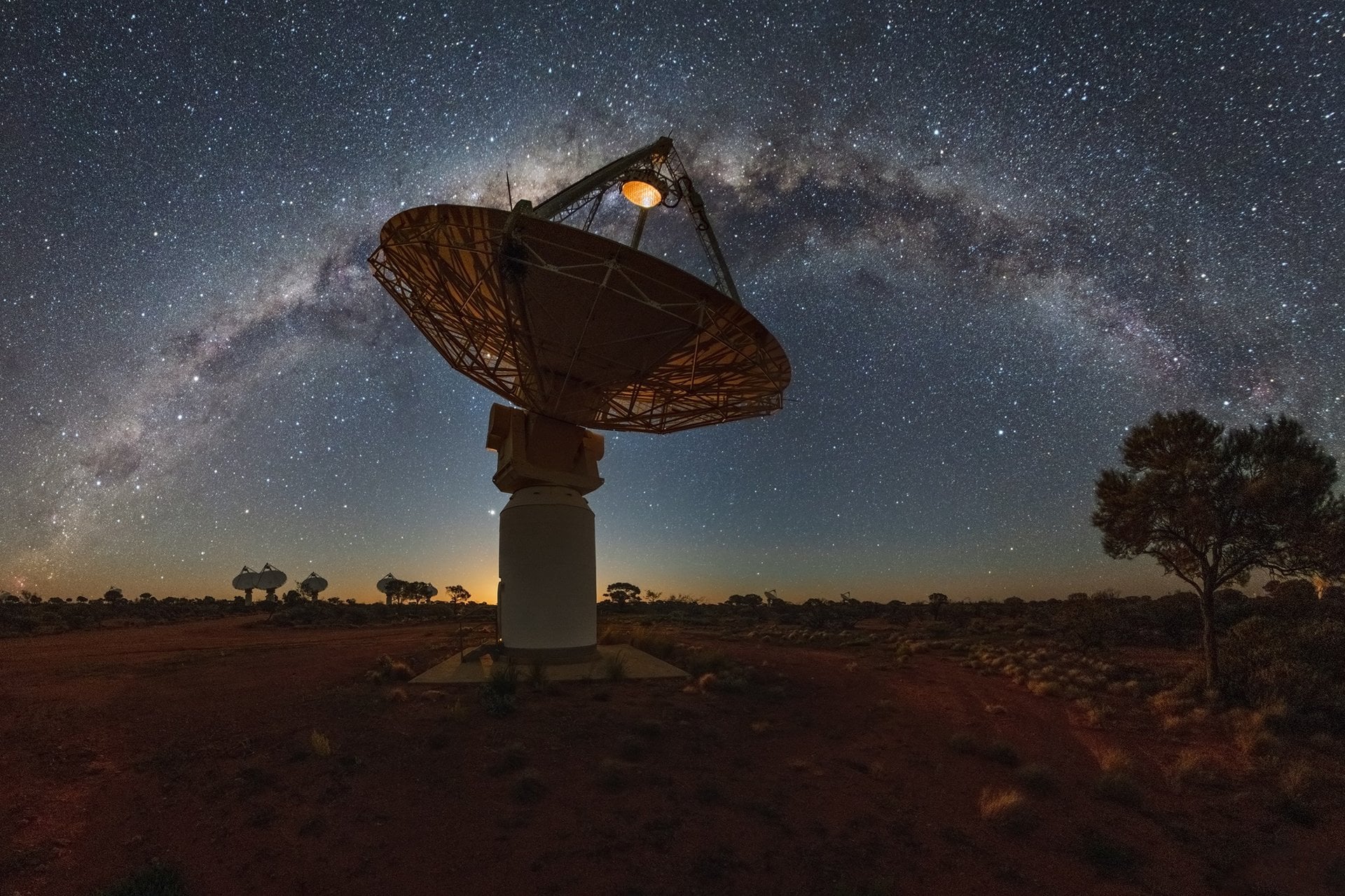
Astronomers using the Australian Square Kilometre Array Pathfinder, or ASKAP, have identified a compact binary star system that appears to explain one of radio astronomy’s lingering mysteries: long-period radio transients. These signals, which can repeat over intervals of minutes to hours, have resisted a clear origin story for more than two decades.
The newly identified system, ASKAP J1745−5051, consists of a white dwarf and a low-mass red dwarf orbiting each other in just over an hour. As material is stripped from the larger companion and accretes onto the white dwarf, the system produces powerful bursts of radio waves and X-rays in a cycle that repeats every 1.4 hours. According to the report, that behavior matches the unusual properties astronomers have been trying to explain in long-period radio transients.
Why these signals have been so difficult to explain
Long-period radio transients differ sharply from better-known fast radio bursts. Fast radio bursts typically last for milliseconds to a few seconds. Long-period signals can last for minutes to hours and repeat on regular cycles. That odd timing profile has made them hard to place within standard source models.
When the first of these signals was detected in 2005, one leading explanation was that they came from slowly spinning neutron stars with extremely strong magnetic fields, often grouped conceptually with magnetars. But the source article notes that current astronomical models suggest such signals would not originate in magnetar systems. That left room for an alternative idea: that some long-period transients come from close binary systems involving a white dwarf.
The new ASKAP result strengthens that second interpretation. Rather than relying only on abstract timing matches, researchers have now found a real system whose behavior appears to account for the class’s defining observational features.

The system at the center of the discovery
ASKAP J1745−5051 is described as a binary made up of a white dwarf and a red dwarf star with about 0.10 solar masses. The pair orbit each other with a period of a little more than one hour. In such a tight system, matter pulled from the red dwarf spirals toward the dense white dwarf. That accretion process can power both radio emission and X-ray output.
The repeating 1.4-hour cycle is especially important because it offers a natural clock. For astronomers, periodicity is often the bridge between a strange signal and a physical mechanism. Here, the cycle ties the radio bursts to a compact orbital interaction rather than to a one-off explosive event.
The report also says ASKAP J1745−5051 is only the second known long-period source to emit X-rays regularly. That makes it more than an isolated curiosity. It gives researchers another data point connecting radio behavior with high-energy emission in these systems.
A student-led finding with wider consequences
The work was led by PhD student Kovi Rose of the University of Sydney and CSIRO, with collaborators from the SKA Observatory, the Australia Telescope National Facility, and several other institutions. The discovery is notable not only because it identifies a candidate engine for a poorly understood signal class, but because it turns that class into a more useful physical laboratory.
The source article describes the system as enabling the study of extreme physics. That is not an overstatement. Close binaries involving accretion onto compact objects offer a way to observe how matter behaves in intense gravitational and magnetic environments. Once linked to a repeating and measurable radio pattern, those systems become especially valuable as test cases.

Why this matters for radio astronomy
The importance of the result lies in how it narrows uncertainty. Long-period radio transients were not just unexplained; they were difficult to even categorize. The new system does not necessarily prove that every such signal comes from an accreting white dwarf binary, but it does provide what the source describes as the clearest evidence yet for the origin of this unusual class.
That shift matters for observation strategy. If astronomers now have a stronger physical template, they can search archives and future surveys for similar timing, polarization, and X-ray patterns. They can also refine models of how these binaries form, how long they remain visible, and how often they should appear across the Milky Way.
From mystery to framework
In astronomy, many discoveries begin with a signal that seems wrong for every existing box. Long-period radio transients fit that pattern for years. They were too slow for one class of explanation, too structured for another, and too rare to map easily.
ASKAP J1745−5051 appears to change that. By linking a repeating radio transient to a white dwarf pulling matter from a red dwarf companion, astronomers now have a source that reproduces the key behavior of the mystery signals and provides a plausible physical mechanism behind them. That does not close the case on every long-period transient in the sky. But it does move the field from speculation toward a working framework, which is often the real turning point in science.
This article is based on reporting by Universe Today. Read the original article.

Originally published on universetoday.com