Psyche’s Mars flyby was more than a gravity assist
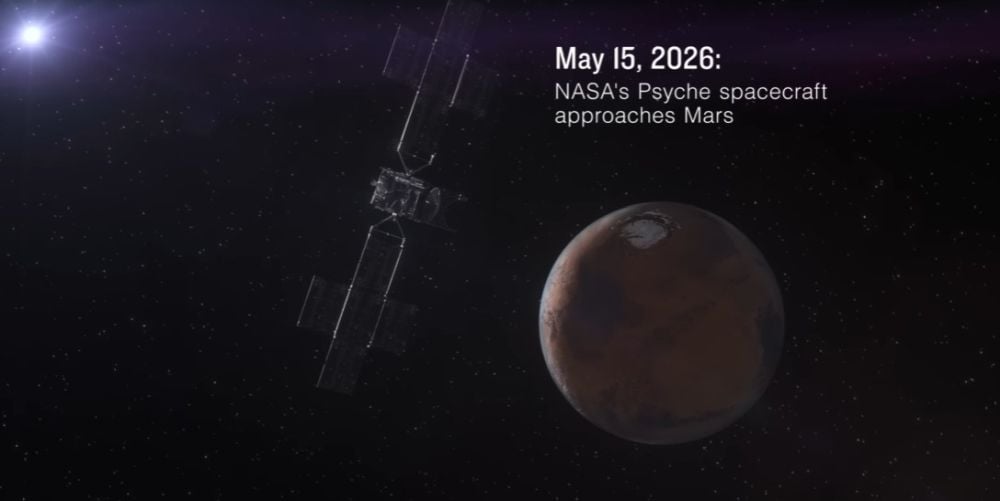
NASA’s Psyche spacecraft used its May flyby of Mars to do two things at once: gain speed and adjust course for its journey to asteroid 16 Psyche, and test its science instruments during a close planetary encounter. According to the supplied source text, NASA has now released a time-lapse video from the event, offering a visual record of a maneuver that also served as an early systems check for the mission’s hardware.
Psyche launched in October 2023 and is headed for the metal-rich asteroid 16 Psyche in the main asteroid belt, with arrival expected in August 2029. The Mars encounter was a planned step along the way. By passing within about 3,500 kilometers, or roughly 2,200 miles, of the planet, the spacecraft used Mars’ gravity to increase velocity and make a slight trajectory adjustment. Such flybys are a standard tool in interplanetary mission design, but they also create rare opportunities to exercise instruments under real mission conditions.
That is exactly how the team used this encounter. The source text says it took months to download and analyze the flyby data, and the results showed the instruments performed as designed.
A useful rehearsal before the main event
Psyche is not going to Mars as a primary destination, so the mission team was not expecting major discoveries about the planet. Mars has already been studied extensively by orbiters, landers, and rovers. But for a spacecraft en route to a much more mysterious destination, the flyby offered a valuable rehearsal.
As described in the source material, Psyche’s multispectral camera was among the instruments tested during the encounter. The mission’s imager, magnetometer, and gamma-ray and neutron spectrometer teams all used the opportunity to collect observations. Because scientists already know a great deal about Mars, those measurements could be compared against existing knowledge. That made the planet an effective calibration target.
Lindy Elkins-Tanton, principal investigator for Psyche at the University of California, Berkeley, said in the source text that the team did not anticipate big discoveries given how well Mars has been studied, but that the data did complement Mars science from Psyche’s unique perspective. That framing captures the dual value of the flyby: modest scientific contribution to Mars studies, and much more important validation that mission hardware is operating properly before arrival at 16 Psyche.
That validation matters because the spacecraft’s main science campaign will unfold far from Earth, around an object that remains difficult to characterize from afar. There is no easy recovery option if key instruments underperform once the probe reaches its target.

Why asteroid 16 Psyche matters
The mission’s destination is one of the most intriguing objects in the asteroid belt. The source text describes 16 Psyche as a massive, metal-rich asteroid and notes a long-standing hypothesis that it may be the exposed core of a protoplanet whose outer layers were stripped away by collisions. If that interpretation is correct, the object could offer an unusual look at planetary building blocks normally hidden deep inside worlds.
At the same time, the source text also notes that more recent research has challenged the simple exposed-core view. That uncertainty is part of what makes the mission scientifically valuable. Psyche is almost certainly metallic, according to the supplied material, but its precise origin and internal history remain open questions.
NASA’s spacecraft is designed to address those questions directly. Once it arrives, Psyche will study the asteroid from orbit rather than from a quick flyby. The source text says the closest orbit will bring the spacecraft to within 75 kilometers of the asteroid. From there, the mission’s instrument suite will examine composition, surface properties, and magnetic characteristics in much greater detail than Earth-based observations can provide.
The magnetometer could be decisive
Among the payload, the magnetometer stands out as especially important. The source text emphasizes that it will play a leading role in the mission because measurements of 16 Psyche’s magnetic field could help confirm the asteroid’s nature. If the object preserves remnant magnetization, that would strengthen arguments that it formed as part of a larger differentiated body.
The source material also briefly explains how such instruments work. Magnetometers are rugged tools commonly used on space missions. In Psyche’s case, the device uses coils that are magnetically saturated by the spacecraft’s power source. Changes caused by an external magnetic field can then be measured through the difference in that saturation state.
That technical detail matters because it underlines why the Mars flyby was such a useful test. A planetary encounter gives the team a real environment in which to verify instrument behavior, data handling, and analysis pipelines before the spacecraft reaches the asteroid it was built to investigate. In that sense, the flyby helped reduce mission risk.

A long mission with a visible checkpoint
Deep-space missions often move in slow increments, with years separating launch, cruise milestones, and arrival. Psyche’s Mars pass is one of those intermediate checkpoints that makes progress tangible. The release of a time-lapse video turns an orbital mechanics event into something more legible to the public, but the larger significance lies in what the spacecraft accomplished operationally.
The mission now continues toward its 2029 arrival with greater confidence in its systems. That confidence is not abstract. The source text says the instrument results from Mars matched expectations and showed the hardware was performing exactly as designed. For a mission aimed at an object whose true nature is still under debate, that is a meaningful outcome.
Psyche’s importance extends beyond one asteroid. If 16 Psyche turns out to preserve evidence of early planetary differentiation, the mission could help researchers understand how rocky worlds formed and evolved in the early solar system. If it does not fit the classic exposed-core picture, that result may be just as important, forcing a rethink of how metallic asteroids form and what remote observations have been telling scientists.
For now, the Mars flyby does not answer those deeper questions. What it does show is that the spacecraft is progressing toward them with its instruments checked against a known world and its trajectory adjusted for the long trip ahead. In a mission measured across years, that combination of navigation and validation is exactly what a successful midcourse planetary encounter is supposed to deliver.
This article is based on reporting by Universe Today. Read the original article.
Originally published on universetoday.com