A possible milestone for habitable-world science
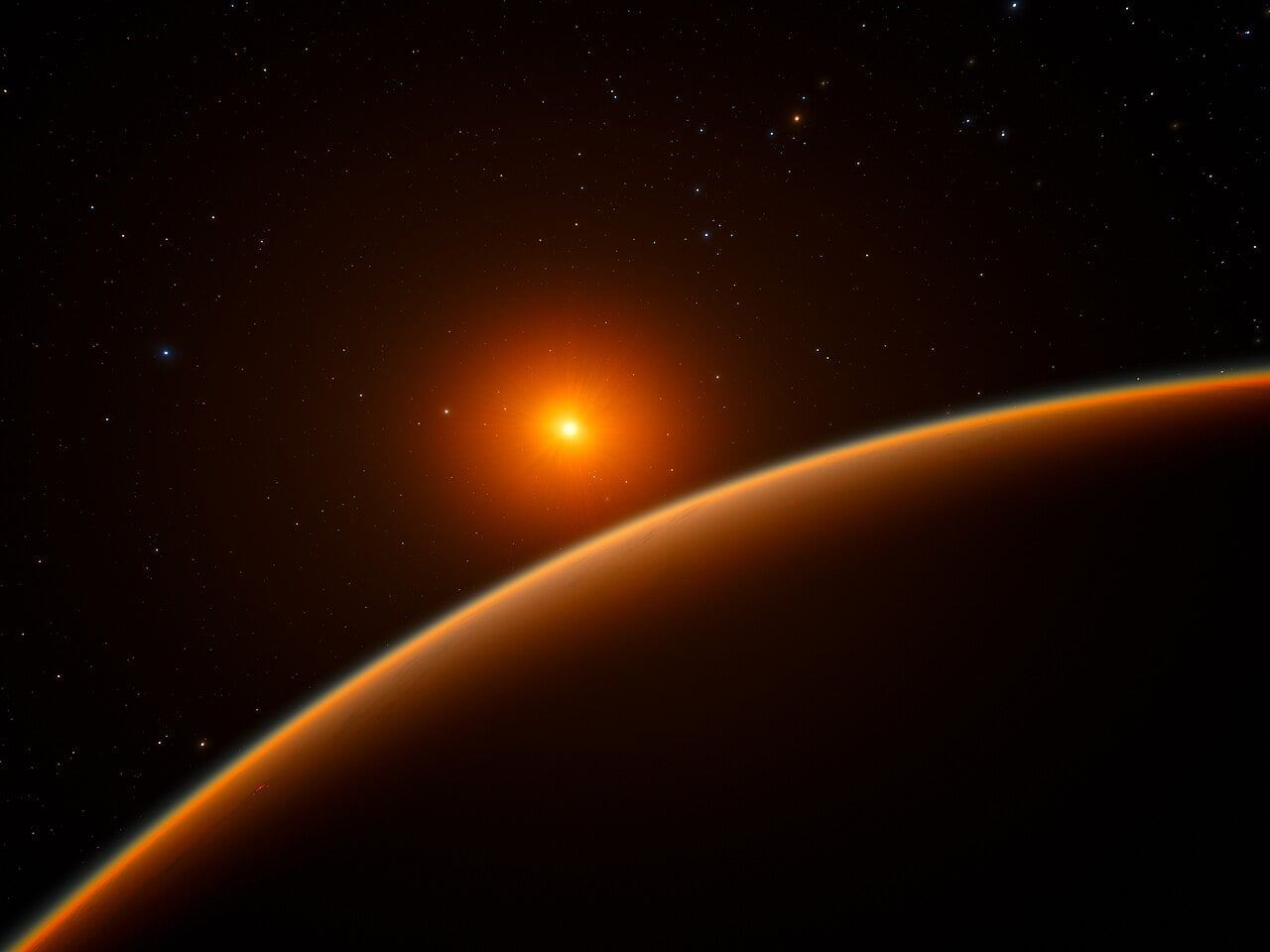
Astronomers have reported what could be a turning point in the search for life-friendly worlds beyond the solar system: evidence of an atmosphere around LHS 1140 b, a rocky planet orbiting within its star’s habitable zone. If confirmed and built upon by follow-up observations, the result would mark the first time researchers have identified an atmosphere around a rocky planet in that temperature range, where liquid water could in principle exist.
The finding matters because location alone does not make a world habitable. Thousands of exoplanets have been discovered, and a growing number orbit at distances from their stars where surface temperatures might allow water to remain liquid. But that “habitable zone” label is only a starting point. A planet also needs to retain an atmosphere capable of regulating temperature, enabling chemical cycles, and shielding the surface from harsher conditions in space.
According to the source report, LHS 1140 b lies about 48 light-years from Earth and circles a small red dwarf star. It has long attracted attention as a potentially rocky world in a promising orbit. What has been missing until now is direct evidence that the planet still holds onto gas rather than existing as a bare, airless surface.
Why an atmosphere changes the picture
An atmosphere is not proof of habitability, and it certainly is not proof of life. But without one, many of the most important ingredients for a stable surface environment become far less plausible. Air can trap and redistribute heat, shape weather, transport chemicals, and provide a buffer against radiation and particle bombardment. In practical terms, an atmosphere is part of the basic infrastructure that makes a world scientifically interesting as a potentially life-supporting environment.
That is why LHS 1140 b stands out. The source text says the result was published in Science and led by Collin Cherubim of Harvard University. Rather than simply scanning a promising target and hoping for a signal, the team first built a model predicting that the planet should possess an upper atmosphere rich in helium that is slowly escaping into space. The significance of the new observation is that the researchers then found a signal consistent with that prediction.
The reported signature was helium escaping from the planet, which points to an atmosphere that has persisted over geologic time. The report says the team believes the atmosphere may have survived for more than three billion years, a timescale that would make the world more compelling as a long-term laboratory for studying planetary evolution around small stars.
How the detection was made
Exoplanet atmosphere work is difficult because planets are tiny and faint compared with their host stars. Researchers often rely on transit observations, watching a planet pass in front of its star and searching for subtle changes in starlight filtered through any surrounding gases. In this case, the team used the WINERED spectrograph on the Magellan Telescope in Chile.
The source report describes an unusually favorable observing night: LHS 1140 b and a neighboring planet both crossed in front of their star during the run. That created a useful comparison. One planet showed no evidence of an atmosphere, while LHS 1140 b displayed a helium signal. That contrast helps strengthen the case that the detected feature belongs to the planet and is not just an artifact of the star or the instrument.
Helium is not the same thing as an oxygen-rich, Earth-like atmosphere. Still, it is an important clue. An escaping helium envelope can indicate that a planet has retained gas over long periods, and it offers astronomers a way to probe atmospheric structure from great distances. For worlds around red dwarfs, that question is especially important because such stars can be active and potentially erosive to planetary atmospheres.
Why red-dwarf planets are so important
Red dwarfs are smaller and dimmer than the Sun, which makes transiting planets easier to study. Their habitable zones also sit closer in, so planets orbit more frequently and provide more observing opportunities. That is one reason many of the most discussed potentially habitable exoplanets orbit this type of star.
But there is a tradeoff. Red dwarfs can emit flares and high-energy radiation that may strip atmospheres from nearby planets over time. That has made atmospheric survival one of the central questions in red-dwarf habitability research. A planet can sit in the nominal habitable zone and still be a poor candidate for life if its atmosphere was blasted away long ago.
The reported result for LHS 1140 b therefore has value beyond a single world. It suggests at least some rocky planets in these environments may be able to keep atmospheres for billions of years. That does not settle the broader debate, but it gives astronomers a concrete example to test with stronger instruments and additional observations.

What comes next
The immediate next step is confirmation and characterization. Scientists will want to verify the signal, refine estimates of the planet’s atmospheric composition, and determine how the gas is distributed and how quickly it is escaping. They will also want to understand whether helium is merely the detectable upper-layer tracer of a more complex atmosphere below.
Future work could focus on several questions:
- How dense the atmosphere is overall.
- Whether heavier molecules are present beneath the upper helium layer.
- How the host star’s activity affects atmospheric loss.
- What the comparison with the neighboring atmosphere-free planet reveals about planetary survival around the same star.
Those follow-up studies will shape whether LHS 1140 b becomes a benchmark target in the next phase of habitable-world astronomy or remains a tantalizing but limited case. Either way, the report points to a meaningful advance: researchers are moving from identifying promising rocky planets to directly probing whether those planets have one of the basic requirements for habitability.
A step, not an answer
Exoplanet headlines often jump too quickly from “habitable zone” to “Earth-like,” but the more careful interpretation is stronger here. LHS 1140 b has not been shown to host oceans, biology, or even a surface environment remotely like Earth’s. What astronomers may have found is something both narrower and more foundational: a rocky planet in the right orbital region that appears to have retained an atmosphere.
That is still a substantial development. The search for life elsewhere depends on narrowing a vast field of worlds into a smaller set worth detailed scrutiny. Each time researchers can replace a theoretical possibility with a measurable planetary property, the field becomes more empirical and more precise. If LHS 1140 b truly has an atmosphere, then one of the most important filters in that process has just become a little more manageable.
For now, the result is best viewed as an early but notable milestone. It does not tell scientists that life exists beyond Earth. It does tell them that at least one rocky habitable-zone candidate may have cleared a major threshold that many worlds never do: holding on to air.
This article is based on reporting by Universe Today. Read the original article.

Originally published on universetoday.com