Falcon 9 sends USSF-481 into orbit
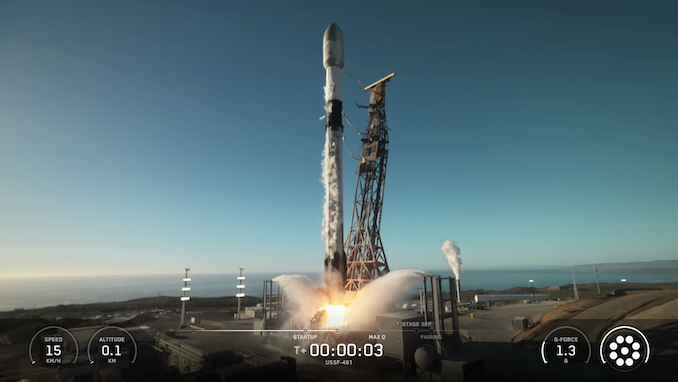
SpaceX launched a classified payload for the United States Space Force on October 15, lifting off from Vandenberg Space Force Base in California aboard a Falcon 9 rocket.
The mission, designated USSF-481, departed Space Launch Complex 4 East at 5:01 p.m. Pacific time. Public notices also refer to the mission as TH-2. Details about the spacecraft and its purpose have not been publicly disclosed.
After leaving the pad, the rocket followed a southerly trajectory. Hazard-area notices indicated a low Earth orbit with an inclination of roughly 80 degrees from the equator, according to Spaceflight Now. That trajectory information offers only a broad indication of the mission profile; it does not identify the payload or its operational role.
Booster completes its 28th flight
SpaceX used Falcon 9 first-stage booster B1081 for the mission. The launch marked the booster’s 28th flight, following missions that included NASA launches, national-security flights, Transporter rideshare missions, European missions and Starlink deployments.
A little more than eight minutes after liftoff, B1081 landed on the droneship Of Course I Still Love You in the Pacific Ocean. The landing was the 228th on that vessel and SpaceX’s 671st Falcon booster landing overall, according to the launch coverage.
Recovering the first stage is now a routine part of many Falcon 9 missions, but the flight still illustrates the operational tempo SpaceX has built around reuse. The same booster can support a mix of commercial, civil and national-security customers while returning for refurbishment and future launches.
A second TH mission in two months
USSF-481 was the second publicly identified “TH” mission to launch in as many months. The previous mission, USSF-259, also known as TH-1, launched on September 16.
The naming does not reveal the payloads’ roles. The Department of the Air Force had not provided information about the nature of USSF-481 when Spaceflight Now reported on the launch. That limited disclosure is common for missions carrying classified national-security payloads.
As a result, public observers can confirm the launch, trajectory and booster recovery, but cannot reliably assess what capability reached orbit, who will operate it, or how it will be used. Any claims beyond the information released by the launch provider, the government or public flight notices would be speculative.
Vandenberg’s role in national-security launches
Vandenberg Space Force Base is a major launch site for missions headed toward polar and high-inclination orbits. Such orbital paths are useful for spacecraft that need coverage across a broad range of latitudes, though the specific assignment of USSF-481 remains undisclosed.
The October 15 mission also demonstrates the continuing role of commercial launch systems in U.S. military space operations. A Falcon 9 flown by SpaceX carried the Space Force payload, while the launch site supplied the range infrastructure and mission support needed for departure from California’s central coast.
For the Space Force, classified launches are part of the broader effort to place and maintain systems in orbit for national-security missions. For SpaceX, the flight added another successful recovery to its reusable-launch record and another national-security mission to the history of B1081.

What is known—and what is not
The publicly available facts are straightforward: Falcon 9 lifted off from Space Launch Complex 4 East, carried the USSF-481 payload on a southerly route, and landed its first stage on a Pacific droneship. The launch was also identified in public notices as TH-2 and followed TH-1 by about a month.
What remains unknown is the payload’s identity, configuration, destination beyond the broad orbital indication, and mission objective. The Department of the Air Force may release additional information later, but no such details were included in the available reporting at the time of launch.
Until then, USSF-481 is best understood as a successful classified Space Force launch enabled by a reused Falcon 9 booster, rather than as evidence for any particular satellite program or military capability.
This article is based on reporting by Spaceflight Now. Read the original article.
Originally published on spaceflightnow.com