A mission to Mars’s most mysterious moon
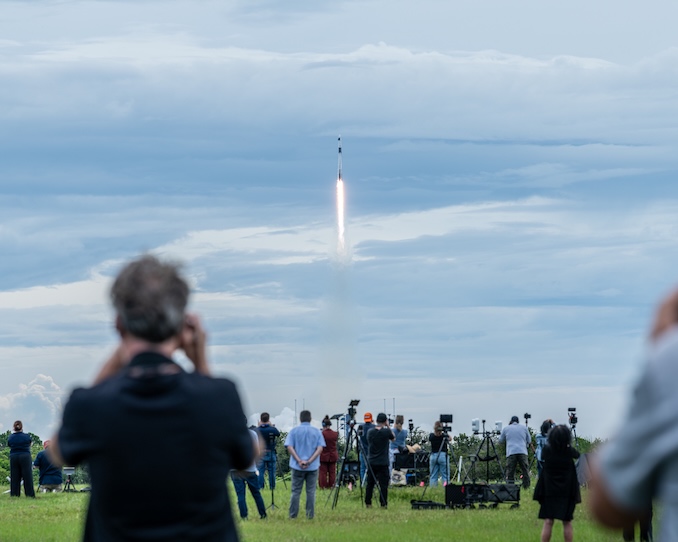
The Martian Moons eXploration mission, known as MMX, is scheduled to launch aboard a Japanese H3 rocket from Tanegashima Space Center at 04:41 JST on 20 October 2026. In Europe, that corresponds to 21:41 CEST on 19 October.
Its central objective is unusually ambitious: collect material from Phobos, one of Mars’s two small moons, and return it to Earth. According to the European Space Agency, MMX would be the first mission to bring back a sample from Phobos and the first mission to return to Earth after visiting the Mars system.
The mission is led by the Japan Aerospace Exploration Agency, or JAXA, with participation from NASA, France’s CNES, the German Aerospace Center and ESA. It is designed to investigate Phobos at close range, deploy a rover to the surface, land to gather samples, and study Mars and the smaller moon Deimos during the mission.
Why Phobos matters
Mars has two moons: Phobos and Deimos. Despite decades of spacecraft missions to Mars, the moons remain poorly understood. ESA notes that no spacecraft has stayed near them for long, leaving scientists with limited information beyond a small number of flybys.
One of the biggest unresolved questions is how they formed. Phobos and Deimos may be asteroids captured by Mars’s gravity. Another possibility is that they are remnants of material thrown into orbit by a giant collision on Mars. Samples collected directly from Phobos could help distinguish between those scenarios.

The stakes extend beyond a single moon. MMX project scientist Elliot Sefton-Nash said that the mission’s data and returned samples can provide a window into the evolution of Mars and the Solar System. Mars, like Earth, has changed substantially since it formed about 4.5 billion years ago. Learning more about the Martian system may therefore add evidence about the formation and evolution of rocky planets more broadly.
A difficult landing in extremely low gravity
MMX is intended to be the first spacecraft to orbit Phobos, the first to land on a moon other than Earth’s, and the first to collect surface samples from that moon. Achieving those goals requires specialized technology for landing, manoeuvring and collecting material robotically in Phobos’s extremely low gravity.
Low gravity changes almost every aspect of surface operations. A spacecraft cannot rely on the conditions familiar from landing on Earth, Mars or the Moon. ESA says dedicated technology has been developed so the mission can land, manoeuvre and collect samples in that environment.
The mission carries 11 science instruments in total. Seven are on the main spacecraft and four are on its rover, called Idefix. The main spacecraft will first study Phobos from a distance. It will then deploy Idefix to the moon’s surface before making its own landing to collect material for the return journey.
More than a sample-return attempt
Although Phobos is the primary target, MMX is structured as a broader investigation of the Mars system. On its way home, the spacecraft is planned to fly past Deimos and conduct further observations of both Deimos and Mars.

That itinerary makes the mission relevant to several long-running questions. Scientists want to know what the Martian moons are made of and whether their composition supports an origin as captured asteroids or as debris from a collision. They also want a clearer record of how the Mars system evolved. Material from Phobos could preserve clues unavailable from remote measurements alone.
ESA also points to a technological significance. A successful round trip to a Martian moon would demonstrate capabilities relevant to future robotic missions that could return samples from Mars itself. In the longer term, the ability to travel to the Mars system and return to Earth could inform planning for human exploration.
A major test for international planetary science
MMX brings together agencies from Japan, the United States and Europe around a mission that combines orbital science, rover operations, landing and sample return. Each element is demanding on its own. Combining them at Phobos makes the mission one of the more complex planetary exploration efforts now approaching launch.
The first milestone is the H3 launch from Tanegashima. If the mission proceeds as planned, MMX will transform Phobos from a body known largely through distant observations and brief flybys into a place investigated from orbit, on the surface and eventually in laboratories on Earth.
That prospect is what gives the mission its scientific appeal. The two Martian moons are nearby in astronomical terms yet still lack a settled origin story. MMX is designed to bring physical evidence into that debate—and to show whether a round trip through the Mars system can become a practical model for future exploration.
This article is based on reporting by esa.int. Read the original article.
Originally published on esa.int