NASA’s Crew-12 mission has returned to Earth after 237 days, closing a seven-month stay in orbit while the International Space Station moves directly into another busy stretch of crew and cargo operations.
The four-person crew splashed down in the Pacific Ocean off California on October 8 aboard SpaceX’s Crew Dragon Freedom. NASA astronauts Jessica Meir and Jack Hathaway returned alongside European Space Agency astronaut Sophie Adenot and Roscosmos cosmonaut Andrey Fedyaev. Their replacements, Crew-13, had arrived at the station a week earlier.
The handover illustrates the operational cadence now expected on the ISS: one long-duration crew departs, another takes over, and cargo spacecraft continue cycling through the outpost to support science and station maintenance.
A 237-day mission ends
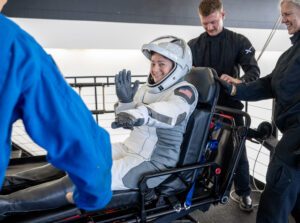
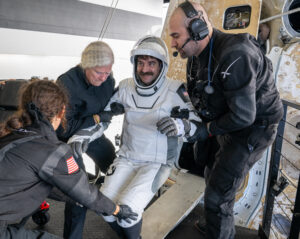
Crew-12 spent 235 of its 237 days in space aboard the ISS. After splashdown at 11:34 a.m. Eastern time, Dragon Freedom was brought aboard SpaceX’s recovery ship Shannon. The astronauts were then helped from the capsule and placed on stretchers, a standard precaution as crews readjust after months in microgravity.
They were flown by helicopter to shore and then traveled to NASA’s Johnson Space Center in Houston. Adenot and Fedyaev are expected to return to their homes in Europe and Russia, respectively.
The mission combined experienced astronauts with first-time fliers. Meir, Crew-12’s commander, had previously flown to the ISS on a Soyuz mission in 2019. Fedyaev had also flown in space before, while Hathaway and Adenot were rookies.

Spacewalk records and repeat Dragon flights
Meir conducted four spacewalks during Crew-12, adding to the three she completed on her 2019 flight. That brings her total to seven, placing her third among women astronauts by number of spacewalks, behind Peggy Whitson and Suni Williams.
Adenot completed three spacewalks during her first mission and became the first French woman to conduct a spacewalk. The milestone adds another national first to an ISS program that continues to depend on multinational crews and operations.
Fedyaev’s flight also marked a spacecraft-use milestone. He previously flew as part of Crew-6 in 2023, making this his second mission on a Crew Dragon. According to Space Policy Online, he is the first person to fly aboard Crew Dragon twice. NASA astronaut Jessica Watkins, who recently launched with Crew-13, is the first NASA astronaut to become a repeat Crew Dragon flier.
Research conducted during the mission
NASA highlighted several areas of research conducted by Crew-12. These included work on venous thrombosis embolism in spaceflight, testing technology intended to produce intravenous fluids for medical care during missions, and efforts to expand stem cells for use in spaceflight research.
Such experiments are closely tied to the practical requirements of longer human missions. Medical care beyond low Earth orbit will be more constrained than it is on the ISS, where crews can return to Earth and receive support from ground teams. Testing technologies that could improve care in space is therefore part of preparing for more distant missions.
The research also reflects a central role of the ISS: it is both an orbiting laboratory and an operational testbed. Crews carry out experiments while maintaining a complex spacecraft, receiving supplies, and supporting the arrival and departure of visiting vehicles.

The station’s schedule does not pause
Crew-12’s return is not a pause in activity. A Northrop Grumman Cygnus cargo spacecraft was scheduled to depart the station the following day, while a SpaceX Cargo Dragon mission was expected the following week.
This overlap between crew rotation and cargo traffic is a defining feature of ISS operations. Cargo vehicles bring experiments, supplies, equipment and other material to the station, while departing vehicles can return research samples and hardware or dispose of waste, depending on the spacecraft.
For Crew-13, the transition means inheriting both the station’s ongoing research agenda and its immediate logistical work. The continuing arrivals and departures also underline why operational coordination remains as important as individual mission milestones.
What Crew-12’s return shows
The conclusion of Crew-12 demonstrates the increasingly routine character of commercial crew transportation to the ISS, even as individual missions continue to produce firsts. Dragon Freedom carried a multinational crew home after more than seven months in orbit, while a new crew was already established aboard the station.
That continuity matters. The ISS is designed around long-duration human presence, not isolated visits. Every crew return is connected to an incoming crew, a sequence of cargo flights and a continuing set of scientific investigations.
For Meir, Hathaway, Adenot and Fedyaev, Crew-12 is now complete. For the ISS, the next operational cycle was already underway before their spacecraft reached the Pacific.
This article is based on reporting by spacepolicyonline.com. Read the original article.

Originally published on spacepolicyonline.com