The Moon has no magnetosphere today. That much is not in dispute. Whether it ever had one is a question that has divided planetary scientists for decades, with Apollo-era rock samples and modern orbital instruments pointing in stubbornly different directions. Now a team of researchers from ETH Zurich, DLR, and the Institute of Applied Geosciences says it can settle the argument, using evidence from a volcanic structure buried beneath a patch of the lunar far side that no one on Earth can see directly.
Their conclusion: the Moon did once host a magnetic dynamo. The proof, they argue, lies beneath a faint surface marking called the Dewar swirl, where a long-dormant volcano appears to be locked in the lunar crust.
A Decades-Long Argument Over a Missing Field
Scientists are certain that the Moon currently lacks a global magnetic field. The disagreement concerns the past. Measurements from Apollo samples and from instruments flown on orbiting spacecraft have proven divisive, each dataset nudging the story in a different direction, and so the debate has continued to rage rather than resolve.
Part of the difficulty is that a magnetic field leaves only indirect traces. Rocks can record the direction and strength of an ambient field at the moment they cool and lock in their magnetization, but those records are then overwritten by later heating, fracturing and bombardment. Reading the Moon's magnetic history means finding material that has survived intact for billions of years and pairing it with an understanding of the geology that produced it.

An Unusual Patch of the Lunar Far Side
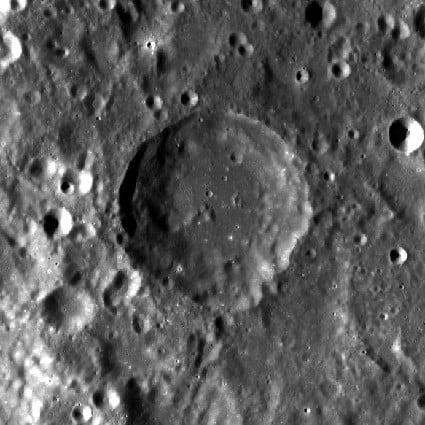
That is where Dewar comes in. The feature sits on the lunar far side, northwest of the South Pole–Aitken (SPA) basin, a region already famous for its potential water resources. Dewar drew attention because it appeared to harbor two distinct anomalies at once — one magnetic and one gravitational.
Planetary geologists have known about the Dewar swirl for a long time and eventually classified it as a "cryptomare," a category describing ancient basalt deposits that lie hidden beneath layers of impact debris. It also carries a "lunar swirl," a surface marking that appears like a brush stroke across the landscape and that almost always coincides with a magnetic anomaly.
Dewar stands out for two reasons. Swirls typically turn up in clusters, whereas Dewar is relatively isolated. And it sits directly on top of a geochemical hotspot rich in iron oxide, titanium dioxide, thorium and pyroxene — an unusual concentration of material that hints at something substantial below.
Reading the Subsurface With Gravity and Magnetism
To work out what is actually hidden between the swirl and the deeper crust, the researchers assembled orbital data from a variety of gravitational and magnetic sensors, including those carried by GRAIL, Lunar Prospector and Kaguya. Combining those measurements let them apply an information theory technique known as variation of information (VI) to calculate the "inversion" of the data — essentially reasoning backward from the observed signals to determine what kind of object could have produced them.
The resulting picture is specific. The geological body sitting directly beneath the Dewar swirl is roughly 60 kilometers wide and runs between 5 and 9 kilometers deep. Crucially, it is denser than the surrounding terrain, which is what generates a "gravitational anomaly" in orbital readings — and that same body is paired with a strong level of magnetization.
- Size: approximately 60 kilometers across, extending 5 to 9 kilometers downward.
- Density: higher than the surrounding crust, producing the gravitational anomaly.
- Magnetism: strongly magnetized, matching the swirl above it.
- Data sources: gravity and magnetic sensors on GRAIL, Lunar Prospector and Kaguya.

A Volcano Hidden Beneath the Swirl
Once the team established the object's general dimensions and density, the identification became clearer: the Dewar swirl is sitting directly on top of a buried volcano. The structure has almost certainly not erupted in billions of years — a fortunate circumstance, since an eruption would likely have scoured away the layers of fine regolith that have been lying across it for nearly as long.
That preservation is what makes the site so valuable. The volcanic body and the magnetized material around it appear to have escaped the kind of disruption that erases magnetic records elsewhere on the Moon, leaving a comparatively tidy archive of conditions deep in lunar history.
Why a Volcano Speaks to the Dynamo Question
The logic connecting a buried volcano to the Moon's magnetic past runs through the magnetization itself. Strongly magnetized crustal rocks are generally understood to have acquired that signature while cooling in the presence of a magnetic field. If the body beneath Dewar is both a volcanic structure and strongly magnetized, then a magnetic field was present when that material formed and cooled — a field that, on a global scale, would have required a dynamo operating inside the Moon.
That is the case the researchers make. Rather than relying on contested readings from individual samples, they tie a magnetic anomaly to a specific, measured geological structure, giving the dynamo hypothesis a physical anchor on the far side. If the interpretation holds, the decade-spanning argument over whether the Moon ever generated its own magnetic field moves from open question toward settled conclusion.

Questions That Remain
Even a persuasive answer leaves plenty unresolved. When exactly did the dynamo operate, and for how long? How strong was the field compared with Earth's? What ultimately shut it down? And what is the precise relationship between lunar swirls and the magnetic anomalies they so reliably accompany — do the magnetic rocks shield the surface from space weathering, preserving the bright swirl pattern, or is some other process at work?
The Dewar site may also be an attractive target for future study. Its combination of a cryptomare, a swirl, a geochemical hotspot and a buried volcanic body in one relatively compact area makes it a natural candidate for detailed remote sensing campaigns, and potentially for sample return that could test the magnetic record directly in a laboratory.
Key Takeaways
- The Moon has no magnetosphere today, but whether it ever did has been debated for decades.
- A new paper from ETH Zurich, DLR and the Institute of Applied Geosciences argues the Moon did once have a magnetic dynamo.
- The evidence centers on the Dewar swirl, an isolated lunar far-side feature northwest of the South Pole–Aitken basin.
- Gravity and magnetic data from GRAIL, Lunar Prospector and Kaguya were combined using variation of information to invert the measurements.
- The buried body is about 60 kilometers wide, 5 to 9 kilometers deep, denser than its surroundings, and strongly magnetized.
- The researchers identify it as a buried volcano that has been dormant for billions of years, preserving the regolith above it.
This article is based on reporting by Universe Today. Read the original article.
Originally published on universetoday.com