SpaceX’s Transporter-18 rideshare mission carried 130 payloads toward polar orbit aboard a Falcon 9 rocket from Vandenberg Space Force Base in California. The flight brought together a broad mix of spacecraft and demonstrations, including an artificial-intelligence prototype from Google, a methane-tracking payload and pharmaceutical-manufacturing laboratories.
The mission illustrates the role of rideshare launches in giving many smaller payloads access to orbit on a single rocket. Rather than flying one large primary spacecraft, Transporter-18 was structured to deploy a large collection of customer payloads into a Sun-synchronous or polar-orbit mission profile.
A crowded mission from Vandenberg
The Falcon 9 launched from Space Launch Complex 4 East at Vandenberg on a southerly trajectory. The mission’s 130 payloads were scheduled for deployment over an approximately 11-minute period beginning about 54 minutes after liftoff.
Spaceflight Now reported that the payload set included projects spanning several uses of space: an AI data-center prototype from Google, a methane tracker and pharmaceutical manufacturing labs. The diversity is a useful marker of how small satellites and hosted experiments are being used for technology demonstrations alongside more established Earth-observation and communications work.
Transporter missions are designed around that diversity. A single launch can accommodate spacecraft with different owners and purposes when they can share a compatible destination orbit and deployment sequence. That model can reduce the need for each project to secure an individual dedicated launch.

Booster B1082 returns for its 25th flight
The launch used Falcon 9 booster B1082, on its 25th flight. Before Transporter-18, the booster had supported missions including NROL-145, USSF-62, OneWeb Launch 20 and OneWeb Launch 21, as well as 21 batches of Starlink satellites.
After the ascent phase, the booster was set to target a landing at Landing Zone 4. Spaceflight Now identified the planned recovery as the 36th landing at that site and the 665th landing of a Falcon booster overall.
Reusing a booster that has already completed two dozen missions is central to SpaceX’s launch model. In this case, it also underpins a mission whose value lies in putting many independent payloads on the same flight. A reusable first stage is only one part of that system, but it is closely tied to the cadence needed for frequent rideshare opportunities.
From AI experiments to environmental monitoring
The Transporter-18 manifest is notable for the range of applications represented. A Google artificial-intelligence prototype suggests continued interest in testing computing concepts in space. The methane-tracking payload points toward satellite-based environmental observation, while pharmaceutical manufacturing labs indicate continued experimentation with production and research in microgravity.
Those payloads do not turn a rideshare mission into a single-purpose program. Their significance is instead collective: the same launch can serve experiments, commercial projects and monitoring systems that may have little in common beyond their need for a ride to orbit.
For smaller spacecraft developers, that is the practical attraction of missions such as Transporter-18. A shared launch can provide a scheduled route to orbit without requiring a project to fill an entire rocket. For launch providers, clustering such payloads turns that demand into a recurring service.
Deployment is the next key phase
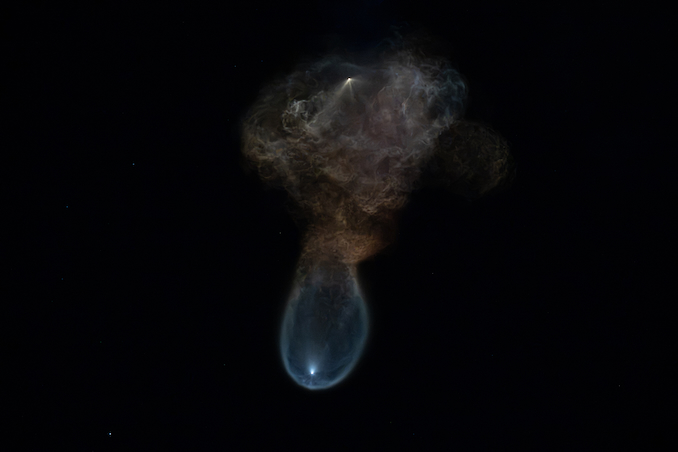
Getting a Falcon 9 off the pad is only the opening event for a mission with 130 payloads. Each satellite or experiment must be released in the planned sequence, establish contact and begin its own commissioning work. The launch therefore marks the start of many separate missions rather than the end of one.
Transporter-18 also followed SpaceX’s Crew-13 flight from Florida on the same day, according to the launch preview. The pairing underscored the company’s ability to operate across distinctly different mission types: a crewed NASA mission from the East Coast and a large rideshare deployment from the West Coast.
The result is a snapshot of an increasingly mixed orbital economy. Human spaceflight, communications constellations, national-security launches, environmental monitoring, computing experiments and in-space research do not all use the same vehicles or schedules. But rideshare missions such as Transporter-18 can provide a shared route for a growing number of smaller ventures.
With 130 payloads headed to orbit, the mission’s most consequential outcome will be measured in what those spacecraft and experiments do after separation: whether they communicate, operate as planned and turn their compact launches into sustained work in space.
This article is based on reporting by Spaceflight Now. Read the original article.
Originally published on spaceflightnow.com