Two Eyes on the Ringed Giant
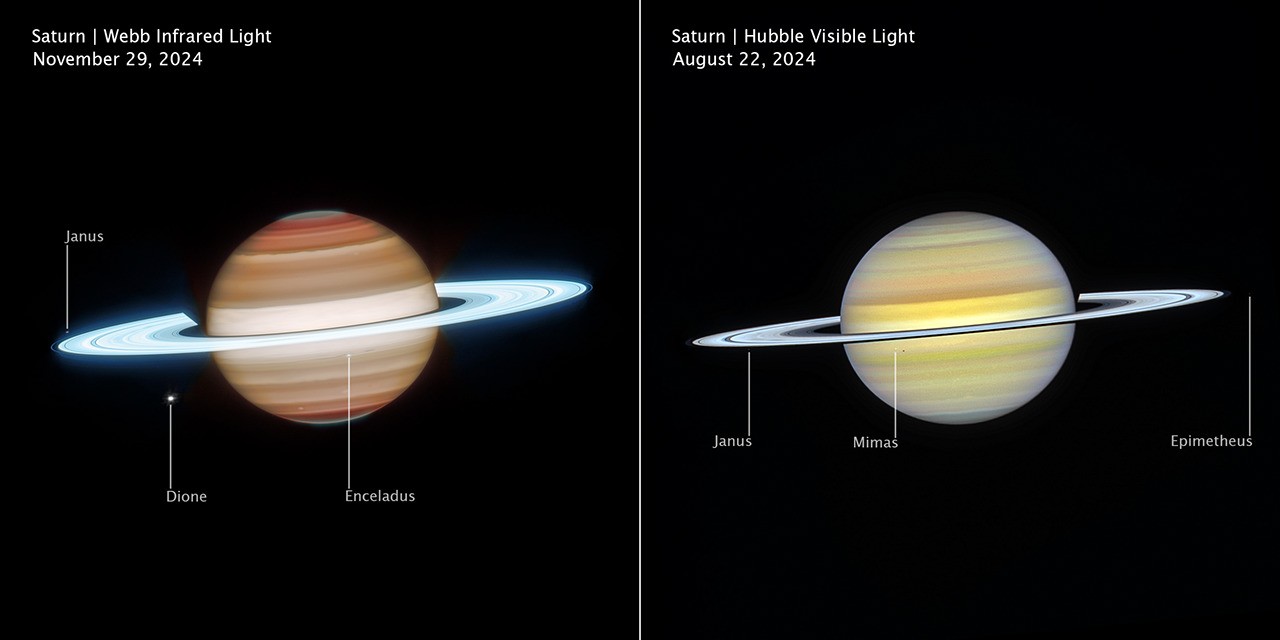
NASA has released the most detailed composite view of Saturn ever assembled, produced by combining observations from two of humanity's most powerful space telescopes — the James Webb Space Telescope and the Hubble Space Telescope. By imaging Saturn in complementary wavelengths of light 14 weeks apart, the two observatories have together produced a portrait of the planet that reaches from deep cloud layers to the uppermost reaches of its atmosphere, revealing structural features that no single telescope could capture alone.
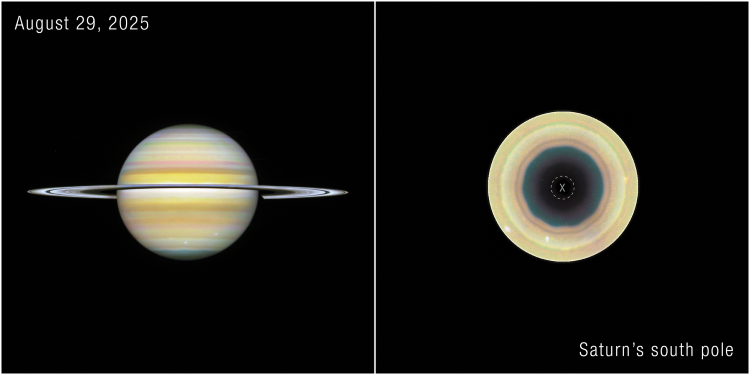
The Hubble observation was made in visible light on August 22, 2024. Webb's observation, made in infrared on November 29, 2024, captured an entirely different picture of the same planet — one in which the rings glow icy white, the poles take on a distinct grey-green coloration, and atmospheric features invisible in optical wavelengths become prominent. The combination of the two datasets allows scientists to effectively slice through Saturn's atmosphere at multiple altitudes simultaneously, what NASA researchers describe as peeling back the layers of an onion.
The Ribbon Wave and the Hexagon
Among the features made visible in the combined imagery is Saturn's Ribbon Wave, a long-lived jet stream that meanders across the planet's northern mid-latitudes. The wave's sinuous path is shaped by atmospheric disturbances in the flow of stratospheric gases that would be invisible without the altitude-specific sensitivity that infrared observations provide. The Ribbon Wave was first observed by the Voyager missions in the early 1980s but has never been characterized with this level of detail.
Also visible in both images are portions of Saturn's iconic North Polar Hexagon — a massive, six-sided jet stream pattern that has persisted around Saturn's north pole for decades and possibly much longer. The hexagon's pointed edges are faintly discernible in the new composite, and the comparison between the infrared and visible-light views adds new information about how the hexagonal structure relates to atmospheric layers at different altitudes. Voyager 1 first documented the hexagon in 1981; subsequent missions including Cassini's 13-year orbital survey ending in 2017 characterized it in increasing detail, and the Webb and Hubble combination extends that record further.

A Remnant Storm Caught in Infrared
One of the more striking features in the Webb infrared image is a small but distinct atmospheric spot — a remnant of the Great Springtime Storm that raged across Saturn's northern hemisphere between 2010 and 2012. That storm was one of the largest atmospheric events observed on any planet in the solar system during the space age, generating a disturbance that circled Saturn's entire northern hemisphere. Twelve years later, its fingerprint is still detectable in the thermal infrared, a testament to the depth and persistence of Saturnian weather systems.
The Rings in Infrared and Visible Light
Saturn's rings behave differently across the electromagnetic spectrum, and the combined imagery makes this contrast vivid. In Hubble's visible-light view, the rings appear as the familiar banded structure of gold and tan hues. In Webb's infrared, the same rings glow a bright icy neon white, a consequence of the high reflectivity of water ice — the primary composition of the ring particles — at near-infrared wavelengths.
Six of Saturn's moons appear in the images: Janus, Dione, Enceladus, Mimas, Epimetheus, and Titan. Enceladus, known to harbor a subsurface ocean and erupt water vapor through geysers at its south pole, is visible as a small bright point near the rings in the wide-field frame.
The Scientific Value of Multi-Wavelength Astronomy
The new Saturn observations exemplify the scientific strategy behind operating multiple complementary observatories simultaneously. Webb and Hubble were designed with different primary missions and different wavelength capabilities, but their simultaneous operation allows astronomers to combine their views in ways that reveal planetary structure with unprecedented depth. Webb's infrared sensitivity probes atmospheric layers that are opaque to visible light; Hubble's sharp visible-light resolution captures cloud structure and surface features with clarity that even Webb cannot match at those wavelengths.
The joint observation builds on the data legacy of the Cassini orbiter, which spent 13 years in orbit around Saturn before its deliberate atmospheric entry in September 2017. Cassini provided the most detailed in-situ characterization of Saturn's atmosphere, rings, and moons ever collected, and the Webb-Hubble observations extend that understanding by enabling systematic monitoring of the planet's weather and atmospheric evolution from Earth's orbital vicinity. With both telescopes in their prime operational years, astronomers expect to revisit Saturn periodically, building a time-series record of atmospheric dynamics that will inform models of giant planet weather for decades.
This article is based on reporting by science.nasa.gov. Read the original article.
Originally published on science.nasa.gov