A Fast Orbital Rescue Moves Closer to Launch
A commercial mission to save one of NASA’s long-serving space observatories has passed a major prelaunch test, bringing an unusually urgent orbital servicing effort closer to flight. Katalyst Space Technologies’ Link spacecraft has completed environmental testing at NASA’s Goddard Space Flight Center, a milestone for a mission designed to dock with the Neil Gehrels Swift Observatory and raise its orbit before the spacecraft reenters Earth’s atmosphere.
The schedule pressure is what makes the mission stand out. Swift, launched in 2004, does not carry its own propulsion system. That means orbital decay has always been part of its long-term fate. But recent solar activity accelerated the descent, lowering Swift from roughly 600 kilometers to 400 kilometers and pushing anticipated reentry into late 2026 if nothing is done. NASA’s own description of the project calls it a race against the clock, and that framing is hard to overstate. This is not a leisurely demonstration. It is a live attempt to preserve an operational science asset before atmospheric drag ends the mission entirely.
What the Testing Milestone Means
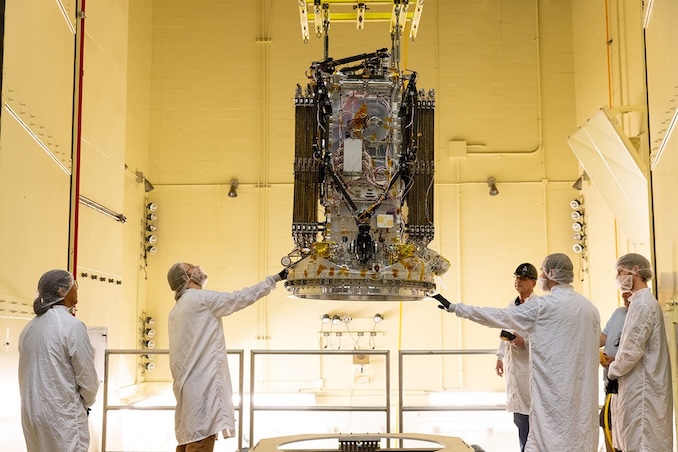
According to the supplied source text, the Link servicing spacecraft finished its run in NASA Goddard’s Space Environment Simulator on May 4 before returning to Katalyst’s facilities in Colorado for additional prelaunch work. During testing, the vehicle fired its three ion thrusters, deployed one of its three arms, and endured space-like hot and cold conditions along with launch-style vibration testing.
Those details matter because the concept depends on more than simply reaching orbit. Link must survive launch, operate reliably in the harsh thermal environment of space, and physically interact with an aging observatory that was never built to be serviced this way. Each successful environmental test reduces one class of risk, but the mission remains technically demanding. NASA described it as a fast, high-risk, high-reward effort, and that is a realistic characterization rather than promotional language.
Orbital servicing has long been discussed as a future pillar of space operations, promising refueling, repairs, upgrades, debris mitigation, and life extension for satellites. What often slows that vision is the mismatch between theory and actual spacecraft fleets. Most satellites in orbit today were not designed to be grabbed, refueled, or boosted by another vehicle. Swift is a clear example. It has scientific value, but not the onboard propulsion needed to correct its orbit. So the rescue mission must solve a real interface problem using commercial hardware under extreme schedule pressure.
Why Swift Is Worth Saving
The supplied report identifies Swift as a $500 million NASA observatory. That price tag alone does not justify rescue, but it signals the scale of the asset at stake. Space telescopes and observatories are expensive to build, launch, and operate, and replacing them is rarely quick. Extending the life of an existing spacecraft can be far more practical than developing a new mission from scratch, especially if the underlying platform still produces useful science.
Swift’s situation also illustrates a broader problem in the orbital economy: the growing need to manage spacecraft after launch rather than treating them as fixed, disposable systems. Environmental conditions change. Solar activity surges. Missions outlive expectations or fall short of original orbital assumptions. A responsive servicing ecosystem could help agencies and companies adapt instead of writing off valuable hardware whenever unplanned degradation appears.
NASA awarded Katalyst a $30 million contract in September 2025 to build the spacecraft capable of docking with Swift and boosting it to a higher altitude. That timeline is striking on its own. In the source text, NASA’s John Van Eepoel said Katalyst reached this stage in just eight months. For traditional aerospace programs, that kind of pace is notable. It suggests NASA is leaning on commercial development methods and already-maturing technologies rather than waiting for a bespoke government program to mature over years.
A Test Case for Commercial Space Servicing
If Link succeeds, the implications extend far beyond Swift. The mission would strengthen the case that commercial firms can perform time-critical servicing tasks on government spacecraft and do so with enough speed to matter operationally. It would also show that agencies can use existing facilities, targeted contracts, and a focused objective to move quickly when a spacecraft’s survival is at stake.
Just as importantly, success would create a practical reference point for other missions now operating without graceful end-of-life options. Operators across civil, commercial, and potentially defense space systems are watching the economics of in-orbit servicing closely. A demonstrated orbit-boost mission could support future business cases for life extension, particularly for spacecraft that still function but are losing altitude or fuel margin.
Failure, however, would also be instructive. A rushed mission dealing with docking complexity, propulsion performance, and a shrinking timeline carries obvious hazards. That does not make the effort reckless; it makes it foundational. Emerging space capabilities only become real through missions that accept genuine operational risk rather than remaining at the concept stage indefinitely.
The Broader Shift in Space Operations
The Swift rescue attempt reflects a deeper transition in how the space sector thinks about assets in orbit. For decades, launch was the defining milestone. Increasingly, the more important question is what happens after deployment. Can spacecraft be serviced, repositioned, upgraded, or recovered from decline? Can agencies rely on commercial providers to do that work on compressed timelines? And can mission design begin to assume a more maintainable orbital infrastructure?
Link’s recent testing milestone does not answer those questions by itself, but it moves one of the clearest near-term demonstrations into sharper focus. NASA is not talking abstractly about a servicing future. It is trying to save a specific observatory before late 2026 reentry becomes unavoidable.
That urgency is exactly why the mission matters. Space servicing is often pitched as a long-range strategic capability. With Swift, it has become immediate. Either a commercial spacecraft reaches an aging observatory and lifts it to safety, or a $500 million NASA asset burns up after two decades in orbit. Few technology demonstrations arrive with stakes that concrete.
This article is based on reporting by Spaceflight Now. Read the original article.
Originally published on spaceflightnow.com