A strange early-universe object is sharpening a major debate
Ever since the James Webb Space Telescope began returning deep infrared views of the distant universe, astronomers have been trying to explain one of its most puzzling discoveries: compact objects now known as “little red dots.” These sources appear in large numbers at very high redshift, meaning they are being seen from a time when the universe was still very young. According to the reported observations, many of them lie about 12 billion light-years away and may have started forming roughly 600 million years after the Big Bang.
That timing matters. Objects showing up so early have immediate implications for how quickly black holes, galaxies, and the first generations of stars could assemble. The problem is that little red dots do not fit neatly into one established category. They appear red in optical light and blue in the ultraviolet, an unusual combination that has led to multiple competing explanations.
A new observation described from a comparison of Chandra X-ray Observatory data with a JWST deep survey adds a potentially important piece to that puzzle. Researchers found an X-ray-emitting little red dot, a surprising result because other members of the class have generally not shown X-ray emission. The object, named 3DHST-AEGIS-12014, sits about 11.8 billion light-years away and appears to share the compact, red characteristics that define the broader population.
What makes it stand out is the X-ray brightness. X-rays are a strong clue because accreting black holes and their surrounding structures are known to produce them. That does not instantly solve the mystery of every little red dot, but it does strengthen the case that at least some of these objects are tied to black hole growth in the early cosmos.
Why little red dots have been so hard to classify
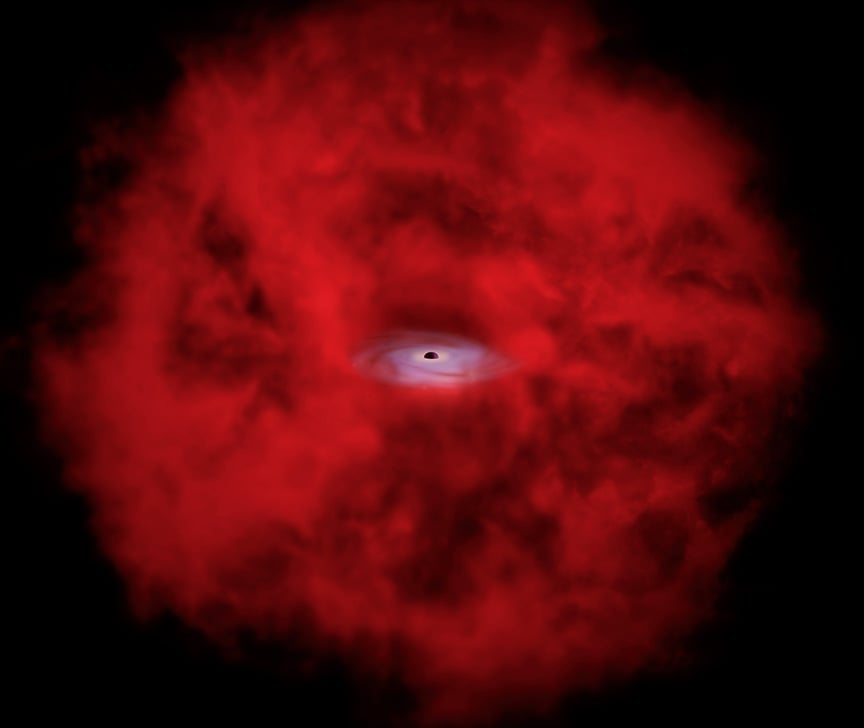
The uncertainty around little red dots comes from the fact that several scenarios remain plausible. One idea is that they are powered by regions around supermassive black holes hidden behind dense gas clouds. Another is that they represent a form of early galaxy that astronomers do not yet fully understand. They have also been discussed as a kind of active galactic nucleus, which would again imply black hole activity. A more exotic suggestion is that some may be short-lived, supermassive, metal-poor stars sometimes described as “black hole stars.”
Each explanation captures part of the available evidence, but none has settled the issue. If hidden black holes are responsible, researchers need to explain why many little red dots do not seem to show the same signatures expected from rapidly growing supermassive black holes of that era. If they are galaxies, astronomers must account for their unusual emission properties. If they are related to an intermediate stage of black hole formation, then observations that bridge one state to another become especially valuable.
That is where 3DHST-AEGIS-12014 becomes interesting. The reporting around the source suggests it may represent a transition case. If the object does host a black hole, surrounding gas could be getting consumed through an accretion disk, gradually opening clearer channels through which X-rays can escape. In that picture, the object would not just be another member of the little-red-dot population. It would be a snapshot of change, showing how a heavily obscured system might evolve into something more recognizable as an active black hole.

A possible bridge between competing ideas
The most compelling aspect of the new detection is not simply that an X-ray source exists, but that it may connect two ideas that have often been discussed separately: unusual early compact sources and the rapid rise of supermassive black holes. Astronomers have long faced the problem of explaining how extremely massive black holes formed so quickly in the young universe. Any object that plausibly traces an intermediate stage is therefore valuable.
In this case, the object’s compact size, red appearance, and early-universe location place it in the same broad regime as other little red dots. Its X-ray emission, however, points toward energetic processes associated with accretion. That does not prove every little red dot is a black-hole-powered object, but it does suggest the class may not be uniform. Some could be obscured black hole systems, some could be transitional forms, and others may still require different explanations.
That possibility is scientifically useful. Astronomers often begin with a category that appears coherent in images and spectra, then later discover that it contains multiple physical phenomena. JWST has opened a view of the early universe detailed enough to create exactly that kind of taxonomic problem. The next phase of the work is to separate appearance from underlying physics.
The reported detection also reinforces the value of combining observatories rather than relying on a single instrument. JWST can identify these faint, distant sources in infrared light, but Chandra provides a different test by asking whether the same objects are also energetic in X-rays. When the answers disagree from one object to another, the mismatch itself becomes evidence.
What comes next
The immediate question is whether 3DHST-AEGIS-12014 is a rare outlier or the first clearly identified member of a broader subgroup. If more X-ray-bright little red dots are found, astronomers will have stronger grounds for arguing that black hole growth is central to the population. If not, this source may still matter as an unusual but informative exception.
Either outcome would help. A rare object can still reveal a physical pathway that theorists need to include. A common one would force a more substantial revision of current models for early black hole and galaxy formation. In both cases, the discovery keeps pressure on simple explanations.
The larger significance is that the early universe is turning out to be more crowded and more complicated than many pre-JWST expectations allowed. Little red dots were already a challenge because they appeared numerous, compact, and hard to explain. The appearance of an X-ray bright example raises the stakes. It suggests at least some of these distant red sources may be tied to the machinery that builds the first massive black holes.
For now, the mystery is not resolved. But it has become sharper. Instead of asking only what little red dots are in general, astronomers can begin asking which kinds exist, what stages they represent, and how they connect to the earliest history of black hole growth. That is a more precise and more productive problem, and it is the kind of advance that often marks real progress in astronomy.
This article is based on reporting by Universe Today. Read the original article.
Originally published on universetoday.com