Türkiye expands its space diplomacy with Artemis Accords signature
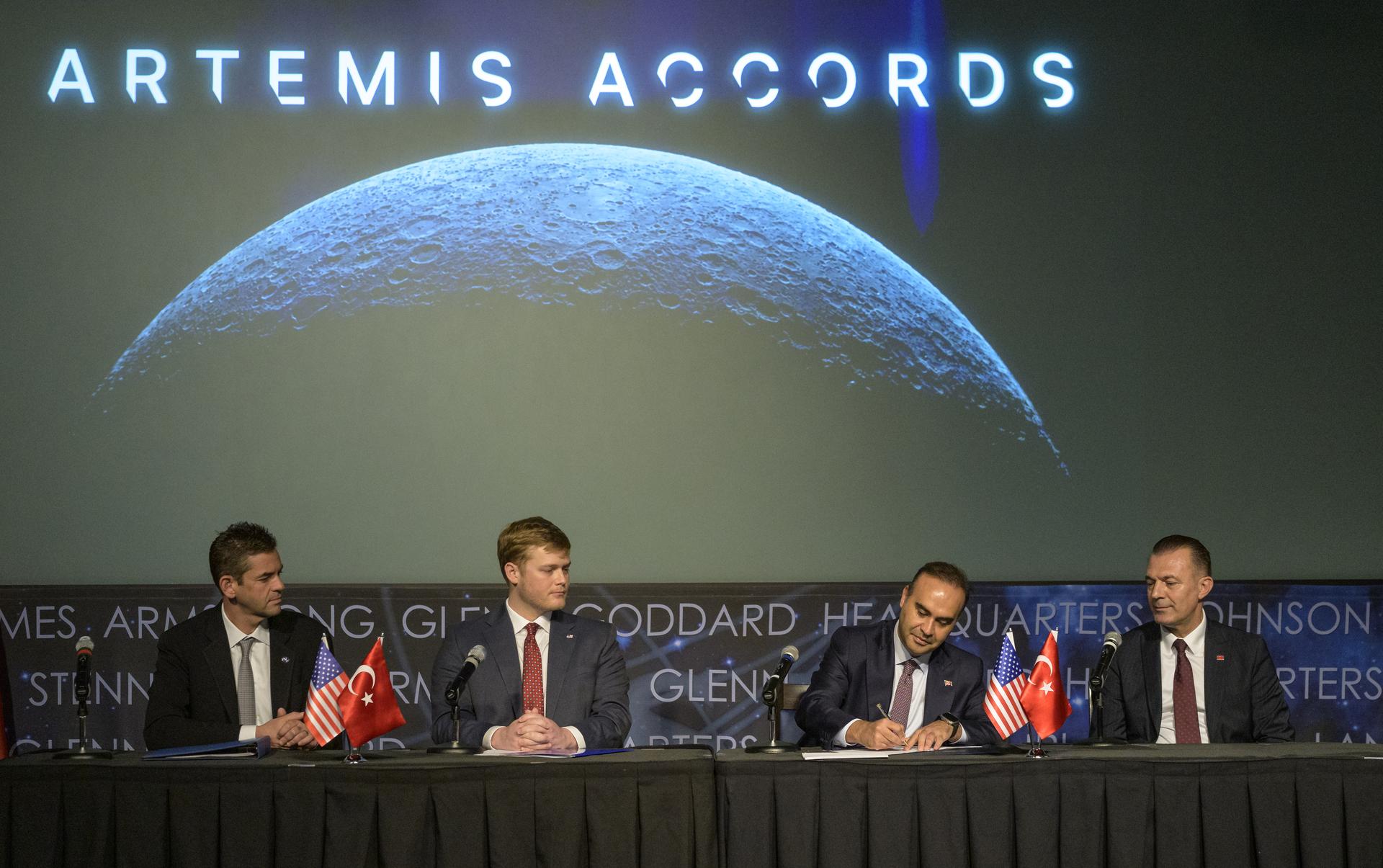
Türkiye has become the 71st signatory of the Artemis Accords, formally joining the U.S.-led framework that sets principles for peaceful, transparent, and cooperative space exploration. The signing took place on Monday, August 31, 2026, during a ceremony at NASA headquarters in Washington hosted by NASA Administrator Jared Isaacman.
The move places Türkiye inside a growing coalition of countries that have endorsed a common approach to future activity beyond Earth orbit, particularly around the Moon and, eventually, Mars. In practical terms, the Artemis Accords are not a mission contract or a hardware agreement. They are a statement of shared operating principles. But as the lunar agenda shifts from concept to execution, those principles increasingly matter because they frame how countries expect to work together, share information, and conduct exploration in crowded and strategically important environments.
NASA described the signatories as a coalition of like-minded nations committed to peaceful and transparent exploration. Isaacman used the moment to connect Türkiye’s entry to the broader U.S. lunar strategy, saying NASA is accelerating a return to the Moon, working toward an enduring human presence there, and laying groundwork for crewed Mars exploration. He also said NASA has invited every Artemis Accords signatory to take part by contributing hardware, scientific payloads, technology demonstrations, CubeSats, and other capabilities to future Artemis missions.
A political framework with operational consequences
The significance of the Artemis Accords lies in how they translate diplomatic alignment into expectations for real missions. As more countries develop lunar ambitions, questions of transparency, coordination, and peaceful conduct stop being abstract. They become part of everyday planning for launches, payloads, communications, and operations near the Moon.
Türkiye’s signature therefore matters on two levels. Symbolically, it signals that Ankara wants to be seen as part of the mainstream international framework shaping the next phase of space exploration. Practically, it creates a clearer pathway for Turkish institutions to position themselves for participation in future programs tied to the Artemis ecosystem.
The ceremony underscored that official intent. Turkish Minister of Industry and Technology Mehmet Fatih Kacır signed on behalf of the Republic of Türkiye. Turkish Space Agency President Yusuf Kıraç also attended, along with U.S. Deputy Assistant Secretary of State for Space and Environment Connor Tomlinson. The participants reflected that this was not simply a technical event between agencies. It was also a diplomatic milestone.

Türkiye arrives with recent human spaceflight momentum
NASA’s announcement pointed to Türkiye’s recent space achievements as evidence that the country is not entering the accords as a passive observer. In 2024, Alper Gezervaci became Türkiye’s first astronaut, traveling to the International Space Station on Axiom Mission 3 and conducting scientific research alongside NASA astronauts. That mission gave Türkiye a visible place in human spaceflight and marked a step change in its public space profile.
Later the same year, a second Turkish astronaut, Tuva Atasever, flew on the Virgin Galactic 07 suborbital mission. According to NASA, that flight included experiments and physiology research. Together, the two missions gave Türkiye back-to-back milestones in orbital and suborbital human space activity, helping establish a stronger foundation for future international partnerships.
Those achievements matter because Artemis participation is not only about diplomacy. It is also about whether countries can sustain the institutions, technical ambitions, and political focus needed to contribute over time. Human spaceflight missions do not by themselves guarantee that capacity, but they can signal seriousness and help build domestic support for broader national space goals.
The lunar angle is especially important
NASA also said Türkiye will soon launch its first lunar mission, AYAP-1. If that schedule holds, the mission would place the country among a relatively small group of nations building and launching their own satellites to the Moon. That point gives the Artemis Accords signature extra relevance. Türkiye is not merely endorsing lunar cooperation in principle while remaining years away from any direct lunar engagement. It is preparing a mission of its own.
That matters for the global lunar landscape because the Moon is becoming a proving ground for national capability, international coordination, and future commercial opportunity. Countries joining the Artemis framework are positioning themselves not just for prestige missions but for a long-term role in the infrastructure and norms of cislunar activity.
Isaacman’s remarks tied that directly to NASA’s vision of a Moon base and a sustained presence on another world. Whether every signatory ultimately contributes major hardware or only targeted payloads, the invitation itself reflects an effort to turn the accords into a working coalition rather than a purely declarative club.
Timing ahead of a major international gathering
Türkiye’s decision also comes just before it hosts the International Astronautical Congress in Antalya in October 2026. NASA said dozens of Artemis Accords signatories are expected to attend the event to discuss the future of peaceful and transparent space exploration. That gives Türkiye an immediate diplomatic stage on which to convert its new status into meetings, partnerships, and agenda-setting opportunities.
Hosting a major international congress shortly after signing the accords could amplify the country’s visibility within the global space community. It allows Türkiye to present itself not only as a participant in others’ programs but as a convening power in its own right. In the context of Artemis, that kind of timing can be useful: it aligns a formal commitment with a live forum for relationship-building.
A growing coalition around lunar exploration
The Artemis Accords began in 2020, when NASA and the U.S. State Department joined with seven other founding nations to establish the framework. Reaching 71 signatories by August 31, 2026 shows how quickly the coalition has expanded. Each additional member broadens the political base behind the norms that NASA and its partners want to carry into the next era of exploration.
For Türkiye, joining now means entering at a moment when the accord is already well established but still evolving through new participation and upcoming missions. For NASA, the signature is another indicator that the Artemis framework continues to attract governments seeking a recognized path into future lunar and deep-space cooperation.
The immediate effect is diplomatic, but the real test will come in contribution and follow-through. Türkiye now has a seat inside a widening framework for lunar exploration. The next question is how it uses it: through missions, payloads, technology partnerships, or a larger role in the politics of international space cooperation. After the August 31 signing in Washington, that question is no longer hypothetical.
This article is based on reporting by NASA. Read the original article.
Originally published on nasa.gov