A different way to look into cosmic history
A new instrument called the Tomographic Ionized-carbon Mapping Experiment, or TIME, is opening a fresh path into one of cosmology’s hardest-to-study eras. Mounted on a 12-meter radio telescope at Kitt Peak Observatory in Arizona, TIME uses line-intensity mapping to capture the combined light from many galaxies at once instead of trying to isolate each one individually.
That matters because the earliest galaxies are extraordinarily difficult to resolve. Their light is faint, heavily redshifted, and separated from us by billions of years. Even with powerful telescopes, astronomers can only sample parts of that distant landscape directly. TIME aims to fill in more of the picture by measuring aggregate emission in specific spectral lines across large regions.
Why line-intensity mapping matters
Line-intensity mapping, or LIM, focuses on a single spectral emission line from many galaxies simultaneously. Instead of needing every individual galaxy to be bright enough to study on its own, the method treats their collective light as a signal that can reveal how cosmic structure changes over time.
In TIME’s case, the instrument is mapping rotational emission lines from carbon monoxide. Those lines provide a way to trace molecular gas and star-forming material, helping researchers understand the environments in which early galaxies were building up.
Targeting the Epoch of Reionization
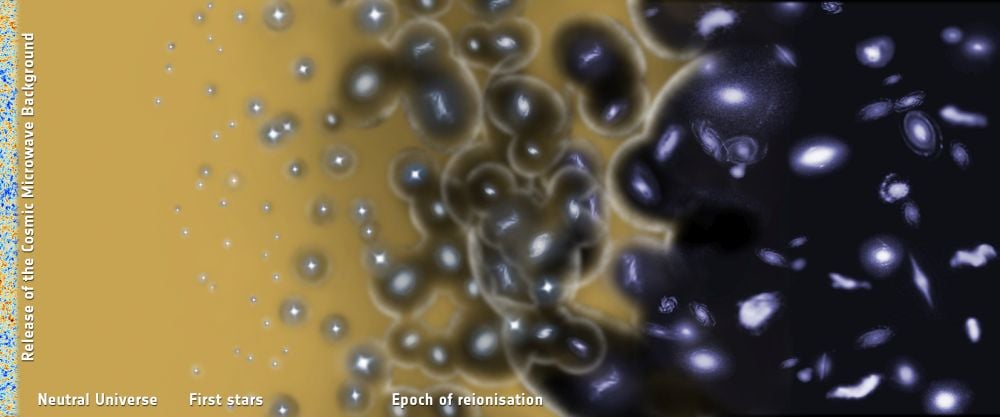
TIME is designed to investigate the Epoch of Reionization, a crucial period when the first stars and galaxies ionized the intergalactic medium. During that transition, hydrogen shifted from neutral to ionized, changing the universe from opaque to translucent and allowing light to travel much more freely across space.
That phase change is one of the major thresholds in cosmic history. Understanding when and how it unfolded can clarify how the first luminous structures transformed the universe around them.
First results arrive
Universe Today reports that TIME began its commissioning run in 2021 and 2022, and researchers have now released initial results in a paper published in The Astrophysical Journal. The first study focused on mapping dust and molecular gas in the Sagittarius A molecular cloud complex at the galactic center.
That early work is not yet the full prize that motivates the project, but it demonstrates the instrument’s capabilities and begins establishing its scientific usefulness. For a mapping experiment built around a relatively new observing approach, proving performance is a meaningful step.
Beyond individual galaxies
TIME’s significance lies in its method as much as its target. Modern astronomy often advances by building sharper instruments that see farther or with finer resolution. TIME pushes in a different direction: it accepts that many early galaxies will remain too dim to resolve one by one and instead turns that limitation into a strategy.
If the technique succeeds at scale, it could help astronomers build a more continuous picture of the early universe than direct imaging alone can provide. Rather than a handful of bright snapshots, researchers may gain a broader map of how gas, galaxies, and structure evolved during one of the universe’s formative eras.
This article is based on reporting by Universe Today. Read the original article.
Originally published on universetoday.com