Lunar fire safety may not resemble Earth at all
Fire has always been among the most feared hazards in human spaceflight. On the Moon, that danger may be harder to predict than mission planners would like. A new paper from researchers at NASA’s Glenn Research Center, Johnson Space Center, and Case Western Reserve University argues that materials judged safe by Earth-based standards may behave very differently on the lunar surface.
The concern is not hypothetical. For decades, NASA has relied on a test known as NASA-STD-6001B to screen material flammability for flight. The standard procedure involves applying a six-inch flame to the bottom of a vertically mounted sample. If the material burns more than six inches upward or drips burning debris, it fails.
That test is useful, but it is rooted in Earth conditions. The Moon offers something else entirely: lower gravity, different fluid dynamics, and operational environments where airflow may not behave in familiar ways. The new research argues that these differences are significant enough to justify dedicated lunar fire experiments before crews begin depending on habitats, suits, and equipment far from Earth.
Why the current standard is limited
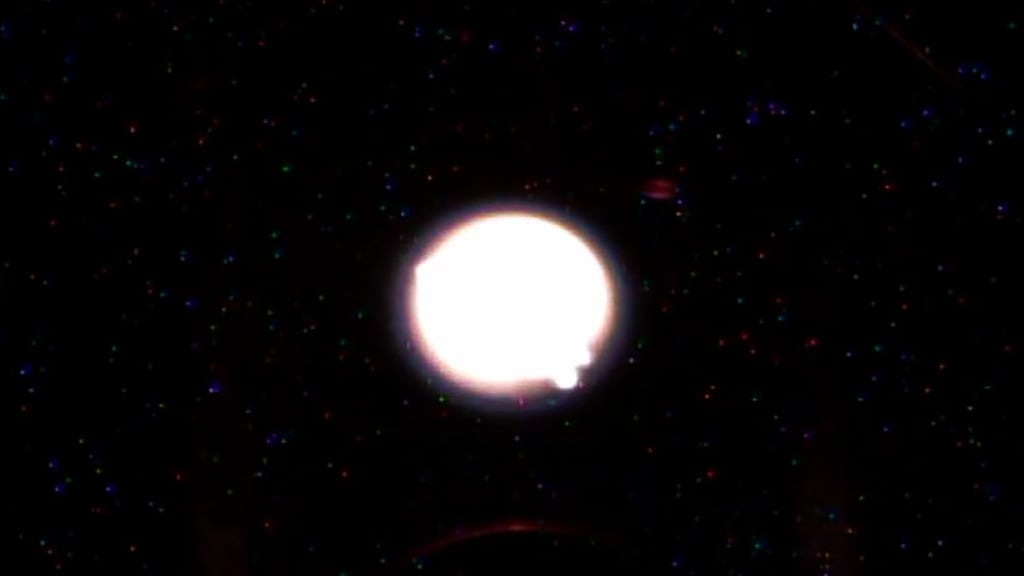
The weakness of an Earth-based flammability test is not that it is poorly designed. It is that convection and orientation work differently away from Earth. Here, hot air rises, fresh oxygen moves in, and flames stretch in ways people intuitively understand. In microgravity, that structure changes. Flames can form slow-moving spherical shapes rather than climbing upward.
The source text points out that on the International Space Station, flames do not simply point up because “up” and “down” do not operate the same way. Instead, fire can spread outward in spherical blobs and depend heavily on ventilation systems for oxygen flow.
The Moon is not microgravity, but it is also not Earth. Its reduced gravity may create combustion behavior that existing standards do not capture. That leaves engineers with a gap between tested assumptions and actual mission conditions.

What previous space fire tests have shown
NASA has not ignored combustion research in space. The agency previously ran the Spacecraft Fire Safety, or Saffire, experiments inside uncrewed Cygnus cargo capsules after they detached from the ISS and before they burned up in Earth’s atmosphere. Those experiments ignited large sheets of material such as cotton-fiberglass blends, fabric, and acrylic in order to study fire spread in microgravity.
Researchers found unusual combustion physics there as well, reinforcing the idea that Earth intuition is not enough. The challenge is that broader in-situ fire testing aboard a crewed station is inherently dangerous. NASA has ignited many small flames for controlled combustion studies, but deliberately testing larger damaging fires inside an occupied spacecraft is a different matter.
That is part of why the Moon becomes an attractive research site despite the obvious operational difficulty. It offers a reduced-gravity environment where fire behavior could be observed without putting a continuously inhabited orbital station at similar risk.
The hidden danger of smoldering materials
One detail in the report is especially important: simply shutting off ventilation would not necessarily eliminate danger. Reduced airflow may slow visible flame spread, but some materials can smolder and then reignite when airflow returns. That means fire response is not just about stopping open flame in the moment. It is also about preventing delayed re-ignition under changing environmental controls.
For lunar missions, that possibility is serious. Habitats, vehicles, and workspaces may cycle through different airflow states, and emergency procedures could involve isolating compartments or changing life-support conditions. If smoldering behavior differs in lunar gravity, a material that seems manageable under one condition could remain hazardous under another.
This is exactly the sort of risk that standard pass-fail screening may miss.
Why the Moon is a special case
The Moon is close enough for sustained human activity to become plausible and distant enough that design mistakes become expensive. Missions there will rely on enclosed environments, specialized materials, and tightly controlled life-support systems. A poorly understood fire event in that setting would be a high-consequence emergency.
The researchers therefore want more than theory. They want direct testing of flammability on the lunar surface itself. The logic is straightforward: if flame propagation changes with gravity and airflow, then lunar mission architecture should be informed by lunar data rather than extrapolation alone.
That is a practical engineering argument, not an abstract one. Material qualification standards help determine what can fly, what can be built into habitats, and how risk models are written. If those standards are missing a lunar-specific factor, the gap should be closed before crews are relying on them far from rapid rescue.
What a lunar fire experiment could change
A successful test campaign could influence several parts of future mission planning:
- Material selection for habitats, suits, and cargo systems.
- Ventilation and airflow design in crewed lunar spaces.
- Emergency response procedures for flame and smoldering events.
- Updates to flammability standards now based primarily on Earth testing.
That would make the research consequential even if the lunar results simply confirm current expectations. Validation under real mission conditions has value on its own. If the results instead reveal that some materials are more flammable, more persistent, or more prone to hidden smoldering than expected, the impact could be larger still.
A quiet but critical part of Artemis-era planning
Space exploration is often discussed in terms of rockets, habitats, and ambition. Yet some of the most important advances are the least cinematic. Understanding how fire behaves on the Moon belongs in that category. It is a foundational safety question that must be answered well before crews are meant to live and work routinely on the lunar surface.
The new paper does not claim that lunar bases will be fire traps. It does make a narrower and more serious point: the tests NASA has relied on for decades were developed on Earth, and the Moon is not Earth. Reduced gravity changes combustion, ventilation changes flame behavior, and smoldering can keep danger alive after visible fire seems to fade.
Before long-duration lunar exploration scales up, that uncertainty needs to become data. For mission planners, engineers, and astronauts, few things are more practical than knowing exactly how a fire will behave before one ever starts.
This article is based on reporting by Universe Today. Read the original article.
Originally published on universetoday.com