A crucial maneuver on the way to a metal world
NASA’s Psyche mission has passed one of the most important checkpoints of its long journey to the asteroid belt. On May 15, the spacecraft flew past Mars to use the planet’s gravity as a slingshot, gaining speed and reshaping its orbit toward its final destination: the metal-rich asteroid 16 Psyche.
The encounter was more than a navigational trick. It also gave mission teams a chance to exercise Psyche’s science instruments under real flight conditions and produced a set of unusual Mars images captured from an angle not often seen in public mission photography. For a spacecraft still years from its target, the flyby offered both operational value and a vivid reminder that interplanetary travel is as much about carefully timed geometry as it is about propulsion.
What the Mars flyby accomplished
Psyche launched in October 2023 on a six-year trip of roughly 2.2 billion miles to the asteroid belt between Mars and Jupiter. Rather than relying only on its propulsion system, the spacecraft used last week’s close approach to Mars to borrow momentum from the planet’s gravity.
According to mission officials, navigators at NASA’s Jet Propulsion Laboratory planned a trajectory that brought Psyche to within 2,864 miles of the Martian surface, comfortably above the thin atmosphere. The result was a boost of about 1,000 miles per hour and a roughly 1-degree shift in the spacecraft’s orbital plane around the Sun. Those changes are what place the probe on course for arrival at asteroid Psyche in summer 2029.
For deep-space missions, gravity assists are often the difference between feasible and impractical trajectories. Every major maneuver saved through celestial mechanics can preserve propellant, expand mission margin, and enable more ambitious destinations.
A dress rehearsal before the main event
The flyby also served as a systems test. Psyche’s team used the encounter as a rehearsal for the mission’s eventual science campaign at the asteroid, exercising the spacecraft’s three instruments during a fast-moving planetary pass. That included its multispectral imager, a gamma-ray and neutron spectrometer, and other onboard systems meant to characterize the composition and structure of its final target.
That matters because 16 Psyche is no ordinary asteroid. Scientists think it may be the exposed core of a planetesimal whose outer layers were stripped away in a collision long ago. If that interpretation is correct, the mission could offer a rare window into the kind of metal-rich interior that normally lies hidden deep inside planets, including Earth.
In other words, the spacecraft is not just heading toward another rock. It is aiming at an object that may preserve information about planetary building blocks and core formation that researchers cannot access directly anywhere else.
Unfamiliar views of a familiar planet
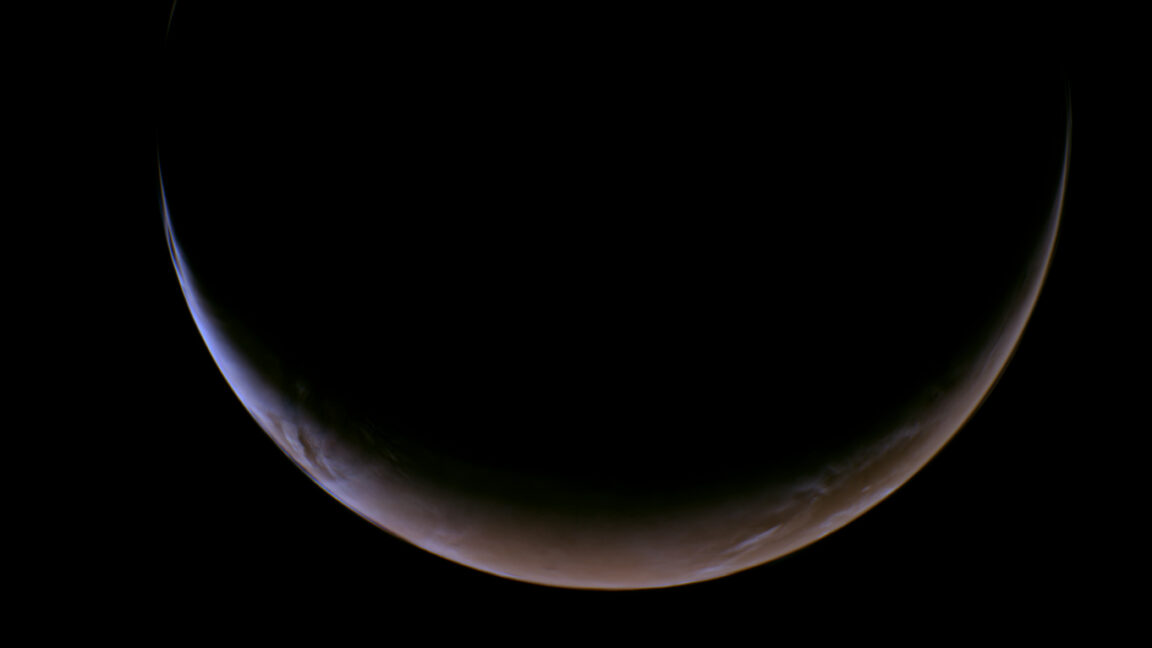
As a bonus, Psyche captured Mars from a rare perspective. One of the most striking views shows the planet as a thin crescent, processed into natural color using red, green, and blue data from the multispectral imager. Because the spacecraft approached at a high phase angle, Mars appeared in a form that differs sharply from the full-disk images more commonly seen from orbiters and telescopes.
Other imagery showed a nearly fuller Mars, including the southern polar region and parts of the Valles Marineris area. These are not the first images of Mars, of course, but they are useful both scientifically and operationally. They help teams verify instrument performance while offering a fresh geometric look at a planet that humanity has observed intensely for decades.
The images also illustrate a subtle truth about exploration: familiar worlds can still look new when seen from different trajectories. Perspective is not just aesthetic. It shapes what instruments can test and what mission planners can learn.
Why Psyche stands out
Psyche is one of NASA’s more unusual planetary missions because its destination raises questions that sit at the boundary between asteroid science and planetary interior science. If 16 Psyche really is a stripped planetary core, studying it could help explain how early rocky bodies formed, differentiated, and suffered violent collisions in the early solar system.
That possibility gives the mission a distinct scientific identity. Most asteroid missions explore primitive remnants that preserve early solar system material. Psyche, by contrast, may be exposing what usually remains buried: a metallic interior. The spacecraft’s instruments are designed to determine the asteroid’s composition, map its surface, measure its gravity field, and search for clues about whether it was once part of a larger body.
The Mars gravity assist does not answer any of those questions directly, but it is the maneuver that keeps them within reach.

The long road still ahead
Even after this successful flyby, Psyche is not halfway through its journey. Arrival is still scheduled for 2029, which means years of cruise remain before the spacecraft can begin its primary science campaign. That long timeline is a reminder of how patient deep-space exploration must be. Major milestones come in short bursts separated by long spans of disciplined engineering and careful navigation.
Still, the Mars encounter provides an important signal that the mission remains on track. As navigation lead Don Han put it, the team confirmed in real time through Deep Space Network Doppler data that Mars delivered the expected boost and orbital change. In a mission defined by precision, that kind of confirmation matters.
Psyche’s unusual pictures of Mars may draw immediate attention, but the deeper significance of the flyby is strategic. The spacecraft has completed a major course-shaping maneuver successfully. It is now headed toward one of the solar system’s most intriguing targets, carrying the hope that a distant metal-rich world can reveal something fundamental about the hidden interiors of planets closer to home.
This article is based on reporting by Ars Technica. Read the original article.
Originally published on arstechnica.com