NASA wraps a long-duration station mission with a safe Soyuz landing
NASA astronaut Chris Williams returned to Earth on July 26, 2026, ending an eight-month mission aboard the International Space Station and closing out a flight that blended science, maintenance work, and the routines of long-duration human spaceflight. Williams landed with Roscosmos cosmonauts Sergey Kud-Sverchkov and Sergei Mikaev after departing the station aboard the Soyuz MS-28 spacecraft.
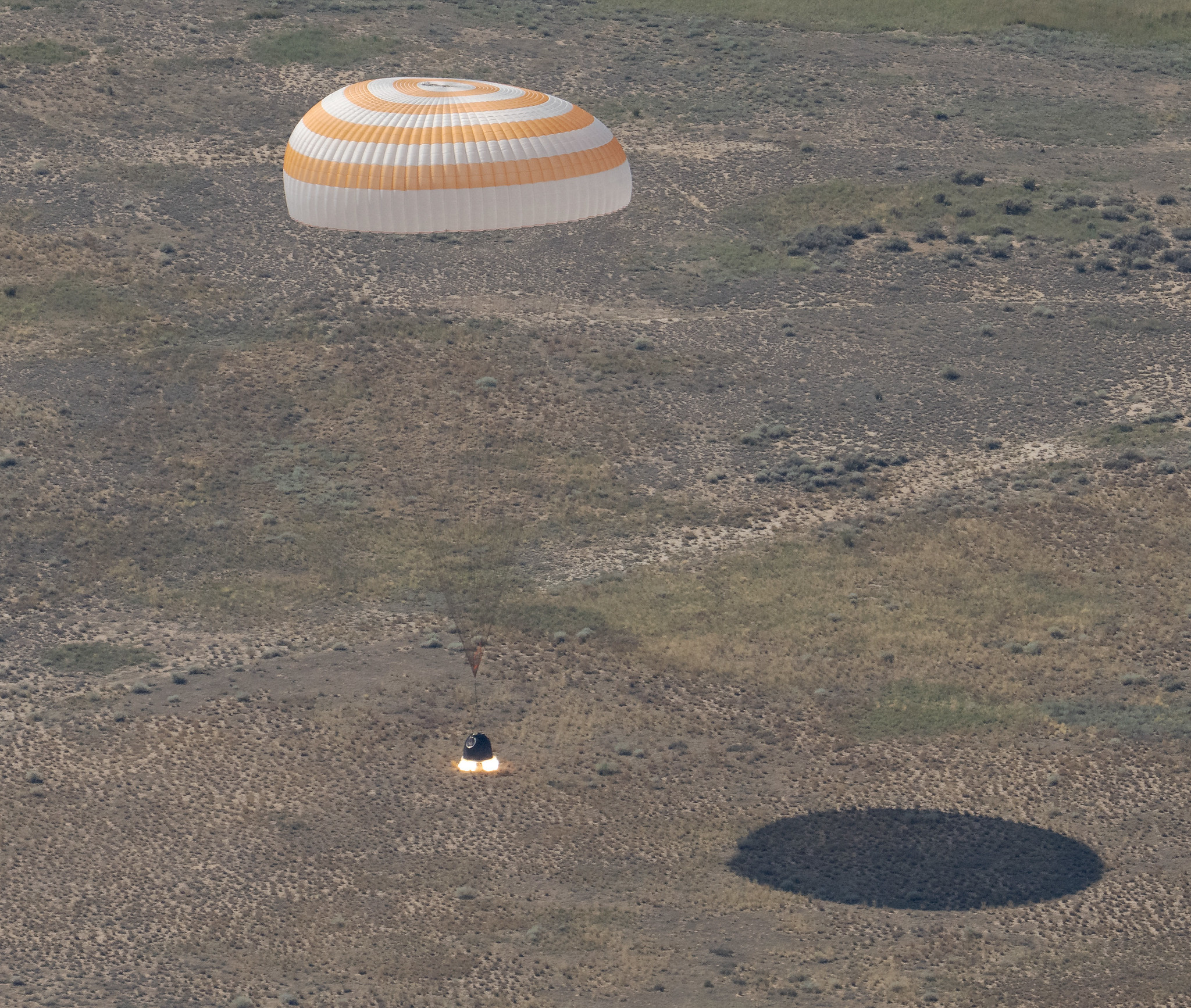
The landing took place at 5:27 a.m. CDT near Dzhezkazgan, Kazakhstan, according to NASA. The parachute-assisted return followed an undocking earlier in the day at 2:03 a.m. The agency described the touchdown as safe, a standard word in spaceflight communications that still carries weight: every crew return is the final critical phase of a mission measured across months of operations in orbit.
For Williams, the mission marked a first. NASA said this was his first spaceflight, as it was for Mikaev, while Kud-Sverchkov completed his second mission. Together, the crew spent 241 days in space after launching to the orbiting laboratory on Nov. 27, 2025.
Those headline numbers help define the scale of the mission. NASA said the crew orbited Earth 3,856 times and traveled more than 102 million miles during their stay. In operational terms, that is the kind of duration that turns a mission into more than a visit. It becomes an extended campaign of experiments, equipment work, and adaptation to the physical demands of living in microgravity for months at a time.
Science, hardware work, and operational experience
NASA said Williams supported a broad mix of scientific investigations and technology demonstrations while aboard the station. Among the areas highlighted by the agency were research tied to potential new cancer treatments and work on improving in-space manufacturing of materials used in high-performance computers and electronics.
That combination reflects the station’s dual role. It remains both a laboratory for biomedical research and a test bed for technologies that may matter far beyond space science. In NASA’s account of the mission, Williams’ work fits the agency’s recurring argument for the station: that research conducted in orbit can produce findings that are difficult or impossible to obtain under Earth’s gravity, while also shaping systems needed for future exploration.
The mission also included physically demanding external operations. NASA said Williams completed two spacewalks during the expedition. One objective was to help prepare for power system upgrades on the station. Another was to replace a faulty joint on the Canadarm2 robotic arm, one of the station’s most important pieces of external infrastructure.
Those tasks underscore a reality that often gets overshadowed by science headlines. The station is not simply a platform for experiments; it is also a continually maintained outpost. Crew time is divided between research and the persistent work required to keep a complex orbital facility functioning, upgraded, and ready for the next set of missions.
A mission framed by continuity
NASA placed the return in a larger institutional narrative, emphasizing that people have lived and worked continuously aboard the International Space Station for more than 25 years. That long arc matters because each individual expedition is both self-contained and cumulative. Crews rotate, but the station’s mission is designed around continuity: maintaining a permanent human presence in low Earth orbit while building operational knowledge from one increment to the next.
Williams’ return therefore represents two things at once. On one level, it is the end of a single expedition for one astronaut and two cosmonauts. On another, it is a handoff point in an ongoing program that NASA says supports scientific discovery, commercial development in low Earth orbit, and preparation for future missions deeper into space.
The agency directly connected the crew’s work to future lunar and Mars exploration, describing the station as part of the foundation for long-duration missions under the Artemis program and beyond. NASA’s case is that the station remains useful not only for present-day research, but also as a place to understand the practical and human challenges of extended spaceflight.
That framing is familiar, but missions like this one give it substance. A 241-day stay is long enough to generate operational lessons about crew endurance, spacecraft logistics, maintenance planning, and the cadence of scientific work in orbit. Even when the public-facing announcement is concise, the institutional value of such a mission lies in the accumulation of those lessons.
What happens after landing
NASA said that following post-landing medical checks, the crew would travel by helicopter to Karaganda, Kazakhstan, where recovery teams are based. From there, Williams was scheduled to board a NASA aircraft for the agency’s Johnson Space Center in Houston.
That sequence is routine but important. Recovery does not end at touchdown. Medical evaluations and transport are built into the process of helping astronauts transition back to Earth after months in microgravity. For a first-time flier returning from a long mission, those first hours back on the ground are part of the mission’s final operational phase.
The end of the flight also gives NASA a clean moment to summarize what the mission represented. In Williams’ case, the agency highlighted a mix of scientific support, station upgrade work, and repair activity on critical hardware. None of that is glamorous in isolation. Taken together, it is a concise description of what long-duration station missions are supposed to do.
The image NASA released of the Soyuz capsule on the ground near Dzhezkazgan captures the straightforward end state: a crew back on Earth after months aloft, with mission objectives carried home as data, hardware experience, and a completed rotation in the station’s long-running history.
For NASA, that outcome remains central. Safe launch, sustained work in orbit, and safe return are still the basic measures of mission success. By those standards, the agency’s July 26 announcement was simple and consequential: Chris Williams’ first mission is complete, and another chapter of continuous station operations has closed without breaking the chain.
This article is based on reporting by NASA. Read the original article.
Originally published on nasa.gov