Clouds may be doing more than hiding sub-Neptunes
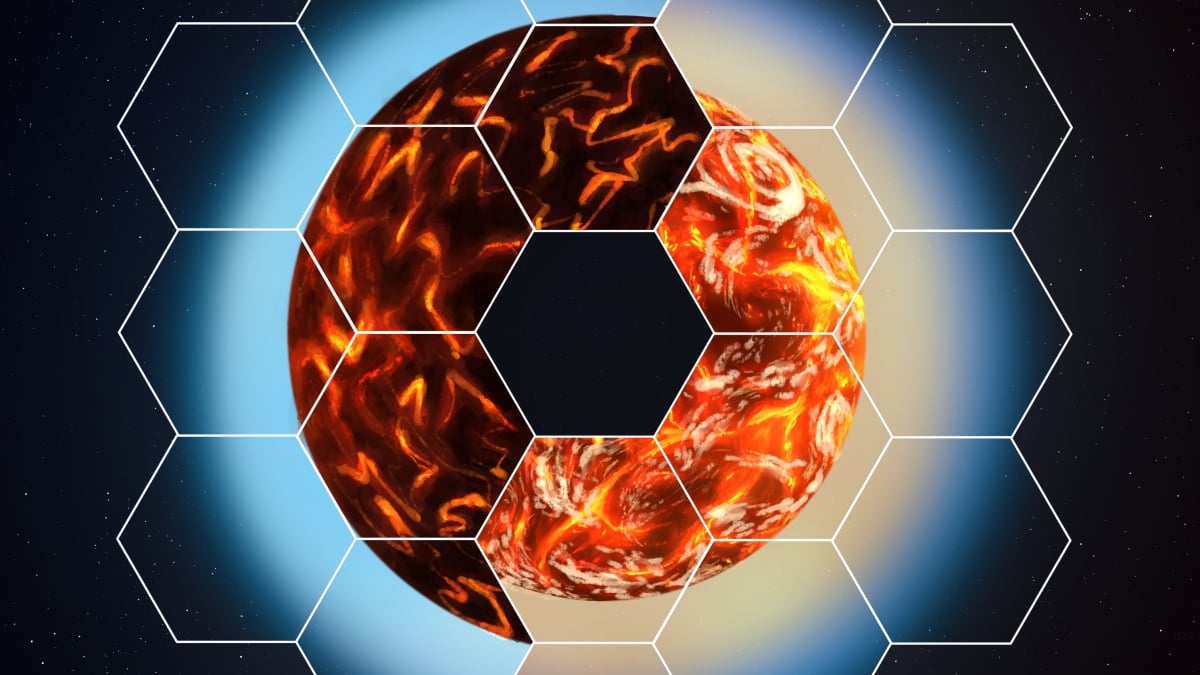
A new study led by researchers at Arizona State University argues that clouds in sub-Neptune atmospheres are not just an observational nuisance. They may actively reshape conditions deep inside the planets themselves. Using James Webb Space Telescope data alongside detailed computer models, the team found that cloud layers can alter temperatures far below the upper atmosphere, extending their influence to the boundary where atmosphere meets interior.
That matters because sub-Neptunes are one of the most common planet classes in the known exoplanet population, yet they remain poorly understood. The source text says astronomers have confirmed 6,324 exoplanets in total, with 2,182 of them classified as sub-Neptunes. Despite that abundance, researchers still do not know whether many of these worlds are primarily rocky planets wrapped in hydrogen-rich atmospheres or volatile-rich bodies containing large amounts of water and carbon-bearing material.
The new work does not settle that question outright. What it does show is that cloud physics can significantly change the thermal environment scientists use to infer what lies beneath the atmosphere. In effect, clouds may be shaping the internal story that astronomers are trying to reconstruct from remote data.
Why sub-Neptunes are so difficult to decode
Sub-Neptunes occupy a frustrating middle ground. They are larger than Earth but smaller than Neptune, making them common in surveys yet difficult to interpret. Telescopes such as JWST can probe their atmospheres, but only indirectly and mostly in their upper layers. That means researchers must work backward from atmospheric signatures to infer interior structure.
The problem is that clouds interfere with that process in two ways. First, they can obscure the chemistry below, blocking a clear view of atmospheric composition. Second, according to this study, they may change the atmosphere’s temperature profile so substantially that the usual assumptions about interior conditions become unreliable.
The team’s modeling points to clouds made of vaporized rocks and salts forming deep in the atmospheres of sub-Neptunes. Those clouds behave like a thermal blanket, trapping heat in lower layers while cooling the upper atmosphere. The source text says the lower atmosphere can be heated by more than 1,000 degrees Celsius, with the effect reaching the interface between atmosphere and interior.
That is a significant shift. If the lower atmosphere is much hotter than expected, the materials present at depth, and the physical transitions between atmospheric gases and the underlying planetary body, may need to be reinterpreted.

From upper atmosphere data to interior structure
The study was led by Sagnick Mukherjee of ASU’s School of Earth and Space Exploration, working with collaborators from ASU, the University of Texas at Austin, NASA Ames Research Center and the SETI Institute. Their findings were published in Astrophysical Journal Letters, according to the source material.
The research approach is important. JWST provides the observational anchor, but the central result comes from connecting those observations to detailed simulations of planetary atmospheres and interiors. That combination reflects the reality of exoplanet science today: even with a powerful observatory, the most interesting conclusions often depend on models that bridge what telescopes can see and what physics implies below the visible layer.
In this case, the bridge is the atmosphere-interior boundary. The team’s results suggest that cloud-driven heating and cooling can change where and how that boundary behaves. For planets that may contain water-rich or volatile-rich layers, even modest changes in assumed temperature can alter conclusions about composition, density and structure. A stronger thermal effect, such as the one described here, could have even larger consequences.
Why the result matters beyond one planet class
The immediate significance is for sub-Neptunes, but the broader lesson is methodological. Planetary atmospheres cannot always be treated as passive surfaces that simply reveal what is underneath. They can be active participants in shaping planetary interiors, especially on worlds with extreme temperatures, unusual chemistry and deep envelopes of gas.
For exoplanet researchers, that raises the bar for interpretation. A spectrum that appears to indicate one kind of composition might need to be reconsidered if cloud layers are changing the temperature structure in ways earlier models did not capture. This is particularly relevant for worlds observed by JWST, which has dramatically improved scientists’ ability to characterize atmospheres but has also exposed how complex those atmospheres can be.
The result also sharpens a long-running question in planetary science: how many seemingly similar exoplanets are actually very different inside? Two sub-Neptunes with comparable sizes and masses might not share the same internal architecture if cloud processes have pushed their thermal structures in different directions. That possibility complicates classification, but it also makes the field more interesting. The category may be common precisely because it contains several distinct planetary outcomes.
What comes next
The source text does not present this as the final word, and it should not be read that way. The value of the study lies in showing that cloud formation, especially from rock and salt vapors deep in the atmosphere, must be taken seriously when interpreting sub-Neptune data. Future work will need to test how robust these results are across different planetary masses, atmospheric compositions and irradiation levels.
For now, the clearest takeaway is that sub-Neptunes may be even less straightforward than astronomers thought. JWST can observe their upper atmospheres, but understanding the whole planet requires tracing how those visible layers connect to hidden interiors. If clouds are both masking and modifying that connection, then every new observation will need more careful physical context.
That does not make these worlds less accessible to science. It makes them more revealing. Sub-Neptunes are common, and common planet types often define the larger architecture of planetary systems. Learning how clouds reshape their interiors is therefore not a niche detail. It is part of the broader effort to understand what kinds of planets the galaxy most often makes, and how those planets actually work beneath the atmospheres we first detect.
This article is based on reporting by Universe Today. Read the original article.
Originally published on universetoday.com