Gravitational waves are starting to reveal black holes with a history
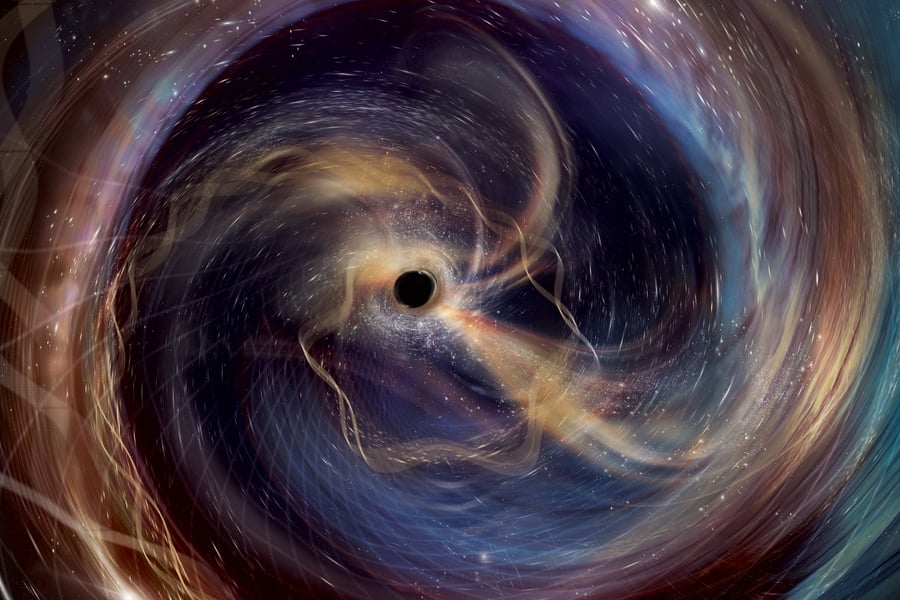
Black hole collisions are already among the most extreme events astronomers can observe. Two compact objects spiral together, merge, and leave behind a heavier remnant while sending gravitational waves across the universe. What researchers are now pulling from those signals is a more complicated story: some of the black holes involved may not be first-generation objects formed directly after massive stars died, but products of earlier mergers that went on to collide again.
That possibility, known as hierarchical merging, has been discussed for years. The latest analysis highlighted by researchers including MIT’s Salvatore Vitale and Cailin Plunkett, Williams College’s Thomas Callister, and Adler Planetarium’s Michael Zevin suggests it may be more than a theoretical edge case. Instead, repeated mergers could account for a meaningful share of the black hole collisions now being detected through gravitational waves.
The case is still statistical rather than definitive for every event, but the pattern is becoming harder to dismiss. As more detections accumulate, astronomers are moving from asking whether hierarchical growth can happen to estimating how often it does.
Why repeated mergers matter
The standard formation story is familiar: a massive star ends its life in a supernova and leaves behind a stellar-mass black hole. If two such black holes are gravitationally bound, they can eventually merge. For a long time, that was the main framework for interpreting gravitational-wave events.
Hierarchical merging adds another layer. After two black holes collide, the newly formed remnant can remain in a dense environment and later merge again with another black hole. That process can repeat, gradually building more massive objects. The scenario is thought to be most likely in especially crowded regions of galaxies, where repeated close encounters are easier to arrange.
This matters because it changes what black hole populations mean. If a nontrivial fraction of observed mergers involve second-generation black holes, then the catalog of gravitational-wave events is not just a census of stellar death. It also becomes a record of black holes interacting, growing, and recycling through multiple rounds of collision.
That would affect how astronomers interpret mass distributions, merger rates, and the environments where these events occur. It would also help explain why some black holes appear more massive or dynamically interesting than simple one-step formation models might predict.
The clue is spin
The strongest hint discussed in the latest work comes from spin. A first-generation black hole formed after a star collapses is expected to have little to no spin in many cases, because the dying star sheds a large amount of mass and angular momentum. A merger remnant, by contrast, should emerge from a much more energetic event with a clear rotational signature.
That makes spin one of the most useful markers for sorting black holes by origin. If a detected merger involves black holes whose spin properties fit the pattern expected from previous collisions, it strengthens the case that at least one member of the pair is not new to the process.
Researchers are not reading this from a single spectacular signal alone. The important development is that the growing gravitational-wave record now contains enough events to search for population-level trends. According to Plunkett, the picture emerging from the data is that a “decent percentage” of merging black holes could be coming from this repeated pathway.
That is a notable shift from earlier uncertainty. Hierarchical merging was long treated as plausible but poorly constrained. The new analysis suggests the uncertainty is narrowing toward a more consistent estimate, even if the exact proportion remains under study.
A rapidly expanding sample
Gravitational-wave astronomy is still young, but it is no longer sparse. Recent detections now number in the hundreds, giving researchers a far broader base for inference than they had in the field’s earliest years. Each new event adds more than a dramatic headline. It also refines the population statistics that can reveal whether observed black holes mostly come from isolated stellar evolution or from repeated dynamical interactions.
That cumulative effect is crucial. Black holes do not carry labels announcing whether they are first- or second-generation. Scientists have to reconstruct their histories indirectly from measurable properties, especially masses and spins, and then compare those observations against formation models.
The event identified as GW250114 is one example now drawing attention in that larger effort. But the broader significance lies in the aggregate. The more signals researchers can compare, the more confidently they can separate one-off mergers from the fingerprints of a repeated process.
In practical terms, this is one of the strengths of gravitational-wave science. The waves do not just confirm that a merger happened. They encode physical details about the objects involved and allow astronomers to test competing scenarios for how those objects came to exist in the first place.
What the emerging picture suggests
If hierarchical merging is indeed common, it would mean crowded galactic environments are playing a larger role in black hole evolution than some simpler models assume. Dense stellar systems would become not just places where black holes happen to meet, but production lines for building progressively heavier remnants.
That would also reinforce the idea that black hole populations are shaped by two linked stages: stellar birth and death on one hand, and later dynamical reshuffling on the other. A black hole’s mass and spin would then reflect both its original creation and its subsequent merger history.
Researchers are still refining how large that repeated-merger contribution is. The current result does not eliminate uncertainty, nor does it imply that most black holes have gone through multiple collisions. But it does strengthen the argument that repeated mergers are not rare curiosities. They may be a regular feature of the universe’s black hole ecosystem.
For astronomy, that is a significant conceptual shift. Black holes were once treated mainly as endpoints. Gravitational-wave observations are increasingly showing them as participants in continuing cycles of assembly. Instead of disappearing into a static catalog of remnants, some black holes may be growing through serial collisions, carrying the imprint of earlier encounters into the next one.
As observatories continue recording new gravitational-wave signals, that history should come into sharper focus. The central question is no longer just how black holes are born. It is how many times they can be remade.
This article is based on reporting by Universe Today. Read the original article.
Originally published on universetoday.com