One of the most consequential ideas about Jupiter’s ocean moon is being reconsidered
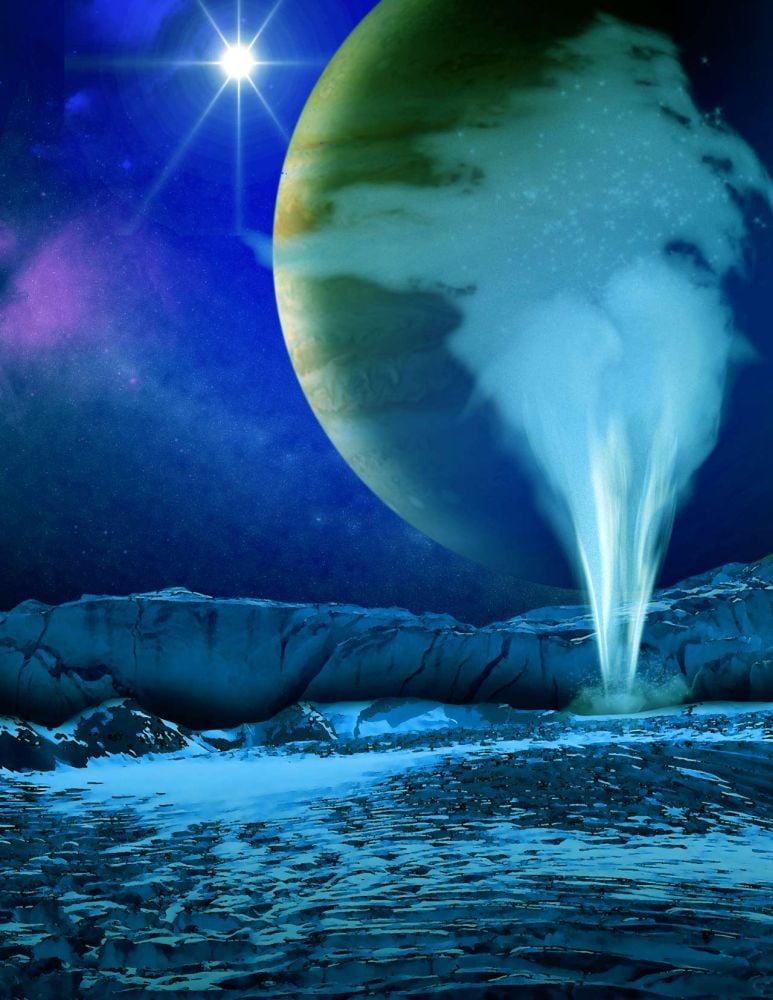
For more than a decade, Europa’s suspected water vapor plumes have shaped how scientists imagined exploring one of the Solar System’s most compelling targets for life. If jets from the moon’s buried ocean were venting into space, a spacecraft could sample that material directly without drilling through kilometers of ice.
That prospect helped turn an already fascinating world into a mission planner’s dream. But now the original research team behind the 2014 plume claim says the evidence may not hold up.
According to new work led by Lorenz Roth, the same researcher who led the initial Science paper, the Hubble Space Telescope observations once interpreted as intermittent water vapor plumes are being reconsidered. The shift does not just revise a detail. It changes the assumptions around how accessible Europa’s ocean may be from orbit.
Why the original claim mattered so much
The 2014 result was dramatic because Europa’s ocean sits beneath an ice shell that may be up to 30 kilometers thick. Sampling the ocean directly through the surface would be technologically daunting. Plumes offered a workaround.
The original interpretation suggested water vapor was escaping through fractures in Europa’s icy shell, with emissions rising roughly 200 kilometers above the surface. A second group reported additional evidence in 2016, also based on Hubble observations, though with explicit caution about possible systematic effects.
Together, those results encouraged the view that plume activity, even if intermittent, might be real and scientifically exploitable. The idea became influential enough that NASA’s Europa Clipper mission was equipped to investigate the phenomenon during future flybys.
The new reassessment
The latest research, as summarized in the source material, concludes that the Hubble detections are now looking increasingly doubtful. That is especially notable because the reassessment comes from the original discoverers rather than from an outside challenge alone.
The earlier plume claims depended on ultraviolet observations and the interpretation of faint emissions. Those kinds of observations can be powerful, but they are also vulnerable to subtle instrumental or analytical issues. The 2016 team had already noted reasons for caution even while arguing that they could not find a definitive alternative explanation at the time.
The new work suggests that caution was warranted. In effect, one of the headline observational arguments for active plumes on Europa is weakening under renewed scrutiny.
What this means for Europa Clipper
Europa Clipper is still on its way to the Jovian system and is expected to begin flybys of Europa in 2031. The mission was specifically prepared to study potential plumes if they exist. If the plumes turn out not to be real, the spacecraft’s science case does not disappear, but part of the mission’s tactical excitement changes.
Europa remains a major target because of its global subsurface ocean, chemically interesting surface, and evidence that the ice shell and ocean may interact. Clipper can still study the moon’s composition, geology, ice shell properties, and habitability potential through remote sensing and other measurements.
What may be lost is the possibility of a relatively direct sample of ocean-derived material lofted into space. That would raise the bar for interpreting any hints of ocean chemistry from the surface or near-surface environment.
A reminder about how planetary science works
The plume story is a useful example of how high-interest results evolve. Planetary science often operates with sparse data collected under difficult conditions. A provocative signal can be scientifically important even if it is provisional, because it drives new questions, new instruments, and better follow-up work.
That does not mean the original researchers were reckless. On the contrary, the source text makes clear that the early papers included caveats. The later reanalysis simply shows the self-correcting side of the process. When evidence is ambiguous, interpretation can shift as methods improve or assumptions are revisited.
That is particularly true for phenomena that are intermittent by nature. If plumes exist only occasionally, they are hard to verify. If they do not exist, patchy data can still create persuasive-looking candidates. Untangling those possibilities takes time.
The larger scientific stakes
Europa remains central to astrobiology because liquid water, energy sources, and chemical gradients may coexist there. The question is not whether the moon is still interesting. It is how reachable its most valuable information really is.
Plumes would have made Europa more accessible. Without them, researchers may need to rely more heavily on indirect evidence and on future mission concepts designed for surface contact, shallow sampling, or other more difficult forms of access.
The reassessment may also influence how scientists weigh plume claims elsewhere in the outer Solar System. Icy worlds are often discussed in terms of venting, fractures, and subsurface oceans, but each detection has to survive close technical review before becoming a reliable planning assumption.

What to watch next
The decisive test may come from spacecraft observations. Europa Clipper will not settle every question immediately, but it will provide much richer data than Earth-orbiting telescopes can deliver. If plume activity exists, even rarely, the mission may still find signs of it. If it does not, the absence of evidence across repeated flybys will become more telling.
For now, the balance has shifted from expectation to uncertainty. A feature that once seemed poised to transform Europa exploration is now back under question.
That is disappointing only if the earlier idea is treated like a promise. In scientific terms, it is something else: a high-profile hypothesis being tested against better scrutiny. Europa is still one of the most important destinations in planetary science. It just may not be handing researchers samples quite so easily.
This article is based on reporting by Universe Today. Read the original article.
Originally published on universetoday.com