A strong week for anyone looking west after sunset
Skywatchers have a compact but rewarding evening sequence ahead in the second half of May. According to Universe Today, the waxing crescent Moon will move through a bright western sky scene and pass near Venus and Jupiter on consecutive nights, producing what the publication describes as one of the best dusk sky shows of 2026.
The timing is unusually favorable because the event combines some of the sky’s easiest objects to recognize. Venus and Jupiter are already dominating the western horizon at dusk, and the Moon’s arrival provides a natural guide for observers who might not normally identify planets on their own.
That accessibility is part of the appeal. You do not need a dark-sky expedition or advanced equipment to appreciate the event. A clear western horizon and a little patience around twilight should be enough for many observers to catch the main conjunctions.
The sequence starts with a very young crescent Moon
The setup begins after the Moon passes new phase on Saturday, May 16, 2026, at 20:02 Universal Time. That marks the start of a new lunar cycle and clears the way for the slender crescent to return to the evening sky.
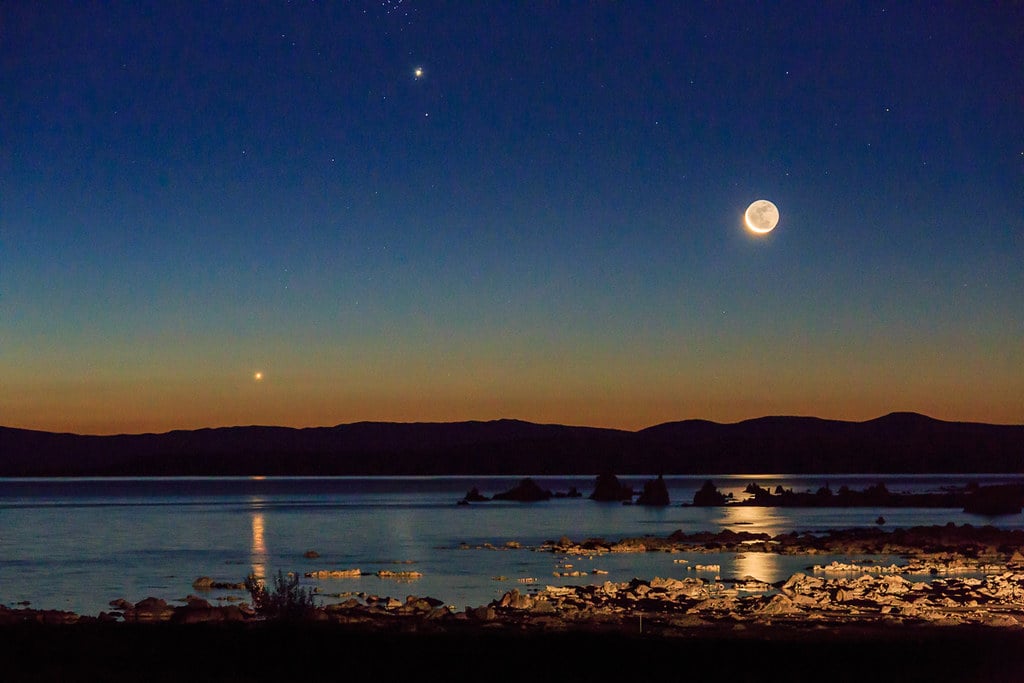
Universe Today advises watching low in the west on Sunday evening, May 17, when the crescent first becomes visible again. It should appear more prominent the following evening, May 18, as the Moon gains illumination and begins to move into closer visual company with the bright planets nearby.
For casual observers, that first reappearance can be one of the most satisfying sights of the month. A thin crescent close to the horizon often stands out sharply in fading blue twilight, especially when it is sharing the sky with bright planetary targets.

Venus gets the first pairing, then Jupiter follows
The first headline conjunction arrives as the Moon passes within 3 degrees of Venus on Tuesday, May 19, at 3:00 UT. Venus is shining at magnitude minus 4 and is described in the source as showing an 83 percent illuminated gibbous disk. The Moon, by contrast, is only about 8 percent illuminated at that stage, creating a visually dramatic pairing between a brilliant planet and a delicate young crescent.
The following evening brings the Moon’s next close pass, this time near Jupiter. Universe Today says the crescent reaches a similar separation of 3 degrees from Jupiter on Wednesday, May 20, at 15:00 UT. By then, the Moon is around 19 percent illuminated, making it easier to spot for new observers while still retaining the elegant shape that makes crescent conjunctions especially photogenic.
Together, those two evenings create the backbone of the week’s sky show. Because the conjunctions occur on consecutive nights, observers get more than a single fleeting chance. Even if local weather interferes on one evening, the broader sequence remains worth following.
Mercury and a comet add extra interest
The western scene is not limited to the Moon, Venus, and Jupiter. Mercury is also beginning to push into the dusk sky. The source notes that the planet had just passed behind the Sun from Earth’s perspective on May 14 in what the article calls an “anti-transit.” That means Mercury is early in a new evening appearance, adding another point of interest for those with especially clear horizons.
Observers in the Southern Hemisphere have an additional bonus. Universe Today notes that Comet C/2025 R3 PanSTARRS is continuing its outbound path and sliding out of Orion past Sirius at dusk. That will not be the main target for most skywatchers, but it adds another layer to an already busy seasonal sky.
Events like this are often most enjoyable because of their layering. A beginner can step outside and simply see a striking Moon-and-planet tableau. A more experienced observer can use the same evening to look for Mercury, track the Moon’s changing illumination, or follow a comet in the background sky.
Telescope users also get a Jupiter bonus
The article highlights an extra observing opportunity for telescope users in the Americas. On Friday evening, May 15, Jupiter was expected to host a double shadow transit involving Europa and Ganymede. While separate from the Moon’s conjunctions, it reinforces the fact that Jupiter is a particularly rich target this week.
That is useful context because bright conjunctions often bring people outdoors who may not have considered a closer telescopic look. A quick view of Jupiter’s disk and moons can turn a simple sunset sighting into a more memorable observing session.
Universe Today also points out that these conjunctions can help with daytime planet spotting, especially when the Moon acts as a nearby reference. Venus is identified as the easier daytime target, while Jupiter is the more challenging one. That is more of an advanced exercise, but it speaks to how bright and well placed these planets are at the moment.
Why this sky show stands out
There are brighter individual events in astronomy and rarer ones too, but this sequence has a different kind of strength. It is easy to understand, visually striking, and available to a wide audience. The Moon provides structure. Venus provides brilliance. Jupiter provides recognition value. Mercury and the comet provide extra depth for observers who want more.
It also arrives at a good seasonal moment. In the Northern Hemisphere, late-spring temperatures make casual evening observing more inviting. In practical terms, that means an event like this can reach people who may not plan dedicated astronomy sessions but are willing to step outside for a few minutes after dusk.
That combination of accessibility and visual quality is what makes a conjunction sequence memorable. You do not need to explain orbital mechanics first. The sky tells the story on its own.
What to watch for on the key nights
On May 17, look for a very thin crescent Moon low in the west after sunset. On May 18, expect an easier crescent and a fuller preview of the week’s main display. On May 19, the Moon draws closest to Venus. On May 20, it shifts on to Jupiter. Through it all, the changing crescent provides a running marker of motion night to night.
For observers willing to follow the sequence rather than only one date, that gradual change is part of the pleasure. The Moon’s movement makes the sky feel active and legible. Each evening is related to the last, but visibly different.
That is why this mid-May run deserves attention. It is not just a conjunction. It is a compact lesson in how the evening sky evolves, delivered through some of its brightest and most familiar objects.
This article is based on reporting by Universe Today. Read the original article.
Originally published on universetoday.com