A New Target for the Search for Extraterrestrial Intelligence
For most of its history, the search for extraterrestrial intelligence has meant one thing above all: listening. Radio telescopes sweep the sky for transmissions that another civilization might be sending on purpose or leaking by accident, and generations of researchers have built their work around the hope of catching a signal that stands out from the natural noise.
A newly circulated proposal argues that this approach, however productive it has been, leaves an enormous blind spot — and that the fix may be sitting in a sample of lunar soil. Instead of waiting for a message, the authors suggest, we could hunt for the physical leftovers of technological civilizations that no longer exist.
The Synchronicity Problem That Limits Radio SETI
The weakness is one of timing. Radio searches assume that another technological species is broadcasting at precisely the moment our instruments are pointed at it. The Milky Way is roughly 13 billion years old, while human radio capability spans a period measured in decades. Any civilization that rose and fell long before us — or that will arise long after our species is gone — is invisible to a radio dish, no matter how sensitive it is.
Put bluntly, hoping that our listening window overlaps with someone else's transmitting window is a considerable leap of faith. The new work proposes stepping around that coincidence problem entirely by looking for something far more durable: matter.

Inside the New Paper
The proposal comes from Lewis J. Pinault, an associated researcher at the SETI Institute, working alongside co-authors. Their paper is available as a preprint on arXiv and has been submitted to the International Journal of Astrobiology. The central claim is that artefact-based SETI — searching for objects rather than signals — deserves serious attention, and that the Moon is a promising place to conduct that search.
Why the Moon Is Described as a Garbage Collector
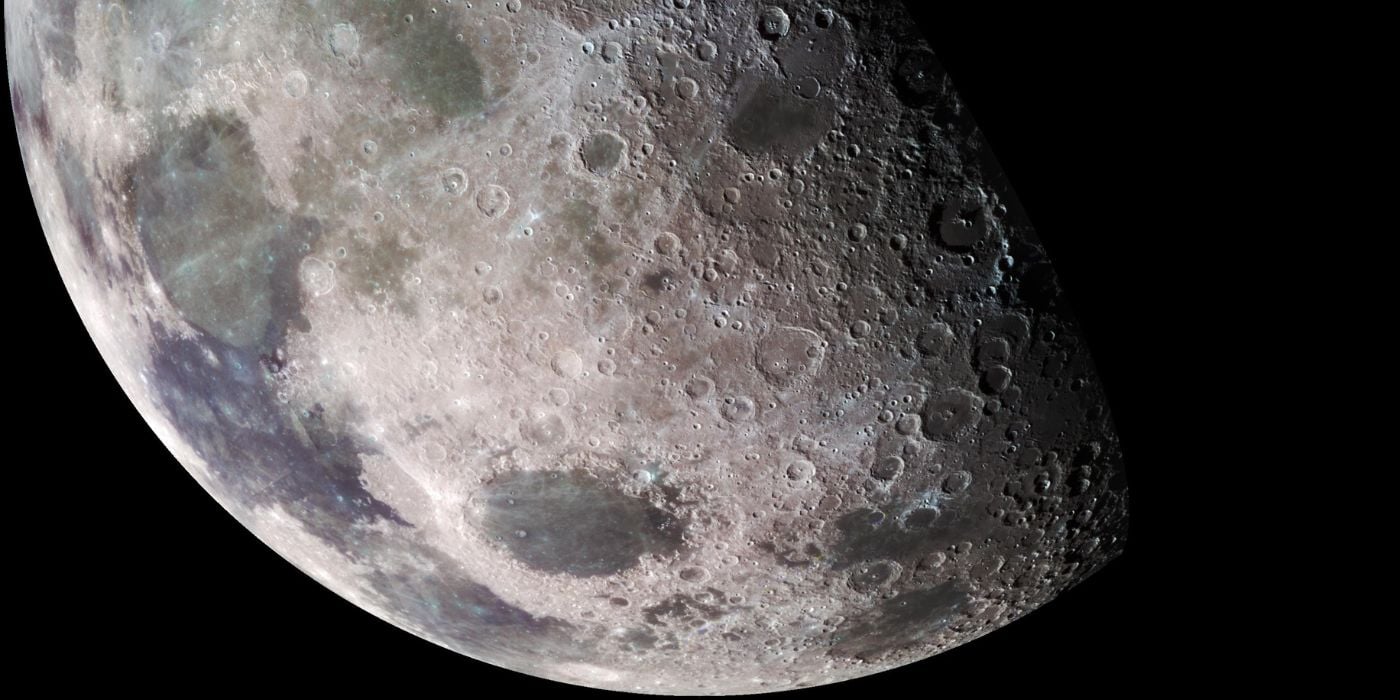
The idea sounds stranger than it actually is. The paper does not argue that aliens ever lived on the Moon, or anywhere else in the Solar System for that matter. The lunar surface matters for a different reason: it accumulates and retains what arrives there, making it an unusually effective collector of debris across extremely long stretches of time.
That reframes the Moon less as a habitat and more as an archive — a place where material from elsewhere could plausibly have settled and stayed put.

Two Categories of Alien Debris
The paper narrows the search to two distinct classes of particle.
Arkhipov Particles: Industrial Shrapnel
The first type honors Ukrainian astronomer Alexei Arkhipov, who introduced the concept in the 1990s. Arkhipov particles would be tiny fragments of unintentional industrial debris. The scenario is straightforward: a civilization constructs a Dyson swarm, a vast array of structures built around its star to capture energy. Over time, portions of that megastructure would inevitably be destroyed. Fragments from those breakups could be pushed out of their home system and eventually drift into ours.
Bracewell Particles: Deliberate Probes
The second type is named for physicist Ronald Bracewell. Bracewell particles would be dispatched on purpose, functioning as smart dust sent toward other solar systems. If any such devices were ever directed at our corner of the galaxy, the Moon is one plausible destination where they could have come to rest over the past several billion years.
Could Material Really Travel Between Star Systems?
The interstellar delivery problem is less daunting than it first appears. The Sun takes roughly 230 million years to complete a single orbit of the Milky Way, and the galaxy itself is about 13 billion years old. Our Solar System has therefore circled the galactic center many times and traveled through much of the galaxy repeatedly.
- The Milky Way is estimated to be around 13 billion years old.
- A single solar orbit of the galaxy takes roughly 230 million years.
- Over that span, the Solar System has crossed much of the galaxy again and again.
- Debris ejected from other systems has had abundant opportunities to intersect our path.
In other words, the raw geometry of galactic motion makes the arrival of foreign material a plausible long-term outcome rather than a fringe impossibility.
Why a Physical Find Would Matter So Much
An artefact sidesteps the synchronicity problem that haunts radio searches. A fragment of alien industry or a dormant probe does not need its creators to still be alive, nor does it need to be transmitting. It simply needs to exist, and to be recognized for what it is. Evidence of a civilization that vanished a billion years ago would still count as evidence.
That reframes the field. SETI becomes partly an archaeological enterprise, in which the guiding question shifts from who is talking to what they left behind.
The Hard Part: Recognition and Contamination
The practical obstacles are formidable. Distinguishing an exotic particle from ordinary planetary or meteoritic material would demand extraordinary care, and the lunar record is not pristine — decades of human activity and prior missions complicate any claim about a sample's origin.
It is also worth stressing what the paper does not claim. No alien particle has been found. This is a proposal about where to look and what to look for, published as a preprint and submitted for peer review, not a report of a discovery.
A Shift in Strategy, Not a Guarantee
Even so, the argument has an appealing internal logic. Radio SETI bets on a coincidence of timing. Artefact SETI bets on the persistence of matter — and the Moon, which has been gathering whatever reaches it for eons, is among the more accessible places to test that bet.
If the idea gains traction, the next phase of the search for alien intelligence may involve laboratories and sample analysis as much as telescopes and antennas. The aliens, if they ever existed, may have left their calling card not in the sky but underfoot.
This article is based on reporting by Universe Today. Read the original article.
Originally published on universetoday.com