A Pre-Dawn Comet, Caught in Motion
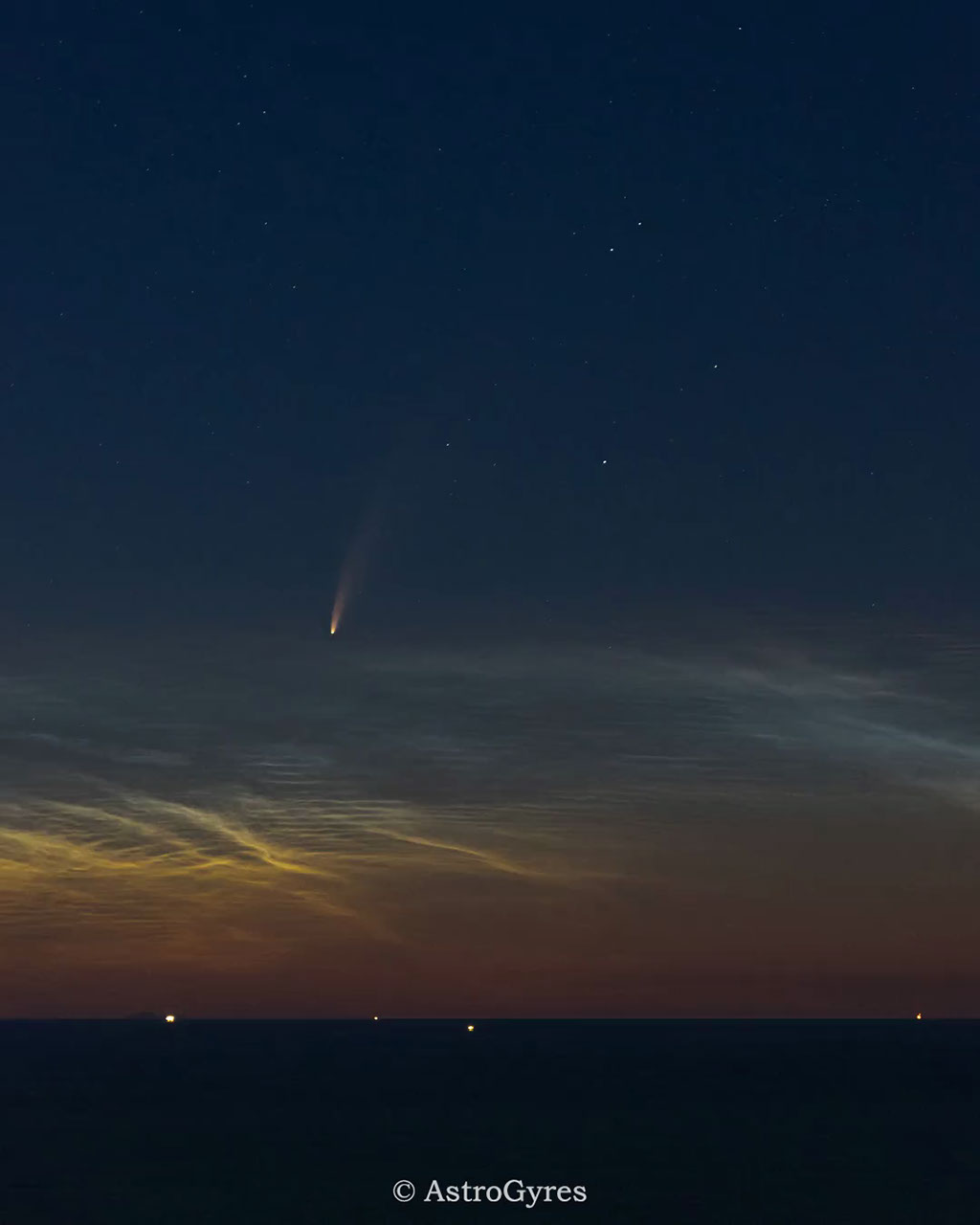
NASA's Astronomy Picture of the Day for September 13, 2026 revisits a morning on the Italian coast when Comet C/2020 F3 (NEOWISE) climbed out of the Adriatic Sea and into the frame of a photographer who had set an alarm for the occasion. The featured entry, credited to Paolo Girotti, is a time-lapse video rather than a single still image, and that choice suits the subject. A comet's story is a story about movement: the brightening as it nears the Sun, the drift of its tails, the slow way it inches above a horizon while the sky behind it shifts in color.
APOD's accompanying explanation frames the sighting as having taken place just over four years before the text was written. The photographer was up before sunrise on July 8, and the resulting footage is described as a dramatic capture of one of the few comets bright enough to be seen without optical aid this century. The object is characterized as an inner-Solar System intruder that came to be known as the Great Comet of 2020.
Inside the Time-Lapse: 240 Frames Across 30 Minutes
The construction of the video is nearly as interesting as the view itself. According to APOD, the sequence combines more than 240 separate images recorded over a span of roughly 30 minutes. Compressing half an hour of real time into a short clip creates the impression that the comet is rising at an impossible speed, but every frame is a genuine exposure of a genuinely changing sky.
Layered into that sequence are several distinct planes of interest:
- Comet NEOWISE itself, climbing away from the Adriatic horizon as seen from Italy.
- A foreground of bright, undulating noctilucent clouds, moving enough to register across the sequence.
- A background of distant stars holding steady while the comet rises through them.
- More than 240 individual exposures stitched into a single continuous motion study.
- About 30 minutes of elapsed pre-dawn time squeezed into one short video.
Together, those elements turn a brief window of darkness before sunrise into something closer to a portrait of the comet's behavior than a snapshot of its appearance.

Noctilucent Clouds in the Foreground
APOD's description singles out the noctilucent clouds that fill the lower part of the frame, calling them bright and undulating. That layering supplies much of the footage's texture. Noctilucent clouds occupy a far higher altitude than ordinary weather clouds, which is why they can continue catching sunlight long after the ground beneath them has fallen into shadow. They are, in effect, a twilight phenomenon, and the pre-dawn hours that comet hunters favor are exactly when they tend to reveal themselves.
Placing that luminous, rippling layer between the camera and the comet adds depth that a clean sky would lack. The eye reads the scene in stages: the textured clouds nearest to the viewer, the comet rising behind them, and the fixed stars farthest out.
The Comet That Refused to Fade
What made NEOWISE memorable was not a single brilliant night but its staying power. The APOD explanation notes that the comet remained unexpectedly bright for more than a month, far longer than a brief flare of activity would have suggested. Its ion tail and dust tail were observed to emanate from a nucleus spanning roughly five kilometers across.
Five kilometers is modest measured against the giants of the Solar System, which is part of why the comet's extended performance caught observers off guard. A body of that scale can produce a long, elaborate tail when it is shedding material under solar heating, but sustaining naked-eye visibility for weeks requires a favorable combination of geometry, activity and viewing conditions. NEOWISE delivered all three, and northern sky enthusiasts awake in the early hours reaped the benefit.
Why APOD Is Moving
The page carrying this image also announces a housekeeping change that regular readers will want to note. APOD's main NASA site is being relocated from apod.nasa.gov to science.nasa.gov/apod, a shift that consolidates the long-running feature within NASA's broader science web presence.
The daily entry credits its authors and editors, Robert Nemiroff, Jerry Bonnell, Cecilia Chirenti and Keighley Rockcliffe, and is described as a service of ASD at NASA's Goddard Space Flight Center, NASA Science Activation and Michigan Technological University.
Reading APOD as a Daily Record
Beyond the individual photograph, each entry functions as an entry point into a deep catalog. The site offers an archive of past images, a submissions channel, an index, a search tool and a calendar, along with an RSS feed for readers who prefer to receive the picture of the day automatically. The stated mission is unchanged: to feature a different image or photograph of the universe each day, paired with a brief explanation written by a professional astronomer.
Position within the sequence gives each entry extra context. Yesterday's APOD was titled "Apollo 11: Catching Some Sun," while tomorrow's is listed simply as "open space." A random APOD generator lets visitors skip the calendar entirely and surface an image from any point in the project's history.

The Takeaway
Comet NEOWISE belongs to a small group of objects that have crossed the threshold from astronomical curiosity to something a casual observer could walk outside and actually see. That threshold is crossed rarely. The APOD video captures one of those crossings in a way a still frame cannot, letting a viewer watch the comet climb, the clouds churn and the stars hold their positions across 30 compressed minutes.
For anyone who missed the comet's run, the time-lapse is a second chance at the experience. For those who remember standing outside before dawn, it is a reminder of why the alarm was worth setting.
This article is based on reporting by science.nasa.gov. Read the original article.
Originally published on science.nasa.gov