Vega-C sends two climate watchers into orbit
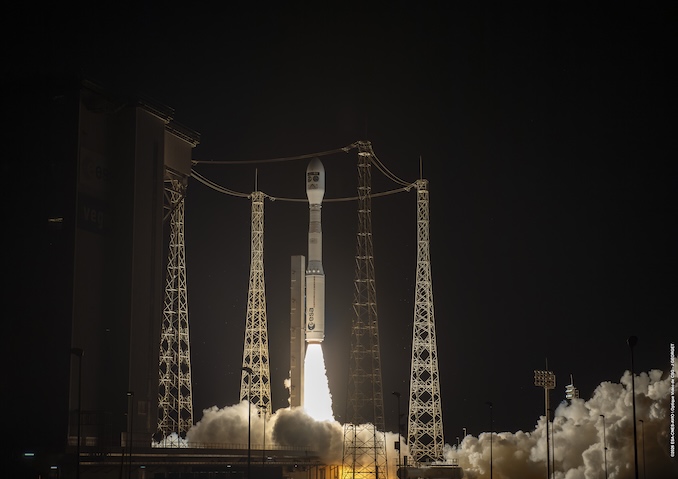
An Avio Vega-C rocket climbed away from Europe's Spaceport in French Guiana on the night of 14-15 September, carrying a pair of European spacecraft built to sharpen the planet's picture of its own vegetation, oceans and atmosphere. The mission, flown under the designation VV30, was the eighth flight of the Vega-C vehicle and its second of 2026.
Liftoff from the Ensemble de Lancement Vega pad took place at 10:21 p.m. local time on 14 September, which corresponded to 0121 UTC and 3:21 a.m. CEST on 15 September. Riding inside the launcher's fairing were two passengers with distinct but complementary assignments: Copernicus Sentinel-3C, managed by the European Organisation for the Exploitation of Meteorological Satellites (EUMETSAT), and FLEX, the Fluorescence Explorer, managed by the European Space Agency.
Roughly an hour after leaving the ground, Sentinel-3C separated from the AVUM+ upper stage — one hour and 49 seconds into the flight, to be precise — and its signal was acquired minutes later. FLEX was released nearly an hour after that, with ground stations confirming contact shortly after deployment. ESA reported that both satellites were in orbit and healthy, clearing the way for their commissioning phases to begin.
A milestone for Avio as prime launch operator
The flight carried significance beyond its payloads. VV30 was only the second Vega-C launch managed solely by the Italian company Avio, rather than jointly with Arianespace. That shift matters for Europe's launch sector, which has been restructuring how its rockets are sold, managed and operated.
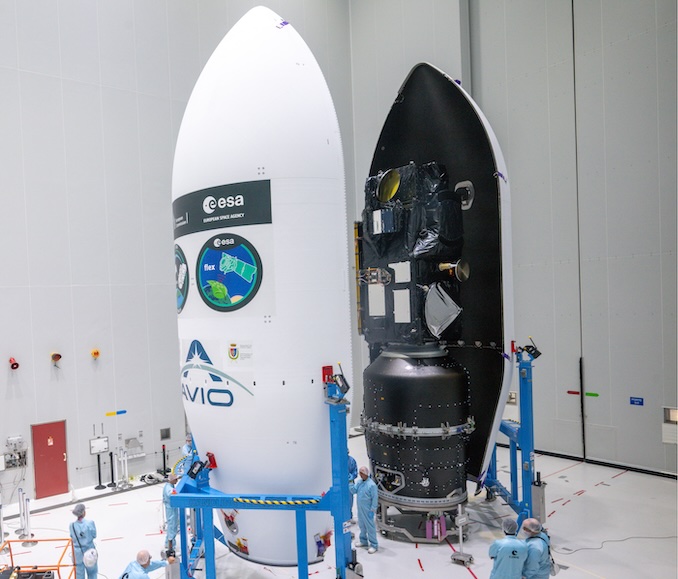
Giulio Ranzo, Avio's chief executive, said the outcome confirmed his company's standing as a dependable launch service operator, describing the rocket's performance as flawless and noting that it delivered two satellites of strategic importance to Europe. He framed the mission as evidence of how thoroughly space technology has become woven into efforts to confront environmental and climate challenges, adding that the spacecraft will supply data that improves understanding of the planet. The Vega-C itself stands 34.8 meters (114.2 feet) tall and flies in a four-stage configuration.
Sentinel-3C: eyes on the seas and skies
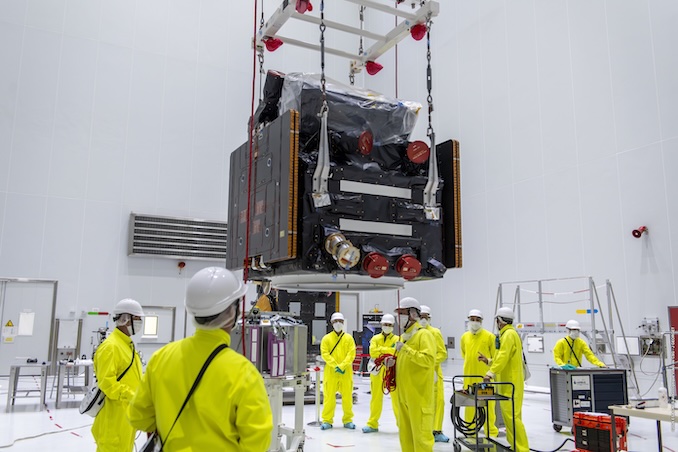
Sentinel-3C was the first payload released and the heavier of the two, tipping the scales at 1,143 kilograms (2,513 pounds). It is the third spacecraft in the Sentinel-3 series, separated from the AVUM+ upper stage one hour and 49 seconds after liftoff, and acquired by tracking stations minutes afterward.
According to EUMETSAT, the Sentinel-3 satellites are built to return high-accuracy optical, radar and altimetry measurements. Those three categories of data underpin the series' reputation as a workhorse for environmental monitoring, and they explain why the spacecraft is described as serving both ocean and atmosphere observation. Its measurements are intended to feed operational services that depend on consistent, long-running records of the planet's surface and atmosphere.
Where Sentinel-3C fits in the series
- It is the third satellite in the Sentinel-3 line, continuing a record already established by its predecessors.
- It pairs optical, radar and altimetry sensing to observe oceans and the atmosphere.
- It flies under EUMETSAT management, with data aimed at long-term environmental monitoring.
FLEX: reading plant health from orbit
The second spacecraft deployed is a different kind of observatory. FLEX, short for Fluorescence Explorer, is an ESA-managed mission dedicated to monitoring the health of vegetation. Its name points to the technique at its core: observing the faint fluorescence that plants emit, a signal that carries information about how vegetation is functioning.
Where Sentinel-3C contributes sustained measurements of oceans and the atmosphere, FLEX concentrates on the land surface and the living cover on it. ESA has framed the pairing as advancing understanding of Earth's vegetation while supporting continued monitoring of the oceans — two strands of environmental observation that rarely travel together on a single launch.
Flight timeline at a glance
- Liftoff: 10:21 p.m. local time on 14 September (0121 UTC; 3:21 a.m. CEST on 15 September).
- Sentinel-3C separation: one hour and 49 seconds after liftoff, from the AVUM+ upper stage.
- Sentinel-3C signal: acquired minutes after separation.
- FLEX deployment: nearly an hour after Sentinel-3C was released.
- FLEX signal: confirmed shortly after deployment, with ESA reporting both spacecraft healthy.
What happens next
With both satellites safely in orbit and communicating, attention turns to commissioning — the period in which each spacecraft's systems, instruments and ground links are checked out before routine operations begin. Only after that process concludes will the missions start returning the steady streams of data their operators and users expect.
For Sentinel-3C, that means taking up its place alongside the earlier satellites of the Sentinel-3 series in EUMETSAT's monitoring architecture. For FLEX, it means the start of a campaign to observe vegetation fluorescence from orbit, adding a new dimension to how Europe tracks the health of plant life across continents.
Europe's Earth observation push
The VV30 mission illustrates a pattern in Europe's Earth Observation Programmes: institutional science missions and operational monitoring satellites sharing a ride to orbit, launched by a European rocket from European soil in South America. ESA characterised the two spacecraft as jointly capable of deepening knowledge of vegetation while sustaining ocean monitoring.
That combination — an ESA Earth Explorer alongside a Copernicus Sentinel — reflects the breadth of the continent's environmental ambitions, from food and forestry to marine and atmospheric science. It also places a spotlight on Avio, whose solo stewardship of Vega-C flights is now a defining feature of how these satellites reach space. If VV30's clean performance holds as the pattern, Europe's spaceport has another reliable route to orbit for the climate-monitoring fleet it is steadily assembling.
This article is based on reporting by Spaceflight Now. Read the original article.
Originally published on spaceflightnow.com