A distant blazar revealed a problem much closer to home
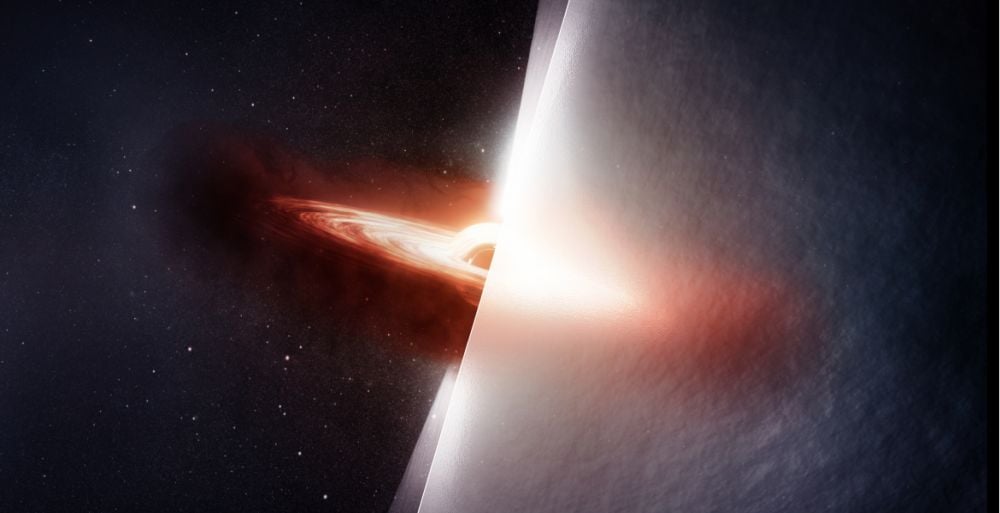
Astronomers studying a blazar roughly 10 billion light-years away have found that some of the distortion in its radio signal is caused not by material near the source, but by turbulence inside the Milky Way itself. The finding gives researchers a clearer picture of how our galaxy’s interstellar medium interferes with precision radio observations, including attempts to image the environment around the Milky Way’s central black hole.
The work, reported by researchers at the Center for Astrophysics | Harvard & Smithsonian and collaborators, focuses on the quasar TXS 2005+403 and was published in The Astrophysical Journal Letters.
Two kinds of scattering, one difficult to separate
Radio signals from distant active galactic nuclei can be altered in more than one way before they reach Earth. Astronomers already understand that plasma near a source can create diffractive scattering, which broadens and blurs the signal. That effect has been studied with very long baseline interferometry, or VLBI, which combines observations from radio telescopes separated by thousands of kilometers.
The harder challenge is refractive scattering, a subtler distortion caused by intervening turbulent material. In this case, the researchers say the Milky Way’s interstellar medium is adding fine-scale substructure that further blurs the signal from the distant blazar.

Why TXS 2005+403 matters
The quasar used in the study turned out to be unusually useful because it is bright, heavily scattered, and already broadened by plasma close to the source. That makes it a good probe for teasing out the added imprint of turbulence within our own galaxy. In effect, the object becomes a background beacon that allows astronomers to map what the Milky Way is doing to the light passing through it.
That matters because observations of compact, bright radio sources depend on understanding what part of an image belongs to the source and what part has been smeared out by the medium between the source and the observer.
A better handle on the Milky Way’s interference
The researchers say the discovery identifies exactly how turbulence in the interstellar medium affects images. That is especially important for work near the limits of angular resolution, where tiny distortions can materially affect what astronomers think they are seeing.
Radio VLBI already offers the highest angular resolution in astronomy, but that power comes with sensitivity to propagation effects. If the galaxy’s own gas and turbulence are creating additional blur, then astronomers need to model that blur carefully before drawing conclusions about extreme objects such as black holes, jets, or compact galactic nuclei.
Implications for black hole imaging
One of the practical implications flagged in the source material is future imaging of the Milky Way’s supermassive black hole. Efforts to sharpen those views depend not only on better instruments, but also on a better understanding of the foreground distortion imposed by our own galaxy.
In that sense, the study is less about a single exotic quasar than about calibration. By learning how local turbulence reshapes incoming radio waves, astronomers can refine the correction tools needed to recover cleaner images of distant and compact phenomena.
A reminder that astronomy is also about the medium
It is easy to think of astronomy as a discipline focused entirely on distant targets, but this result shows how often the decisive variable lies in the space between. Light and radio waves do not arrive untouched. They carry the imprint of every medium they cross, including the diffuse and turbulent material spread through the Milky Way.
That makes the interstellar medium more than background scenery. It is an active part of the measurement problem, and in some cases a source of valuable information in its own right.
What comes next
As radio astronomy pushes toward even finer resolution and more ambitious black hole imaging, researchers will need similar probes to map scattering across different sight lines. The more precisely they can separate intrinsic structure from galactic distortion, the more confidently they can interpret what they see.
The TXS 2005+403 result advances that effort by showing that the Milky Way’s turbulence leaves a measurable, direct imprint on quasar light. For astronomers, that is both a complication and an opportunity.
This article is based on reporting by Universe Today. Read the original article.
Originally published on universetoday.com