A decades-old Mars debate gets a new geological answer
Scientists have long argued over whether Mars once held a vast ocean across much of its northern hemisphere. One of the biggest problems has been the missing shoreline. Researchers expected that a large stable ocean would leave behind something like a bathtub ring: a level, clearly traceable boundary showing where the water once stood. Instead, the possible Martian shorelines that have been identified appear distorted by several kilometers in elevation.
A new paper in Nature, described by Universe Today, argues that this may have been the wrong feature to prioritize. Rather than searching for a crisp shoreline, researchers Abdallah Zaki and Michael Lamb of Caltech suggest scientists should have been looking for a continental shelf.
The shelf hypothesis
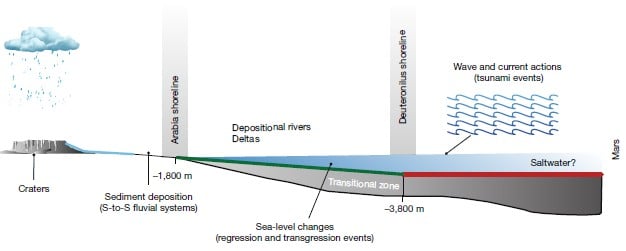
On Earth, the most prominent large-scale feature of an ocean margin is not the visible shoreline but the low-gradient coastal plain and continental shelf beneath the water. According to the report, the researchers compared slope patterns on Earth and Mars and found what they describe as an almost exact flat-zone match on Mars between roughly -1,800 and -3,800 meters in elevation.
The scale of the feature is striking. The shelf-like region covers 10.2 million square kilometers, or nearly 7% of the Martian surface. That alone would make it one of the most consequential pieces of geological evidence yet proposed in the long-running ocean debate.
The argument is strengthened by where other clues appear. The source says that many known deltas found by rovers and orbiters sit within this zone. Two putative shorelines known as Arabia and Deuteronilus also lie inside it, and thick accumulations of layered rocks and clays are concentrated there as well. Those materials are associated with long-lived water.
Why the shorelines look warped
The distorted shoreline problem has haunted the ancient-ocean hypothesis for years because a stable body of water should not leave a margin that varies dramatically in elevation. Several explanations had been proposed. One was true polar wander, in which shifts in a planet’s mass distribution alter its orientation and deform surface features. Another suggested that the huge volcanic rise around Tharsis bent the planet’s crust while the ocean still existed.
The new study points to a simpler explanation. Without plate tectonics to recycle crust, Martian deltas and shoreline deposits could have accumulated and altered the visible margin over time. In that interpretation, the obvious shoreline became a misleading target, while the broader shelf geometry preserved the stronger signal.
If that is correct, the failure to find a neat bathtub ring was never decisive evidence against an ocean. It may have reflected an Earth-based intuition applied too literally to a planet with different geological rules.
A better way to read Mars
The shelf idea matters because it reframes how scientists look for ancient environments on other worlds. Instead of asking whether Mars preserved a familiar coastline, the question becomes whether its topography records a broad marine transition zone. That is a more subtle but potentially more robust geological signature.
It also helps tie together several lines of evidence that have often been discussed separately: deltas, clays, layered sedimentary deposits, and candidate shorelines. By placing them inside a single shelf-like region, the study offers a coherent framework rather than a collection of suggestive but disconnected observations.
Why this matters beyond a map debate
The existence of a large ancient ocean on Mars would have implications for climate history, sediment transport, and the long-term habitability of the planet. Long-lived water environments are among the most important targets in the search for past life because they provide time and stability for chemistry, sediment deposition, and potentially biology.
This new work does not close the case on its own, but it changes the terms of the argument. The absence of a textbook shoreline has often been treated as a major weakness in the ocean hypothesis. The shelf model suggests that Mars may have preserved a different, and perhaps more revealing, record of its watery past.
If future work supports the interpretation, one of Mars science’s most persistent puzzles may turn out to have a straightforward answer. The red planet did not fail to keep an ocean’s trace. Scientists may simply have been looking for the wrong shape.
This article is based on reporting by Universe Today. Read the original article.
Originally published on universetoday.com