A new kind of world has moved from speculation to confirmation
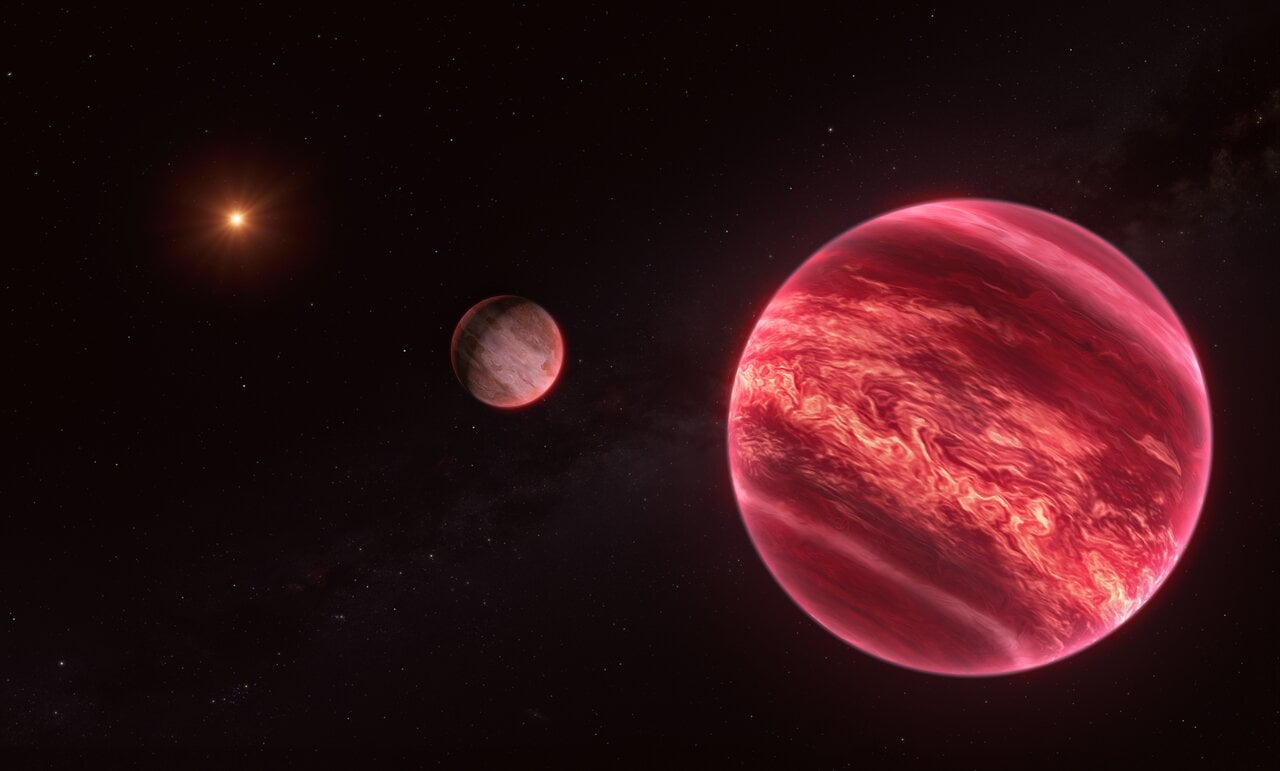
Astronomers have confirmed what is described as the first exo-satellite: a moon-like object outside the Solar System orbiting a larger companion in another star system. The finding centers on CD-35 2722, a red dwarf star about 70 light-years away, and on a strange hierarchy of bodies that does not fit neatly into the usual categories of star, planet, and moon.
According to the reported observations, the main companion to the star, known as CD-35 2722b, has a mass estimated between 29 and 38 times that of Jupiter. That places it in brown dwarf territory. Brown dwarfs are often described as occupying the murky middle ground between stars and planets: too small to sustain hydrogen fusion like stars, but massive enough to blur the conventional picture of what a planet is.
The newly confirmed companion to that brown dwarf appears to be about the mass of Jupiter. In other words, astronomers are not talking about a tiny, cratered moon in the style of the Solar System’s smaller satellites. They are describing a giant object orbiting another giant object, with both of them ultimately bound to a star.
Why this system is hard to classify
The reason this result stands out is not only that it adds a new body to an extrasolar catalog. It forces a closer look at the labels astronomy uses when the architecture of a system becomes less familiar than the Sun and its planets.
In the broadest sense, the standard framework is simple: stars shine, planets orbit stars, and moons orbit planets. But nature does not always organize itself so cleanly. Brown dwarfs already complicate the picture because they sit between stars and planets in mass and physical behavior. An object orbiting one of them can look moon-like dynamically, but planetary in size.
That is the case here. If a Jupiter-mass object orbits a brown dwarf, should it be called a moon because of what it orbits? Should it be called a planet because of its size and likely physical structure? Or does the system need a more specialized term that reflects the fact that brown dwarfs are not comfortably planets or stars?
The reported answer, at least for now, is to call it an exo-satellite: an extrasolar satellite orbiting a substellar body. The term is useful because it describes the relationship without pretending the classification problem is fully settled.

How astronomers found it
The host star, CD-35 2722, is an M-type red dwarf. Researchers first detected that it wobbles periodically, indicating the gravitational pull of a companion. From that motion, they estimated that the companion, CD-35 2722b, falls in the brown dwarf mass range.
That brown dwarf is also close and bright enough relative to its surroundings to be directly imaged with the European Southern Observatory’s Very Large Telescope. More recent spectral observations then showed that the brown dwarf itself has a regular wobble. The best estimate from that signal points to an orbiting body with roughly Jupiter’s mass.
That two-step wobble matters. It means astronomers are not simply inferring an unusual system from one indirect clue. They have a star whose motion reveals a brown dwarf companion, and a brown dwarf whose own motion reveals a still smaller companion. That layered evidence is what elevates the object from a theoretical possibility to the first confirmed example in this class.
What the discovery changes
The immediate significance is conceptual. Astronomers have long expected that bodies orbiting brown dwarfs should exist, especially because brown dwarfs span a wide range of temperatures, masses, and physical appearances. Some resemble undersized stars. Others may look far more like oversized planets. A system like CD-35 2722 shows that those expectations were well founded.
But the finding also matters because it widens the map of where complex planetary-style systems can form. If brown dwarfs can host giant satellites, then the architecture of planetary systems may be broader than the star-planet-moon template suggests. Bodies can assemble in nested layers around substellar objects, and those layers may turn out to be common rather than exceptional.
The report also points to a longer-term implication: some exo-satellites around brown dwarfs could fall within the habitable zone of the broader star system. That does not mean the newly confirmed object is habitable. It is roughly Jupiter-sized, and no claim like that is being made here. But it does mean these systems may eventually matter in the search for environments where temperatures permit liquid water.

A reminder that definitions in astronomy are tools, not laws of nature
The discovery arrives against the backdrop of older classification disputes, especially the long-running debate over Pluto and the boundaries between planets, dwarf planets, and moons. Those arguments often seem semantic, but they become scientifically important when categories begin to obscure as much as they explain.
CD-35 2722’s newly confirmed exo-satellite shows why. A giant object orbiting a brown dwarf is real whether astronomers call it a moon, a planet, or something else. The challenge is to use terms that accurately describe formation, orbital dynamics, and physical properties without forcing every unusual system into a Solar System-derived template.
That is likely to become more important as instrumentation improves. Better direct imaging, more precise radial velocity measurements, and more detailed spectral studies will almost certainly reveal additional systems that sit between familiar bins. Brown dwarfs, in particular, are promising places to look because they naturally blur boundaries that astronomy once treated as sharper than they are.
What to watch next
The key next question is whether CD-35 2722 is the first confirmed exo-satellite because such systems are truly rare, or simply because technology has only recently become good enough to identify them with confidence. If more are found, researchers will be able to compare their masses, orbits, and host brown dwarfs to determine whether this system is typical or an outlier.
Either result would be useful. A rare configuration would tell astronomers something important about formation pathways around brown dwarfs. A growing catalog would point to a previously underexplored population of extrasolar systems with their own internal structure and evolutionary history.
For now, the most important shift is straightforward: the catalog of known worlds has gained a category that was once hypothetical. The first confirmed exo-satellite does more than add one more distant object. It exposes how much of the universe still sits between the labels humans prefer to use.
This article is based on reporting by Universe Today. Read the original article.

Originally published on universetoday.com