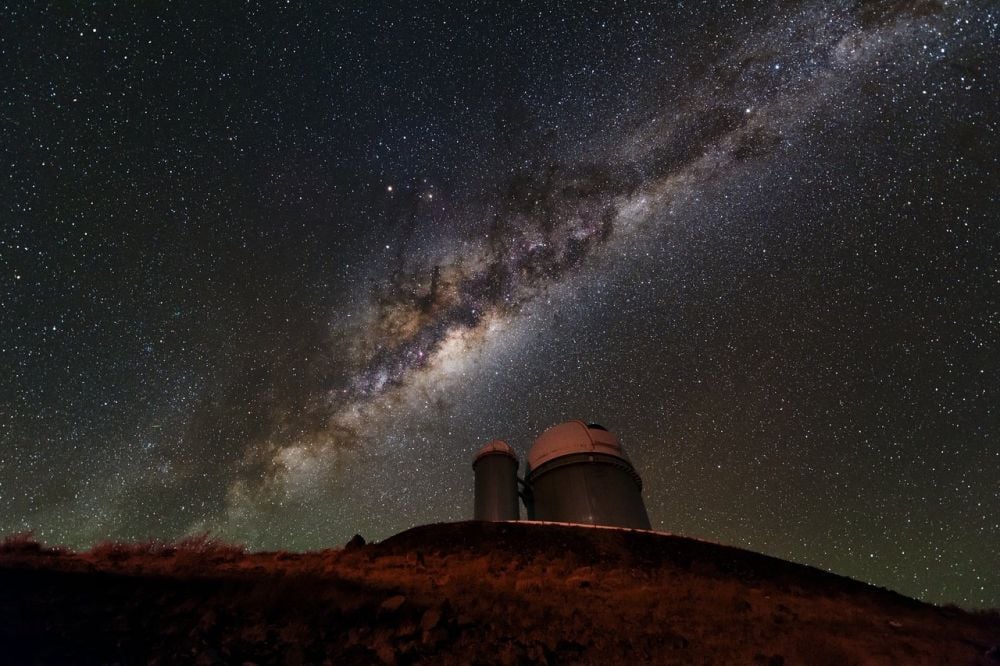
An old puzzle about our galaxy may have a violent answer
The Milky Way’s structure looks familiar from afar: a bright spiral disk filled with stars, gas, and dust. But the closer astronomers look, the more the galaxy reveals a layered and turbulent history. One longstanding puzzle is why the Milky Way has two disk structures that behave so differently. Its thin disk contains most of the younger stars and rotates in the orderly way people tend to associate with spiral galaxies. Its thick disk, populated by older stars, rotates much more slowly. New research presented at the Royal Astronomical Society’s National Astronomy Meeting in Birmingham argues that an ancient cosmic flip may explain why.
According to the supplied report, the work was led by Kirill Batrakov of Durham University and used the Auriga simulations, a set of cosmological zoom simulations designed to study how galaxies form. These simulations model the growth of galaxies from shortly after the Big Bang while accounting for major ingredients such as gravity, dark matter, black holes, and supernovae. By comparing possible evolutionary histories, the researchers concluded that a major past merger could have flipped the orientation of the Milky Way’s disk billions of years ago, leaving behind the mismatched rotation patterns astronomers observe today.
The result is notable because it connects a present-day structural oddity to the Milky Way’s merger history, one of the main ways galaxies grow and change over cosmic time. Astronomers already know that galaxies merge and interact frequently. Observations across the universe show examples at many stages, from close encounters to full absorption. The Milky Way itself bears scars of that history. Yet even with increasingly detailed surveys, turning those scars into a coherent timeline remains difficult. Research like this matters because our galaxy is both complex and unusually accessible: we live inside it, which makes it harder to see as a whole but easier to study in fine detail.
What Gaia revealed about the Milky Way’s two disks
The modern version of this puzzle sharpened with data from the European Space Agency’s Gaia mission, which observed billions of stars in the Milky Way. Gaia showed that the thick disk rotates much more slowly than the thin disk. That is surprising because both components are part of the same galaxy, yet they preserve very different orbital behavior. The source text describes the thick disk as containing older, metal-poor stars that follow more eccentric, chaotic orbits, while the thin disk contains younger stars and makes up the familiar spiral structure.
Those differences have long hinted at a merger-driven origin. Stars in the thick disk are often interpreted as evidence of ancient interactions with other galaxies, including stars that formed elsewhere and were later absorbed by the Milky Way. But explaining exactly how those mergers translated into the current rotation pattern has been harder. A slower-spinning thick disk is not just a decorative detail. It is a clue to how the galaxy settled, was disturbed, and reorganized itself over billions of years.
The new simulation-based explanation is that a major merger did more than simply add stars. It may have reoriented the galactic disk itself. In that scenario, an incoming galaxy or merger event was powerful enough to change the alignment of the Milky Way’s structure, effectively flipping the disk relative to the older stellar population. The younger thin disk then formed or re-formed in the new orientation, while the older thick disk retained evidence of the earlier configuration and the violent transition between the two.

Why simulations matter here
Because astronomers cannot run experiments on galaxies, simulations are one of the few ways to test whether a proposed history can realistically produce the structures seen today. The Auriga suite is especially useful for this kind of problem because it follows galaxy formation over long spans of cosmic time and includes multiple physical processes that shape galactic evolution. That does not make any single simulation a direct replay of the Milky Way’s past. What it provides is a physics-based set of plausible histories that can be compared against observation.
In this case, the appeal of the new work lies in how it links a specific observed fact, the slow rotation of the thick disk, to a specific class of past event, a major merger that altered the galaxy’s orientation. The explanation is also conceptually economical. Rather than treating the thin and thick disks as only loosely related components, it frames them as records from different phases of the same galaxy before and after a disruptive reconfiguration.
That idea fits a broader trend in astronomy, where the Milky Way is increasingly understood not as a quiet, steadily evolving spiral but as a system shaped by repeated interactions. The galaxy’s halo, stellar streams, and chemically distinct populations already tell a story of assembly through accretion. A disk flip would add another dramatic chapter, one that helps explain why some of the galaxy’s oldest stars move in ways that seem out of step with the orderly disk visible today.
A better history of our own galaxy has wider value
One reason this research draws attention is that the Milky Way is a critical testbed for galaxy formation more broadly. The supplied source quotes Batrakov saying that because we live inside the Milky Way, astronomers can study it in more detail than any other galaxy, making it central to wider understanding. That is the real significance of resolving puzzles like the two-disk problem. The answer is not only about local galactic archaeology. It feeds back into how scientists interpret spiral galaxies everywhere else.
If mergers can flip disks and leave behind long-lived kinematic signatures, astronomers may be able to look for similar patterns in other systems. That could improve reconstructions of when galaxies absorbed companions, how quickly they rebuilt organized disks afterward, and how common these dramatic reorientations really are. It could also refine the role that mergers play in shaping stellar populations, metallicity gradients, and halo structure.
For now, the new work remains a simulation-based interpretation presented at a major astronomy meeting, not the final word on the Milky Way’s history. But it offers a compelling framework for a stubborn problem. The galaxy’s thick disk has long looked like an archive of ancient disruption. The new analysis suggests that disruption may have been even more profound than previously thought: not just a collision that stirred old stars, but an event that changed the orientation of the galaxy itself.
That is part of what makes the result so arresting. The night sky often gives the impression of permanence. Yet the deeper story of the Milky Way is one of upheaval, assembly, and recovery. If this interpretation holds up, the galaxy around us may once have been turned on its side by an ancient merger and then rebuilt into the spiral home we know today.
This article is based on reporting by Universe Today. Read the original article.
Originally published on universetoday.com