Martian dust storms may pose a more complex threat than planners assumed
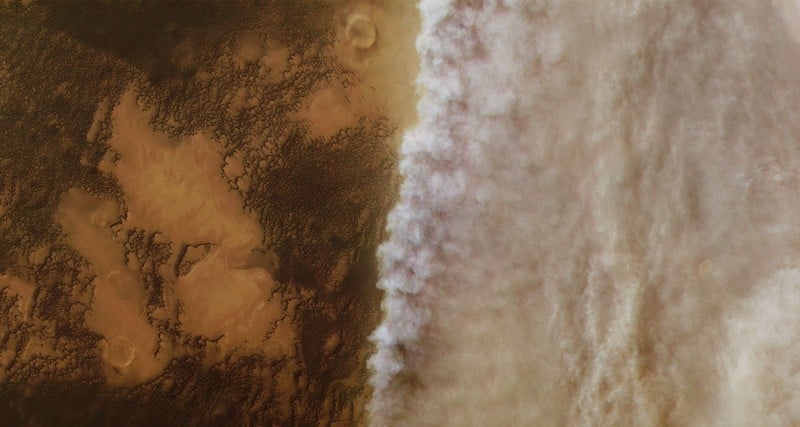
Global dust storms on Mars have long been treated as a major operational problem because they can dim sunlight, cut visibility and disrupt surface activity for weeks or longer. New research now points to another layer of risk: these storms may also create electrically charged conditions in the lower atmosphere, potentially adding an electrostatic hazard to future robotic and human missions.
The study, published in The Planetary Science Journal and described in the source report, comes from researchers at the University of Alabama in Huntsville and NASA’s Marshall Space Flight Center. Using atmospheric data tied to Mars Year 34, the team examined the planetwide dust storm that unfolded in mid-2018 and found that the lower Martian atmosphere could produce electric fields under what the authors call breakdown-favorable conditions.
That phrase is important. The researchers are not claiming to have demonstrated direct damage to a specific rover, habitat or communication system. Instead, they are identifying environmental conditions that deserve much closer engineering attention. In practical terms, the work argues that mission planners should stop thinking about major dust storms only as weather and visibility events. They may also be electrostatic events with consequences for equipment, operations and safety.
Why Martian dust already worries mission designers
Mars is uniquely vulnerable to dust-driven disruption. Unlike Earth, where storms are locally destructive but geographically limited, Mars can produce storms vast enough to engulf the entire planet. That makes dust a systems-level problem. Solar-powered spacecraft can lose critical energy input. Optical observations become harder or impossible. Surface navigation degrades. Mechanical components may face heavier contamination loads. Human explorers, if and when they arrive, would have to cope with pervasive fine particles in an already hostile environment.
The 2018 global storm is a useful case study because it was large, well observed and severe enough to underline the stakes. Such events do not simply create a dirty atmosphere; they can fundamentally alter what systems on the surface are able to do. If electrical charging is part of that picture, the risk model becomes broader and more demanding.
The new study therefore extends an existing concern rather than replacing it. Engineers already expect dust to interfere with solar power, optics and thermal control. The fresh question is whether the same storm environment can also generate electric fields strong enough to affect electronics, materials, communication reliability or dust behavior around mission hardware.

How the researchers approached the problem
According to the report, the team used Mars Climate Database version 6.1, a high-resolution weather dataset built from Mars general circulation model simulations. They focused on Mars Year 34, which ran from May 5, 2017 to March 23, 2019, capturing the timing of the major 2018 global dust storm.
The value of this approach is scale. Direct measurement opportunities on Mars are limited, and a planetwide storm is not easy to study comprehensively from scattered surface assets alone. Modeling and climate-database analysis let researchers examine how atmospheric conditions evolve across wider regions and heights, then infer where charging environments may become favorable.
The team’s conclusion was that electric fields were produced in the lower atmosphere during the storm. That does not automatically mean arcs, system failures or mission-ending events are inevitable. But it does show that dust storms may organize the atmosphere in ways relevant to electrical breakdown processes, not just to ordinary meteorology.
That matters because electrostatic effects can be subtle until they are not. Charge accumulation can influence how dust adheres to surfaces, how particles move, and how exposed hardware behaves under stress. Even if the most dramatic failure modes remain uncertain, the existence of structured electrical conditions is enough to justify more detailed testing and design work.
What this could mean for future Mars exploration
The study’s significance lies in mission planning. Future Mars systems are expected to be more ambitious, more networked and more dependent on long-duration surface performance than many earlier missions. Human exploration concepts add further complexity through habitats, power systems, communications gear, life-support hardware and repeated extravehicular activity.
If major dust storms can create electrostatic environments, several areas come into focus. Power systems may need better protection against transient electrical effects. Surface materials and coatings may need reevaluation for charge buildup and dust interaction. Communication and sensing architectures could need stronger resilience. Operational planning might also change, with storm response procedures expanded beyond sheltering from dust and conserving power.
There is also a link between electrostatics and dust management itself. Mars dust is already troublesome because it is fine, pervasive and difficult to keep out of sensitive systems. If atmospheric charging changes how particles stick to suits, radiators, seals, solar panels or instrument covers, then the burden on maintenance and cleaning systems could rise. For a robotic mission, that can shorten useful life. For a human mission, it can affect workload, health precautions and safety margins.
None of that is proven directly by this one study, and the researchers appear careful not to overclaim. But the engineering implications follow naturally from the environmental finding. If the atmosphere becomes electrically structured during large storms, then Mars hardware should be tested against that possibility early, not treated as an afterthought.

From atmospheric science to mission design
The broader lesson is that Mars exploration keeps becoming less abstract and more operational. Every new result narrows the gap between planetary science and field engineering. Dust storms are no longer just a subject for atmospheric modeling or dramatic orbital imagery; they are a planning variable that shapes energy systems, communications, timelines and vehicle design.
This is especially relevant as agencies and companies talk more seriously about sustained surface missions. Short robotic campaigns can sometimes tolerate risk through redundancy or conservative timing. Long-duration crews cannot rely on that approach alone. They need a much richer picture of environmental hazards, including compound hazards that interact across systems.
The new research adds one such compound hazard. A dust storm that already reduces sunlight and visibility may also alter the electrical character of the atmosphere. That does not make future Mars missions unworkable. It does mean they will require more robust assumptions, better environmental models and hardware designed for a storm regime that is harsher than it first appears.
Mars remains a compelling destination precisely because it challenges explorers at every level. This study sharpens one of those challenges. The red planet’s storms may not just hide the landscape. They may actively electrify it, forcing mission designers to treat weather, dust and electrical risk as parts of the same problem.
This article is based on reporting by Universe Today. Read the original article.
Originally published on universetoday.com