A small comet appears to have done something never seen before
Comet 41P/Tuttle-Giacobini-Kresak, a roughly kilometer-scale body that swings through the inner solar system, may be heading toward self-destruction after an unusual change in its rotation. Universe Today reports that a study published in March 2026 in The Astronomical Journal found the comet was spinning in reverse during its 2017 perihelion passage, making it the first known comet observed to reverse its spin.
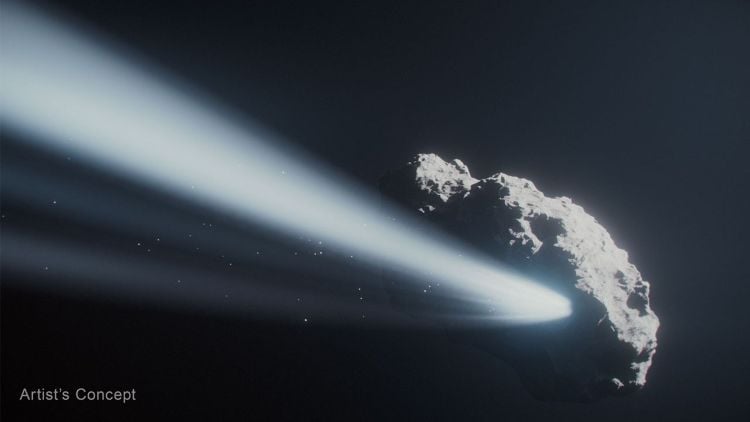
The result comes from analysis of data gathered by NASA's Hubble Space Telescope. According to the report, the reversal is tied to outgassing, the process in which solar heating causes ice in the comet to evaporate and vent gas and dust into space. Those jets are not just decorative sources of a comet's tail. They can also behave like small thrusters, applying torque to the nucleus. In the case of 41P, the study argues that uneven jets may have slowed the comet's initial spin, stopped it, and then driven it in the opposite direction.
That sequence is striking because rotation is one of the basic properties that helps determine how a small solar system body evolves. A change this dramatic suggests that even a modest comet can be dynamically fragile, with surface activity capable of rewriting its physical state over a relatively short span of time.
Why reverse spin matters
Comets are often introduced through their visual spectacle, but scientists value them for another reason: they are remnants from the early solar system, preserving material and structure that date back about 4.6 billion years. When a comet behaves in an unfamiliar way, researchers gain a fresh window into how these primitive bodies respond to solar heating, lose mass, and sometimes die.
Universe Today quotes UCLA planetary scientist David Jewitt, the study's sole author, explaining the mechanism in simple terms. Jets of gas leaving the surface act like repeated pushes on a merry-go-round. If the pushes oppose the original motion strongly enough, they can slow the rotation and eventually reverse it. For a large object, such torques may produce only subtle long-term changes. For a small comet like 41P, they can be transformative.
That helps explain why the finding resonates beyond a single object. Reverse spin is not just an oddity to add to a catalog. It is evidence that cometary activity can be forceful enough to reorganize rotation in a way that may destabilize the body itself. Once a nucleus begins spinning under altered stresses, fractures, mass shedding, and eventual breakup become more plausible outcomes.

A surface changing faster than expected
The study points to another surprising clue: 41P's surface appears to have been less active in 2017 than during its 2001 perihelion passage. Universe Today notes that such a shift is unusual because comet surfaces often evolve over much longer timescales, with notable changes commonly associated with periods stretching over centuries or more. Here, the apparent change arrived over roughly a quarter century.
That accelerated evolution matters because activity patterns and rotation feed back on one another. Jets depend on where volatile material is exposed, how sunlight reaches the surface, and whether fresh layers have been uncovered by erosion or collapse. Rotation, meanwhile, changes which regions are illuminated and how stresses are distributed. A comet does not simply lose ice at a steady rate. It can migrate through states, with one interval of activity setting up the next.
For 41P, the picture that emerges is of a body already in transition. A reduction in surface activity does not necessarily mean stability. It may reflect depletion in some regions, burial of active areas, or a redistribution of vents. Combined with the rotational reversal, it suggests a nucleus that may be entering a more precarious phase of its life.
Could the comet tear itself apart?
The most dramatic implication in the report comes from computer modeling. Universe Today says the current spin state could eventually cause 41P to rip itself apart. The study estimates that the comet's nucleus may survive only a few more decades, far shorter than the roughly 1,000-year average lifetime referenced in the article.
That estimate should be read as a model-based projection, not a dated prediction of exactly when or how breakup will occur. Still, it highlights a key reality of comet physics: these bodies are temporary. Each close pass to the Sun removes material, reshapes the surface, and modifies the forces acting across the nucleus. If rotation accelerates or becomes unstable, the structural weakness of a porous, icy body can become decisive.
Small comet nuclei are especially vulnerable. At about 1 kilometer in diameter, according to the Hubble-based estimate cited by Universe Today, 41P does not have the self-gravity of a larger world to hold itself together against all perturbations. A few persistent jets in the wrong geometry can do more than brighten the coma. They can alter the object's fate.

What this says about comet life cycles
The broader scientific value of 41P lies in how it sharpens understanding of comet mortality. Astronomers already know that comets can fade, fragment, split, or disintegrate. What is harder to pin down is the chain of causes that turns a surviving nucleus into a doomed one. Reverse spin offers a measurable intermediate state, a physical marker that may connect surface venting to catastrophic end stages.
It also underlines the importance of long-baseline observation. Without repeated monitoring across multiple perihelion passages and access to high-quality imaging like Hubble's, changes in activity and rotation could be missed or misread. A comet that seems familiar from one return may behave differently at the next, and those differences can carry the real story.
For planetary science, 41P is a reminder that the small bodies of the solar system are not passive leftovers. They are active systems, sensitive to sunlight, geometry, and internal weakness. Their behavior can change abruptly enough to challenge assumptions about how slowly such objects evolve.
A fragile object with a useful warning
Whether 41P ultimately fragments in a few decades or settles into another state first, the reverse-spin finding already marks it as an important natural experiment. It shows that comet rotation can be more dynamic than previously documented and that outgassing can do more than sculpt a tail for observers on Earth.
That matters for theory, for future observations, and for understanding the lifecycle of primitive solar system bodies. A comet's beauty often comes from material it is losing. In 41P's case, the same process may be writing the final chapters of its existence. If the new interpretation is correct, astronomers are not just watching an active comet. They may be watching the mechanical beginning of its end.
This article is based on reporting by Universe Today. Read the original article.

Originally published on universetoday.com