A telescope old enough to see change
One of the most remarkable things about the Hubble Space Telescope in its thirty-fifth year is that it has become more than a machine for snapshots. It is now a machine for before-and-after astronomy. By surviving far beyond its originally projected 15-year lifespan, Hubble can revisit objects it observed decades ago and reveal changes unfolding on timescales short enough for humans to appreciate directly.
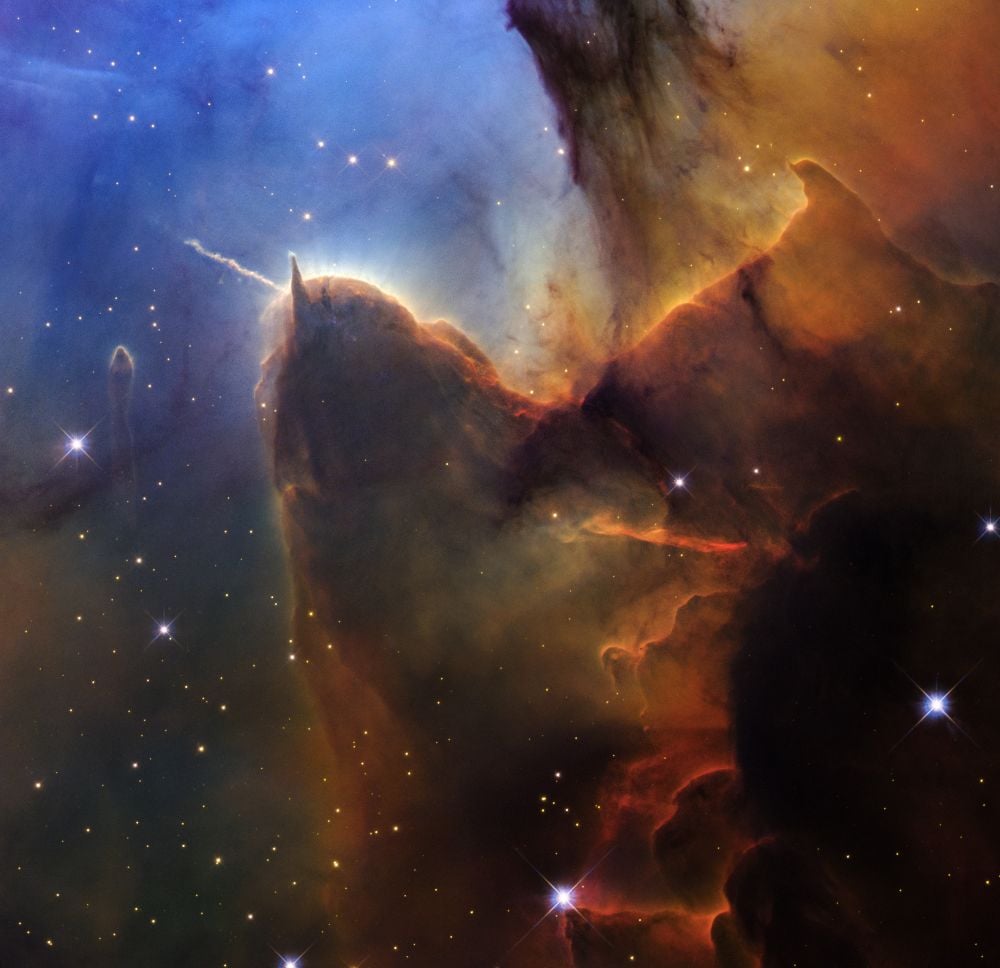
That is the context for its latest return to the Trifid Nebula, a star-forming region about 5,000 light-years away also known as NGC 6514 and Messier 20. Hubble first observed it in 1997. The new revisit, part of NASA’s celebration of the telescope’s 35th year, allows astronomers to compare images separated by nearly three decades and identify physical changes in a nebula still actively being shaped by stellar birth and outflows.
Why the Trifid Nebula is such a good target
The Trifid is visually striking, but it is also scientifically rich. Its name comes from the Latin word for divided into three lobes, and the object is unusual because it combines an emission nebula, a reflection nebula, and a dark nebula in one region. That means multiple physical processes are visible in the same broad structure.
The nebula is powered by a young O-type star called HD 164492A. According to the supplied source text, the star is about 20 times more massive than the Sun. Its intense ultraviolet radiation illuminates the region, while the surrounding stellar population adds more energy to the environment. The source text says the Trifid contains a cluster of more than 3,000 stars.
This is not a quiet cloud. It is an active star-forming zone where massive young stars and their winds shape the gas around them. Those winds have blown an enormous bubble in the nebula, and the shock-front edges of that bubble compress gas in ways that can trigger still more star formation. The result is a dynamic environment where change is not just expected over cosmic timescales, but in some places observable over years or decades.
What Hubble is seeing now
The new Hubble image focuses on a small part of the Trifid Nebula. The source text describes the central feature as resembling a sea slug with a pair of antennae, an image vivid enough to underscore why astronomical structures often stick in the public imagination. But the key scientific feature is one of those “antennae,” which is part of a Herbig-Haro object.
Herbig-Haro objects are bright patches of nebulosity created when jets from a nearby young protostar slam into surrounding material. They are among the clearest visible signatures of star formation in action. Because the power of those jets can wax and wane, and because the shocked gas continues to move, these structures can change shape over relatively short intervals.
That is what makes repeat imaging so valuable. The source text says Hubble has already caught some of these changes across observations over the years. By comparing images, astronomers can learn about the energy in the jet and how it evolves over time. In effect, Hubble is turning a distant star-forming region into a time-lapse laboratory.
Aging hardware, expanding scientific value
There is an irony here. Hubble’s continued scientific usefulness is a direct consequence of its age. When it was launched, the ability to build long-baseline visual records of changing nebulae was not the telescope’s headline appeal. Today that capability is one of its most distinctive strengths. A mission expected to last 15 years has now accumulated enough history to measure visible evolution in places once thought of mainly as static celestial scenery.
The Trifid revisit also shows why observatory longevity matters. Newer telescopes can surpass older ones in sensitivity or wavelength coverage, but there is no substitute for a decades-long archive when the scientific question involves change over time. In that sense, Hubble’s archive is not just documentation of past work. It is an instrument in its own right.
What this reveals about star formation
Star formation is often described in broad conceptual terms: clouds collapse, protostars ignite, jets emerge, winds carve cavities, and radiation reshapes nearby gas. The Trifid observations make those ideas more concrete. Jets from hidden young stars do not merely exist; they visibly alter the surrounding nebula. Winds from massive stars do not just influence structure in theory; they sculpt bubbles and shock fronts whose consequences can be imaged.
Because the Trifid contains multiple nebular components and an active stellar population, it provides an especially compelling window into that interplay. Hubble’s ability to return to the same region after decades turns the nebula from a beautiful object into an evolving system whose motion and energy budget can be studied directly.
Why it matters
The new Trifid images demonstrate one of the rarest achievements in astronomy: watching the universe change in front of us. Hubble’s revisit shows that even across thousands of light-years, star-forming environments can evolve on human timescales. That gives astronomers more than a prettier image. It gives them a way to test how jets, winds, and compressed gas reshape stellar nurseries over time.
This article is based on reporting by Universe Today. Read the original article.
Originally published on universetoday.com