A rare visitor is offering a rare chemical clue
Interstellar comet 3I/ATLAS caused a surge of interest as it passed through the Solar System, not just because it was only the third known interstellar object ever detected, but because astronomers had a narrow chance to learn where it came from. New observations from the Atacama Large Millimeter/submillimeter Array, or ALMA, have now delivered one of the clearest answers yet. Researchers report the first measurement of deuterated water in an interstellar object, opening a chemical window into the environment where the comet formed.
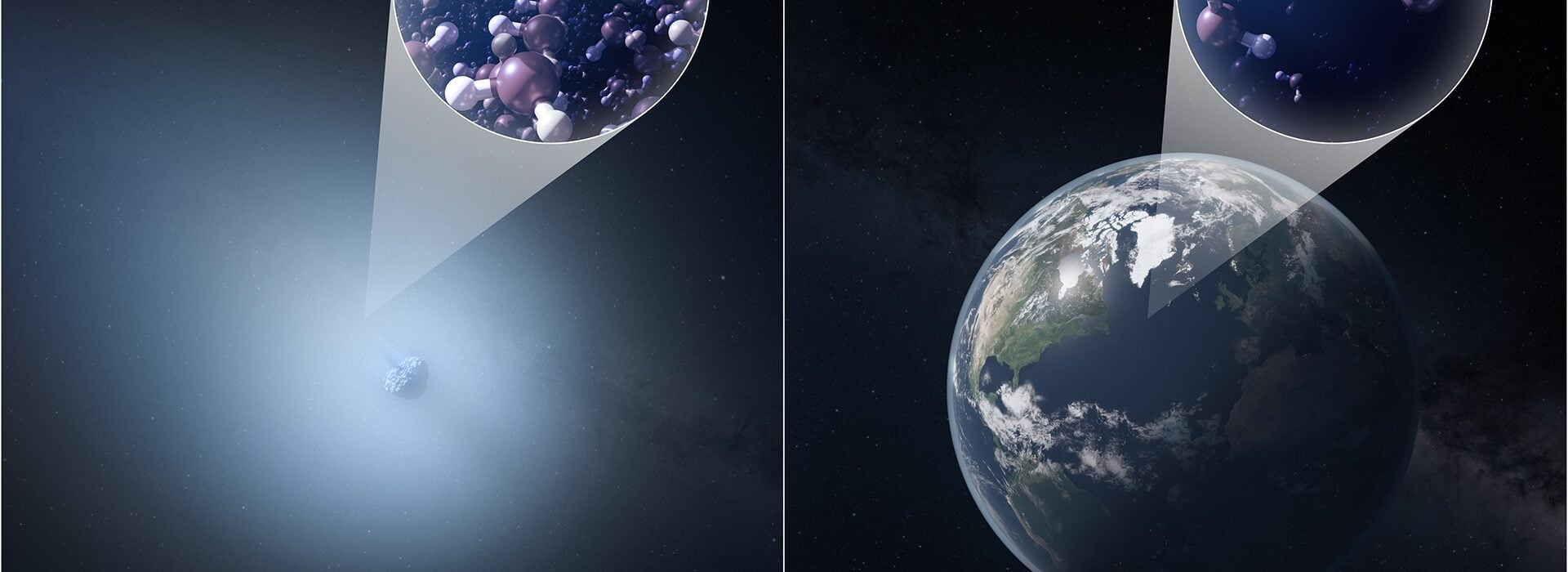
The key result is that 3I/ATLAS appears to be unusually rich in deuterated water, sometimes described as semi-heavy water. In this form of water, one hydrogen atom is replaced by deuterium, a heavier hydrogen isotope. According to the research cited by the observing team, that chemistry points to formation in conditions that were colder and exposed to lower levels of radiation than those associated with the early Solar System.
That makes the comet more than a passing curiosity. It turns 3I/ATLAS into a messenger from another planetary system, carrying material signatures that survived its journey through interstellar space and a close pass by the Sun.
Why the measurement matters
Comets are often described as dirty snowballs because they contain water ice, volatile compounds, dust, and chemically interesting frozen material. For planetary scientists, they preserve information about the environments where they formed. In our own Solar System, the ratio between ordinary water and deuterated water helps researchers compare formation regions and thermal histories.
Until now, that kind of chemical test had not been achieved for an interstellar object. The ALMA observations therefore represent a first: a direct measurement of deuterated water in an object known to have originated beyond the Sun’s planetary family. Instead of relying only on orbit, brightness, or dust behavior, astronomers can now begin comparing extrasolar small bodies using composition.
The result matters because chemistry can say something that trajectory alone cannot. An interstellar comet may tell astronomers that it came from another system, but molecules can begin to describe what that system was like. In this case, the evidence suggests a formation environment colder than the one that produced Earth and many familiar Solar System bodies.
How ALMA caught the comet in time
The observing window was extremely tight. The research team made its observations in December 2025, just six days after 3I/ATLAS reached perihelion, its closest point to the Sun. That timing was important because the comet had only just emerged from its transit behind the Sun, and most instruments cannot safely point that close to the solar glare.
ALMA had two advantages. One was the Atacama Compact Array, which combines measurements from closely grouped dishes to detect faint targets. The other was ALMA’s ability to observe toward the Sun in a way that most optical telescopes cannot. That combination allowed the team to study the comet during a brief period when other facilities would have struggled to do the same.
The researchers described this as a constraint on cometary molecules that other instruments could not provide. In practical terms, ALMA was able to observe the object at exactly the moment when its freshly heated material could still reveal its chemical makeup.
What the chemistry says about another planetary system
The main interpretation from the observations is straightforward but significant. The abundance of deuterated water suggests that the comet formed in a cold environment with comparatively low radiation exposure. That differs from the conditions scientists associate with the early Solar System and implies that the body’s home system followed a different thermal and chemical path.
That does not mean astronomers have reconstructed the comet’s original planetary architecture in detail. But it does mean they now have evidence that small bodies in other systems may preserve formation histories that look measurably different from the one recorded by comets closer to home. 3I/ATLAS is therefore not only an interstellar traveler. It is also a sample of planetary-system diversity.
The discovery is especially notable because interstellar objects are rare, fast-moving, and difficult to study. Even when they are found, researchers often have only a short time to collect useful data before the objects recede back into deep space. That makes every robust chemical measurement unusually valuable.

A step toward comparative comet science beyond the Solar System
The work was led by Luis E. Salazar Manzano of the University of Michigan and Teresa Paneque-Carreño, principal investigator of the ALMA Director’s Discretionary Time program behind the observation. The collaboration included researchers from the National Radio Astronomy Observatory, the Laboratory for Instrumentation and Research in Astrophysics, the Leach Science Center, the Millennium Nucleus on Young Exoplanets and their Moons, NASA Goddard, and NASA’s Jet Propulsion Laboratory.
That institutional mix reflects how unusual this kind of opportunity is. Measuring deuterated water in an interstellar object is not routine observational astronomy. It required a fast response, a suitable instrument, and a target bright enough to yield usable data during a brief observing window.
The larger implication is that astronomy is moving from simply spotting interstellar objects to chemically characterizing them. Each new detection expands the possibility of comparing how other star systems build icy bodies, retain volatiles, and preserve early materials. If future objects can be studied with similar precision, researchers may begin to map not just the existence of interstellar visitors, but the diversity of the planetary systems that send them out.
For now, 3I/ATLAS has delivered an unusually specific message. Its water chemistry suggests it was born in a place colder and less irradiated than the environment that shaped our own planetary neighborhood. For a comet seen only briefly on its way through, that is an extraordinary amount to learn.
This article is based on reporting by Universe Today. Read the original article.
Originally published on universetoday.com