Another nation joins the Artemis framework
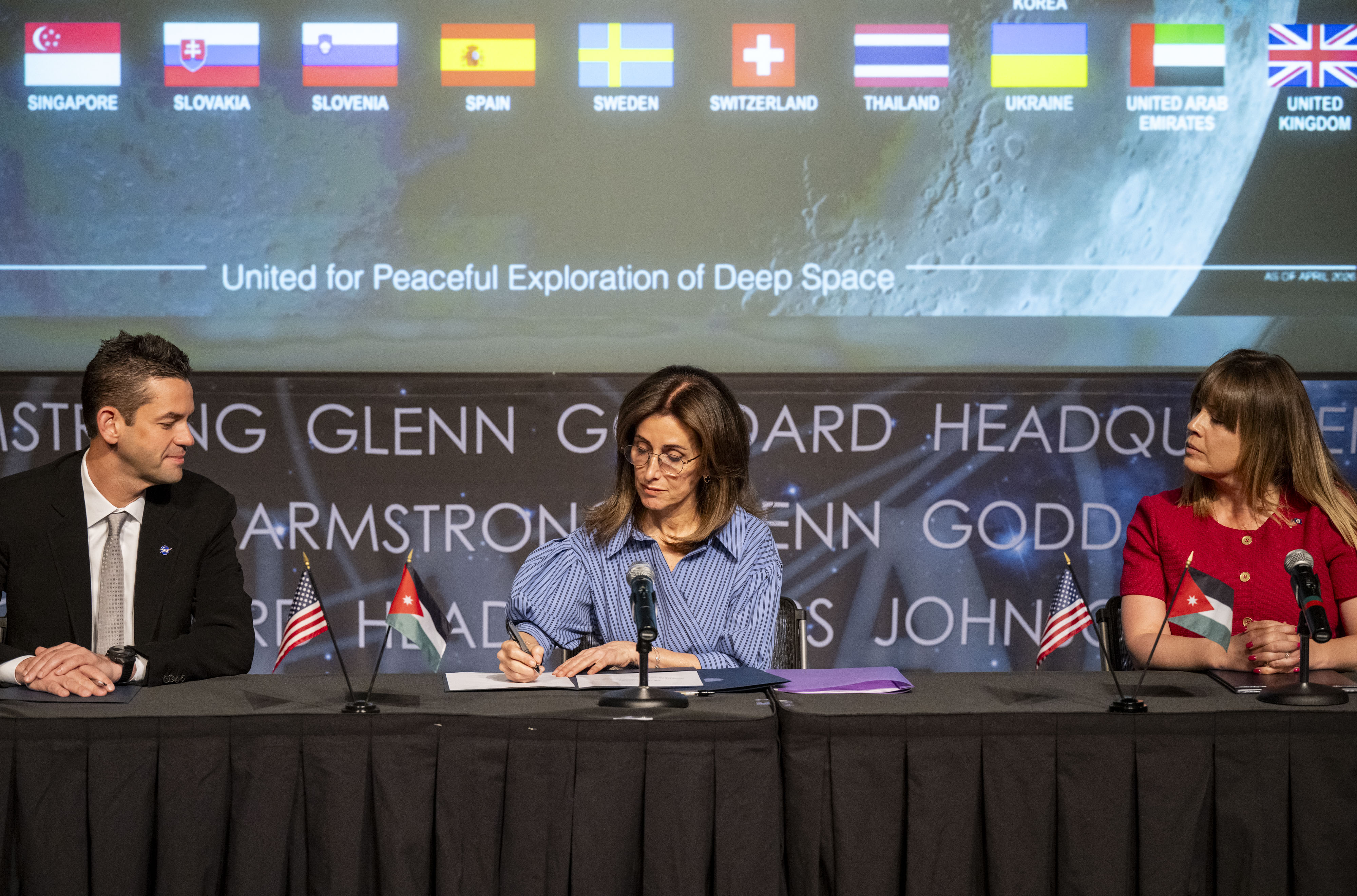
Jordan has become the 63rd signatory to the Artemis Accords, signing the agreement during a ceremony at NASA headquarters in Washington on April 23, 2026. The accords are a U.S.-led framework for responsible civil space exploration, and Jordan’s entry adds another country to the growing coalition around lunar exploration and related international norms.
The ceremony included Jordan’s ambassador to the United States, Dina Kawar, NASA Administrator Jared Isaacman, and Ruth Perry of the U.S. Department of State. In NASA’s account, the moment was presented not only as a diplomatic expansion of the accords but also as a practical widening of the partnership base supporting future exploration activities.
Why Jordan’s signature matters
In formal terms, the step means Jordan is aligning itself with the principles that underpin the Artemis Accords, which were established in 2020 by the United States and seven founding partner nations. In practical terms, the signing is also a signal that space participation is broadening beyond the largest traditional space powers.
NASA’s statement emphasizes Jordan’s engineering base and growing technology ambitions. Ambassador Kawar said the country has one of the world’s highest engineer-per-capita ratios and highlighted ongoing efforts to position Jordan as a regional and global technology hub spanning AI, digital infrastructure, advanced manufacturing, and space.
A smaller space actor with visible momentum
Jordan is not entering the conversation from zero. NASA’s article points to the 2018 launch of JY1, a CubeSat developed by university students and launched on a SpaceX Falcon 9 from Vandenberg Space Force Base. The agency also highlights a privately operated analog research facility in Wadi Rum, where the Jordan Space Research Initiative conducted PETRA1 and PETRA2 missions in 2024 and 2025 focused on human spaceflight and planetary research with benefits on Earth.
Those examples matter because they show the country’s space interest is linked to both education and applied research. For the Artemis framework, that kind of contribution can be valuable even when a partner is not a major launch provider or spacecraft prime contractor.
The accords are moving from symbolism to implementation
NASA Administrator Jared Isaacman described Jordan’s entry as coming at a pivotal moment, arguing that the principles of the accords are now being put into practice through humanity’s return to the Moon. His statement also referenced the goal of building a Moon Base and sustaining a long-term presence on the lunar surface with contributions from international partners.
That language reflects how the accords have evolved. Early signings were often interpreted as declarations of geopolitical alignment around space governance. As Artemis planning matures, each new signature increasingly raises a second question: what role, capability, or perspective can the new partner bring to actual missions, standards, research, or infrastructure?
A widening coalition around lunar norms
For the United States, every additional signatory strengthens the political weight of the accords as a preferred framework for civil cooperation in deep space. For signatories such as Jordan, joining offers a path to formal participation in a rules-based exploration architecture that connects diplomacy, science, and industrial development.
The immediate effect of Jordan’s signature is symbolic but real. It expands the map of countries publicly committing to the accords’ principles and reinforces the idea that lunar exploration is being built as a multinational project rather than a narrowly bilateral one. Over time, the significance will depend on whether the partnership develops into specific technical, scientific, or commercial contributions.
For now, the milestone is clear: Jordan has formally joined the Artemis Accords, becoming the 63rd nation to do so and adding fresh momentum to the coalition gathering around the next phase of international space exploration.
This article is based on reporting by NASA. Read the original article.
Originally published on nasa.gov