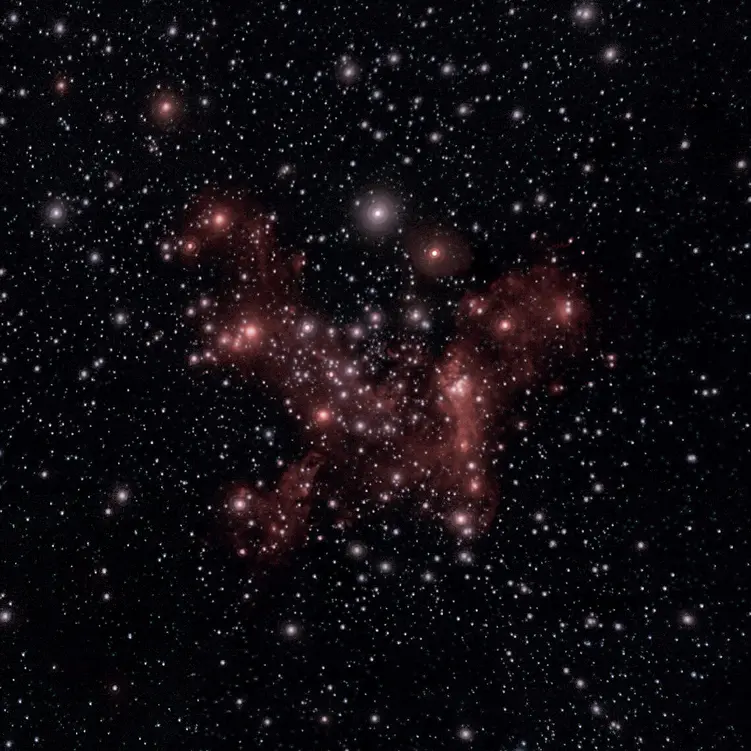
A long-running mystery near the Milky Way’s center may be narrowing
At the center of the Milky Way sits Sagittarius A*, the supermassive black hole whose gravitational field dominates one of the most extreme environments in the galaxy. For years, astronomers have watched compact gas clouds move through that region on paths that seemed too similar to be coincidence. Now, using high-resolution infrared observations, a team led by researchers at the Max Planck Institute for Extraterrestrial Physics says those clouds likely come from a specific source: a massive contact binary star system called IRS 16SW.
The result matters because the gas clouds are not just curiosities. They may be part of the process that gradually feeds material toward the black hole. In a region where stars race through deep gravity wells and gas is constantly disturbed, identifying a repeatable origin for such clouds would help explain how matter gets injected into the environment around Sagittarius A*.
Why G1, G2 and G2t attracted attention
The source article highlights three compact clouds, known as G1, G2 and G2t. Each contains roughly the mass of a few Earths and glows in infrared light from hot hydrogen and helium. What made them stand out was not just their proximity to the black hole, but the fact that all three appeared to trace almost identical long, looping orbits around Sagittarius A*.
That resemblance posed an obvious question. If the clouds were unrelated, the odds of them sharing such similar orbital parameters would be extremely small. The alternative was that they had a common origin, but for years the source remained uncertain. The new work strengthens the common-origin idea by reconstructing the clouds’ positions and velocities with observations from the SINFONI and ERIS spectrographs on the European Southern Observatory’s Very Large Telescope.
By combining those measurements, the researchers were able to run the orbits backward in time and ask where the material most plausibly came from. Their answer points to IRS 16SW, located in the clockwise ring of young stars that orbits Sagittarius A*.

A binary system built for violence
IRS 16SW is not an ordinary stellar system. It is described in the source as a massive contact binary, meaning two giant stars are so close together that they touch and continuously exchange material. Such systems are already unstable and energetic by nature. Add strong stellar winds and a dense surrounding medium, and the conditions become even more severe.
According to the source, when the winds from the binary interact with surrounding gas, they create a shock. Computer simulations indicate that this shock can generate clumps of gas with the properties seen in G1, G2 and G2t. That gives the study a physically plausible mechanism, not just an orbital coincidence. In other words, the team is not only saying the clouds and the binary line up in space and time. It is also saying the binary can plausibly manufacture the kind of objects astronomers have been tracking near the black hole.
That combination of orbital reconstruction and simulation is what makes the new result more compelling than earlier suggestions. A crowded galactic center can generate many possible explanations, but fewer of them match both the motion and the apparent formation process of these specific clouds.
What this says about feeding Sagittarius A*
The phrase “feeding the black hole” can sound like a single dramatic event, but in reality it is usually a matter of small amounts of material being injected into the black hole’s environment over time. The clouds in this study are compact and only a few Earth masses each, yet in a region as dynamic as the galactic center, repeated delivery of such clumps can matter.
The source article frames the broader mystery clearly: despite the violence of the region around Sagittarius A*, astronomers have long wanted to know what is actually supplying it with material. If IRS 16SW is indeed creating clouds that later travel inward on similar trajectories, then massive binary stars may be one important source of that supply chain.
That idea is appealing because it links stellar evolution directly to black hole feeding in the Milky Way. Rather than relying solely on random gas flows or rare disruptive events, the galactic center may have a more persistent mechanism for generating material that drifts toward the central black hole.
The role of new instrumentation
The study also underscores how much modern infrared astronomy has changed the picture of the galactic center. Dust blocks much of the visible light from this region, making infrared instruments essential. The observations cited in the source came from SINFONI and ERIS on the Very Large Telescope, tools capable of measuring both the position and motion of faint structures in a crowded field.
That technical capability is crucial when the objects of interest are compact gas clouds moving through a background packed with stars, ionized gas, and strong gravitational distortion. Without precise infrared spectroscopy and imaging, the subtle differences between possible orbital histories would be much harder to resolve.
Why the finding resonates beyond one black hole
Sagittarius A* is the nearest supermassive black hole, making it a laboratory for questions that apply far more broadly across galaxy evolution. If massive contact binaries can generate gas clumps that migrate toward a central black hole here, similar processes may operate in other galactic nuclei as well. The Milky Way offers a chance to watch such mechanisms with far more detail than distant galaxies allow.
- The gas clouds G1, G2 and G2t each contain roughly the mass of a few Earths and glow in infrared light.
- Researchers used Very Large Telescope observations from the SINFONI and ERIS spectrographs to reconstruct their orbits.
- Tracing those orbits backward pointed to IRS 16SW, a massive contact binary in the young stellar ring around Sagittarius A*.
- Simulations suggest shocks created by the binary’s stellar winds can form clumps matching the observed clouds.
The picture is still developing, but it is sharper than before. A trio of strange clouds once treated mainly as isolated oddities now looks more like evidence of a repeating process in the Milky Way’s core. If that interpretation holds, one of the galaxy’s biggest monsters may be getting at least part of its diet from the chaotic lives of two stars locked together at the center.
This article is based on reporting by Universe Today. Read the original article.

Originally published on universetoday.com