Two nearby exoplanets have yielded their clearest climate portrait yet
Astronomers have produced the first temperature maps of two Earth-sized exoplanets orbiting another star, using the James Webb Space Telescope to study TRAPPIST-1b and TRAPPIST-1c across complete orbits. The result is a stark one: both worlds appear to be rocky, airless planets with brutally uneven climates, their star-facing hemispheres heated to extremes while their permanent night sides plunge far below freezing.
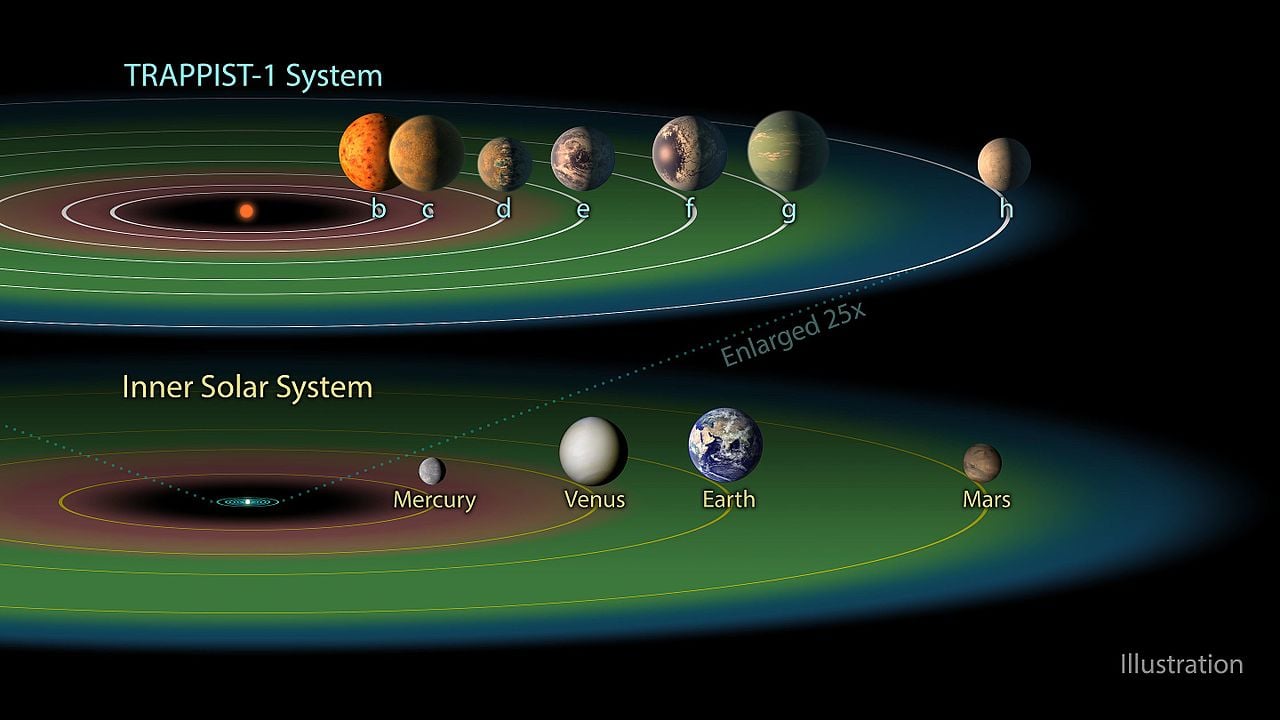
The observations focus on the two innermost planets in the TRAPPIST-1 system, a compact seven-planet family circling a red dwarf star about 40 light-years from Earth. The system has been a major target for exoplanet science ever since its discovery, partly because several of its worlds lie in or near the star’s habitable zone and partly because red dwarfs are the most common stars in the Milky Way. Understanding what kinds of atmospheres their planets can retain is therefore central to the broader search for potentially habitable environments beyond the Solar System.
In the new work, an international team from the Universities of Geneva and Bern used Webb to observe TRAPPIST-1b and 1c continuously in infrared light for a total of 60 hours. By measuring thermal emission from each planet as it moved around its star, the researchers reconstructed how much heat was being radiated from the day side and the night side. That allowed them to create detailed temperature maps rather than infer climate conditions from more limited snapshots.
Tidally locked worlds with no sign of atmospheric heat transfer
The defining condition on both planets is tidal locking. Like the Moon’s relationship with Earth, the planets rotate in sync with their orbits, meaning the same face always points toward their star. On such worlds, there is no ordinary day-night cycle. One hemisphere experiences perpetual daylight, while the other remains in permanent darkness. If a substantial atmosphere exists, it can transport heat between the two sides and soften the temperature contrast. If no atmosphere is present, the thermal divide should be extreme.
That is essentially what Webb saw. TRAPPIST-1b reaches temperatures above 200 degrees Celsius on its day side, while the night side falls below minus 200 degrees Celsius. TRAPPIST-1c showed a similar pattern. Those huge contrasts are the key scientific result because they imply that heat is not being redistributed efficiently around either planet. In other words, there is no evidence in these observations for an atmosphere thick enough to smooth conditions between the hemispheres.
This finding narrows the range of possible interpretations for the two planets. The simplest reading is that both are bare rocky worlds. They are close to their parent star, heavily irradiated, and unable to maintain the kind of atmosphere that could moderate climate or support surface conditions remotely similar to Earth’s. That does not make the system less interesting. It makes it more legible. Exoplanet science often advances by ruling out plausible worlds as much as by identifying promising ones.
Why TRAPPIST-1 still matters for the search for life
TRAPPIST-1 remains one of the most compelling nearby laboratories for studying planetary diversity around red dwarfs. Its seven planets are all roughly terrestrial in scale, and their compact architecture makes repeated observations comparatively efficient. The innermost worlds were expected to be the toughest environments, but the system’s more temperate planets still attract attention because they orbit in a region where liquid water could in principle exist under the right atmospheric conditions.
That is why the new maps matter beyond TRAPPIST-1b and 1c themselves. Red dwarf stars dominate the stellar population of the galaxy. If planets around them commonly lose their atmospheres when they orbit too close, that helps define where scientists should look next and what signatures they should prioritize. The result also demonstrates Webb’s ability to move from merely detecting planets to characterizing their climates directly, even when those planets are small and rocky.
Temperature mapping of Earth-sized exoplanets had long been an aspirational goal because the signal is faint and the measurements demand extraordinary stability. Webb’s infrared sensitivity is now making that kind of analysis possible. In this case, the telescope was able to track both planets through full orbital cycles and extract thermal differences large enough to diagnose their atmospheric state. That is a major methodological step for the field, even if the specific planets studied turned out to be hostile.
A milestone built on a harsh answer
There is a tendency in exoplanet coverage to treat every new measurement as a referendum on habitability. The more important lesson from these observations is subtler. Habitability is not the only scientific prize. Knowing that TRAPPIST-1b and 1c are likely airless, tidally locked rocky worlds tells researchers something concrete about atmospheric survival, planetary evolution, and the environmental limits of worlds around small stars.
It also sharpens the agenda for future observations. If the inner planets are effectively stripped down to rock, the next question becomes how conditions change farther out in the same system. Do cooler TRAPPIST-1 planets retain atmospheres more successfully? Can Webb or future observatories detect gases on those worlds? How common is this pattern across other red-dwarf systems?
For now, TRAPPIST-1b and 1c stand as two of the clearest examples yet of what a tidally locked terrestrial planet can look like when there is no atmospheric buffer between eternal day and endless night. The science is impressive precisely because the answer is so unforgiving. Webb did not reveal hidden clement conditions on these worlds. It revealed their exposed surfaces, their thermal extremes, and a new level of precision in humanity’s attempt to read the climates of planets orbiting distant suns.
This article is based on reporting by Universe Today. Read the original article.
Originally published on universetoday.com