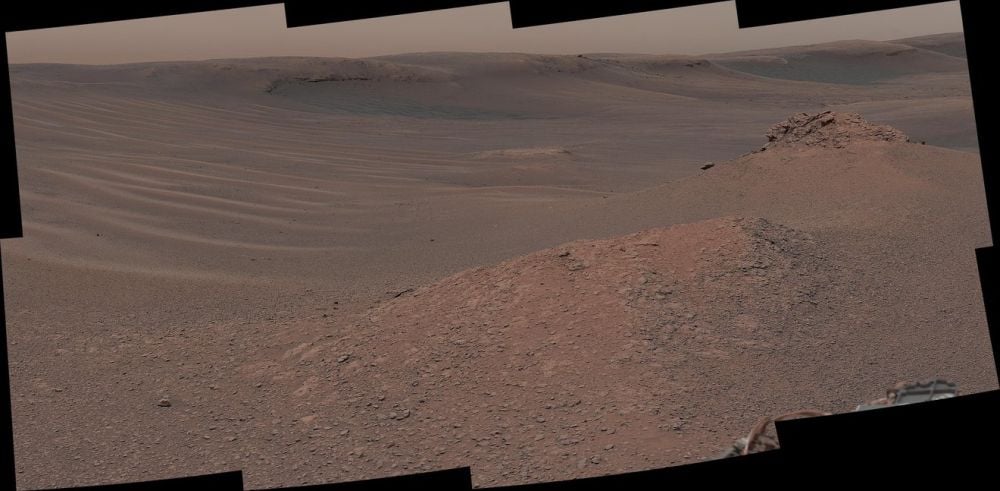
New chemistry from Gale Crater sharpens Mars’ habitability story
NASA’s Curiosity rover has detected the most diverse collection of organic molecules yet reported on Mars, adding fresh detail to one of planetary science’s central questions: whether the Red Planet once offered conditions that could support life, and whether traces of that ancient environment can still survive in its rocks today.
The results come from Curiosity’s analysis of a clay-bearing sandstone target called Mary Anning 3 in Gale Crater. Using its Sample Analysis at Mars, or SAM, instrument suite, the rover identified 21 organic compounds. Seven of those molecules had not previously been found on Mars. The finding does not prove life ever existed there, but it strengthens the case that ancient Martian environments could preserve chemical signatures that future missions may want to investigate even more closely.
Why organics matter, and why they are not the same as life
Organic molecules are carbon-containing compounds that can be produced through both biological and non-biological processes. That distinction matters. A discovery of organics on Mars is not itself evidence of past organisms. Geological reactions can create them, and the available source material explicitly says there is currently no way to determine whether the molecules detected by Curiosity have a biological or geological origin.
Still, the result is significant. The value of the new detection lies in what it says about preservation. If Mars can hold onto a chemically varied set of organics in ancient rock, then the planet may also be capable of protecting more complex biosignatures, if such signs ever formed there in the first place. In other words, Curiosity has not solved the life-on-Mars question, but it has helped show that the archive scientists are searching is real and scientifically useful.
The Mary Anning 3 sample and SAM’s wet chemistry advantage
The source material points to Curiosity’s 2020 drilling campaign into the Mary Anning 3 rock, located in a clay-rich region of Mount Sharp associated with ancient lakes and streams. That context is important. Clay-bearing rocks are often considered strong targets in astrobiology because they can trap and protect organic material over long timescales. The relevant rocks in Gale Crater are around 3.5 billion years old, placing them in a period when Mars is thought to have been warmer, wetter, and more geologically active.
SAM, the rover’s onboard laboratory, is built to analyze both rocky and atmospheric samples and includes a limited number of cups reserved for wet chemistry experiments. In this case, one of those cups was used to help reveal a broader range of compounds. The outcome, according to the supplied text, was a notably diverse organic inventory, including a molecule described as a precursor to RNA and DNA.
That last detail will attract attention, but it needs careful framing. A precursor molecule is not evidence that RNA or DNA ever existed on Mars. It is better understood as another sign that prebiotic-relevant chemistry can appear in ancient Martian rocks. The importance is contextual rather than sensational: Mars preserved a wider chemical toolkit than many earlier detections had shown.
What this changes for Mars exploration
The discovery strengthens a trend that has been building for years. Mars is no longer viewed simply as a dry, chemically barren world where organics would be too fragile to endure. Instead, each well-supported detection of preserved carbon chemistry makes the planet look more like a place where ancient environmental records may still be recoverable. That matters both for current rover science and for future sample-return ambitions, because the most valuable samples are often the ones that promise both habitability clues and preservation potential.
Curiosity’s finding also underscores the importance of site selection. Gale Crater’s clay-bearing units continue to justify the mission’s long traverse because they tie together environmental history and preservation conditions. If organics survive best in particular mineral settings, then those settings become prime targets not just for discovery headlines but for strategy. The search is increasingly about where Mars kept its best records, not simply whether interesting chemistry ever existed somewhere on the planet.
Why caution still matters
Planetary science has repeatedly shown that Mars can produce excitement faster than certainty. The new results are compelling because they are measured and specific. Researchers are not claiming fossilized life, nor are they presenting the compounds as uniquely biological. They are saying something narrower and arguably more durable: ancient Martian rock in Gale Crater contains a broad set of organic molecules, and that preservation capacity raises the scientific value of Mars as a target in the search for past biosignatures.
That caution is a strength, not a weakness. A careful result is more likely to stand. In this case, the finding makes the long-term Mars story more interesting because it narrows one of the key uncertainties. Even if biology remains unproven, Mars appears capable of storing the kind of chemistry that future missions will want to examine with more powerful instruments and, ideally, in laboratories on Earth.
Curiosity’s discovery is therefore not a final answer but an improved roadmap. It tells scientists that some Martian rocks did a better job preserving ancient chemistry than skeptics might have assumed. For a planet whose surface is exposed to radiation, oxidation, and billions of years of environmental change, that is no small result.
- Curiosity identified 21 organic compounds in a clay-bearing Martian sandstone sample from Gale Crater.
- Seven of the detected molecules had not previously been found on Mars.
- The result does not prove life existed on Mars, but it shows the planet can preserve potentially important biosignatures.
This article is based on reporting by Universe Today. Read the original article.
Originally published on universetoday.com