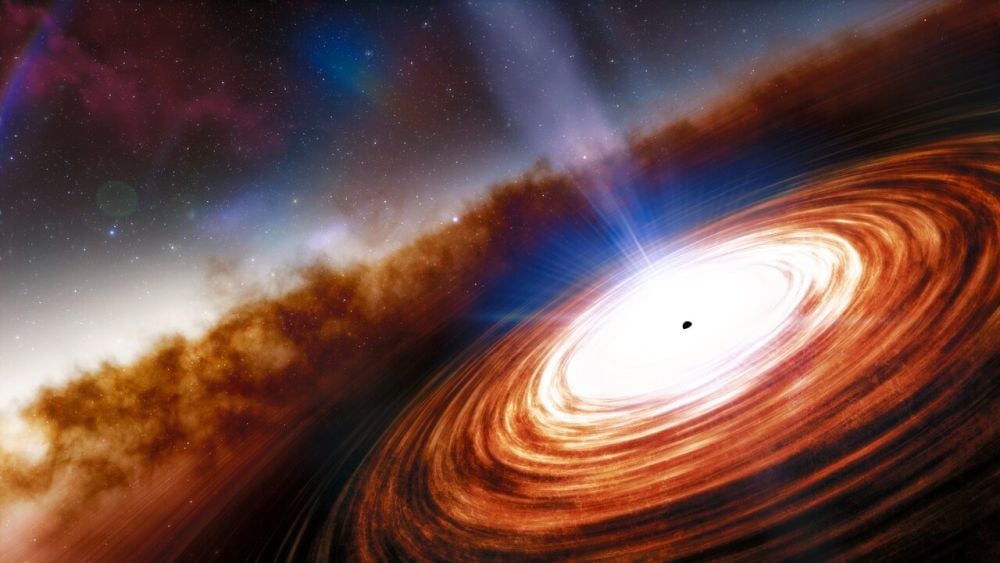
One of the most stubborn puzzles to emerge from the James Webb Space Telescope is not just that the early universe formed galaxies quickly, but that some of those galaxies appear to host black holes far larger than standard expectations would allow. A new study now offers a possible explanation for how these "overmassive" black holes formed at cosmic dawn.
The mismatch JWST exposed
In the nearby universe, astronomers are used to seeing a fairly consistent relationship between the mass of a supermassive black hole and the stellar mass of its host galaxy. In broad terms, the black hole usually accounts for about 0.1% to 0.5% of the stellar mass, especially in elliptical and bulge-dominated galaxies. That regularity helped support the idea that black holes and galaxies grew together in a more or less synchronized way.
JWST’s view of the high-redshift universe disrupted that picture. In galaxies from the universe’s first one or two billion years, researchers found supermassive black holes that frequently accounted for 10% to 30% of their host galaxies’ masses. In some of the most extreme "Little Red Dots," the inferred black hole masses even exceeded the stellar masses of the host galaxies. These systems are now referred to as overmassive black hole galaxies, or OBGs.

A proposed solution from new research
The new paper, titled How Overmassive Black Holes Formed at Cosmic Dawn, is set to be published in The Astrophysical Journal Letters and is currently available on arXiv. Led by Muhammad Latif of United Arab Emirates University, the work aims to explain how these outsized black holes could emerge so early without simply discarding the idea that black holes and galaxies are connected.
The core significance of the study is that it tries to update theory to fit the observational shock delivered by JWST. Astronomers expected surprises from the telescope, but the scale of these early black holes has forced a deeper rethink. If the standard co-evolution picture no longer works in the early universe, then models of galaxy assembly, black hole growth, or both need revision.
Why the issue matters beyond black holes
This is not a narrow bookkeeping problem about mass ratios. The relationship between galaxies and their central black holes sits near the heart of modern astrophysics. It influences how scientists think about star formation, gas inflow, radiation feedback, and the pace at which structure emerged after the Big Bang. If early black holes could outgrow their galaxies by such large margins, then the pathways to building the first massive structures may have been more uneven, more rapid, or more specialized than expected.
That is why the OBG problem has drawn such attention. JWST did not simply find black holes earlier than anticipated. It found systems that appear to violate one of the field’s most useful empirical rules. Theoretical work is now racing to explain whether those systems formed through unusually efficient black hole growth, unusually delayed stellar buildup, or some combination that standard models have not adequately captured.
The state of the puzzle
The source report does not lay out every element of the proposed mechanism, but it makes clear what the paper is trying to do: explain how black holes became disproportionately massive in the universe’s earliest galaxies. That alone marks an important stage in the scientific response to JWST. Observational surprises are now being met with targeted theory rather than generalized astonishment.
The coming test will be whether the new model can explain not just one or two extreme examples, but the wider population of early black hole systems JWST continues to uncover. If it can, it may help restore a coherent picture of cosmic dawn. If not, the telescope’s findings will continue to pressure existing ideas about how the first galaxies and the first supermassive black holes came into being.
Either way, the direction is clear: JWST has forced cosmology into a period of revision, and oversized early black holes are now one of the most important reasons why.
This article is based on reporting by Universe Today. Read the original article.
Originally published on universetoday.com