A cooler gas giant yields a valuable atmospheric signal
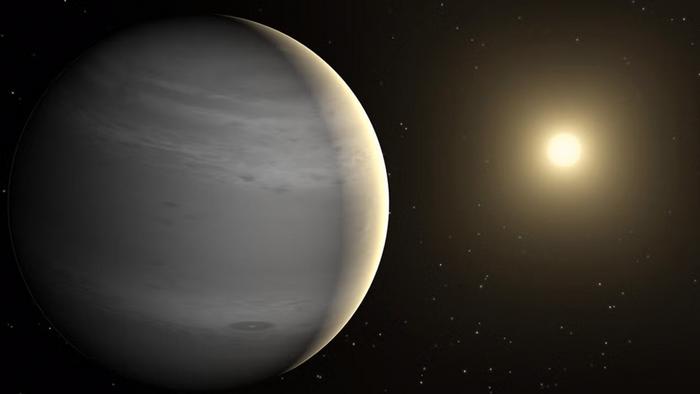
The James Webb Space Telescope has identified methane in the atmosphere of TOI-199b, a Saturn-sized exoplanet orbiting a Sun-like star about 335 light-years from Earth. The result is notable not just because methane was detected, but because the planet falls into a relatively underexplored class of worlds: temperate gas giants.
According to the reported study in The Astronomical Journal, TOI-199b has a mass of 0.17 Jupiters and a radius of 0.81 Jupiters. It orbits its host star every 104.9 days and has an estimated temperature of about 79 degrees Celsius. That makes it much cooler than the hot gas giants that have dominated many atmospheric studies so far.
This matters because temperature strongly shapes what astronomers expect to find in a planet’s atmosphere. Models of cooler giant planets have long suggested methane should be present, but obtaining clear observational confirmation has been difficult. In that sense, TOI-199b offers more than another exoplanet data point. It gives researchers a chance to test whether long-standing atmospheric predictions hold up on a real world.
How Webb made the detection
The observation used transmission spectroscopy, one of the most powerful tools in exoplanet science. When a planet passes in front of its star, a small fraction of the starlight filters through the planet’s atmosphere before reaching a telescope. Different molecules absorb different wavelengths of light, leaving identifiable fingerprints in the spectrum.
That is the method the research team used with JWST. By analyzing how starlight changed during TOI-199b’s transit, the astronomers identified methane in the planet’s gaseous envelope. The report also says carbon dioxide and ammonia are potential candidate molecules in the atmosphere, although methane is the confirmed signal highlighted in the source text.
JWST is particularly well suited to this work because of its sensitivity in infrared wavelengths, where many key atmospheric molecules leave their strongest signatures. That capability has already made the observatory central to exoplanet atmospheric science, but each successful observation also helps define which kinds of planets can be studied most effectively and what kinds of measurements are realistic.

Why temperate gas giants matter
Gas giants are common in planetary systems, but not all are equally informative for atmospheric comparisons. Many of the most intensively studied examples orbit very close to their stars, making them hot, inflated, and easier to observe. Those planets have delivered a large share of the field’s early breakthroughs, but they are not representative of every giant-planet environment.
Temperate gas giants fill part of that gap. Their cooler conditions can preserve molecules that would be altered or harder to interpret in hotter atmospheres. Methane is one of the most important of those molecules because it is a major carbon-bearing species expected under the right temperature and chemical conditions.
That is why the TOI-199b result is scientifically useful even though the planet itself is not habitable. A methane-bearing atmosphere on a temperate giant helps anchor models that will be used to interpret a broader range of planets. It also improves confidence that the chemistry being inferred from theory is visible in the real universe when instruments are good enough.
The report describes TOI-199b as the first temperate gas giant exoplanet found to contain methane. If that designation holds, the planet becomes an early benchmark object for future comparative studies.
Model confirmation is part of the story
Exoplanet science is often presented as a search for surprises, but confirmation matters too. In this case, the research team compared Webb’s observations with long-standing models of temperate gas giants and found agreement. That match is important because it shows atmospheric theory can successfully predict at least some of the chemistry expected on cooler giant worlds.
Model validation may sound less dramatic than a wholly unexpected discovery, but it is how the field becomes more precise. When an observation lines up with theory, astronomers gain confidence in using those models to estimate abundances, predict other molecules, and decide which planets deserve additional observing time.
The source text quotes researcher Renyu Hu saying that additional observations could help establish the relative abundance of the gases in TOI-199b’s atmosphere. That next step is critical. Detecting a molecule is one milestone; determining how much of it is present relative to others is where atmospheric interpretation becomes much richer.
Relative abundance data can help researchers test ideas about formation, chemistry, and thermal structure. It can also show whether a planet is chemically typical for its class or an outlier with a more complicated history.
What the detection does and does not mean
Methane is a high-interest molecule in planetary science, but context matters. On TOI-199b, its significance is tied to atmospheric chemistry, not to biology. The planet is a gas giant and the result says nothing about life. Instead, it tells astronomers that a key predicted molecule can be measured on a cooler giant planet using current instrumentation.
That distinction is important because methane can easily become overinterpreted in popular coverage. Here, the real advance is methodological and comparative. Webb has shown it can extract meaningful atmospheric information from a planet in a regime that has been less well sampled than the ultra-hot giants that often dominate the literature.
The result also points toward a larger program of study. If methane can be characterized on one temperate giant, astronomers can begin building a comparative set. That would allow them to ask whether TOI-199b is normal, how atmospheric composition shifts with mass and temperature, and whether carbon chemistry tracks theoretical expectations across a wider population.
A step toward a fuller census of planetary atmospheres
Exoplanet research is moving from isolated detections toward comparative planetary science. That transition depends on adding well-characterized planets across many categories, not just the easiest ones to observe. TOI-199b contributes to that effort because it occupies a regime between the hottest giant planets and the colder giants more familiar from the Solar System.
In practical terms, the discovery reinforces two conclusions at once. First, JWST is continuing to deliver the kind of atmospheric sensitivity astronomers hoped for. Second, the library of planetary atmospheres is starting to include more chemically informative, moderately heated giants rather than only extreme cases.
That combination is what gives the TOI-199b result lasting value. The methane detection is interesting on its own, but its broader importance is as a calibration point for the next decade of atmospheric exoplanet studies. Every such benchmark makes future detections easier to interpret, and every confirmation of theory narrows the gap between speculative modeling and robust planetary science.
For a planet 335 light-years away, that is a meaningful return. TOI-199b may not be a headline world for habitability, but it is becoming an important one for understanding how giant planets work.
This article is based on reporting by Universe Today. Read the original article.

Originally published on universetoday.com