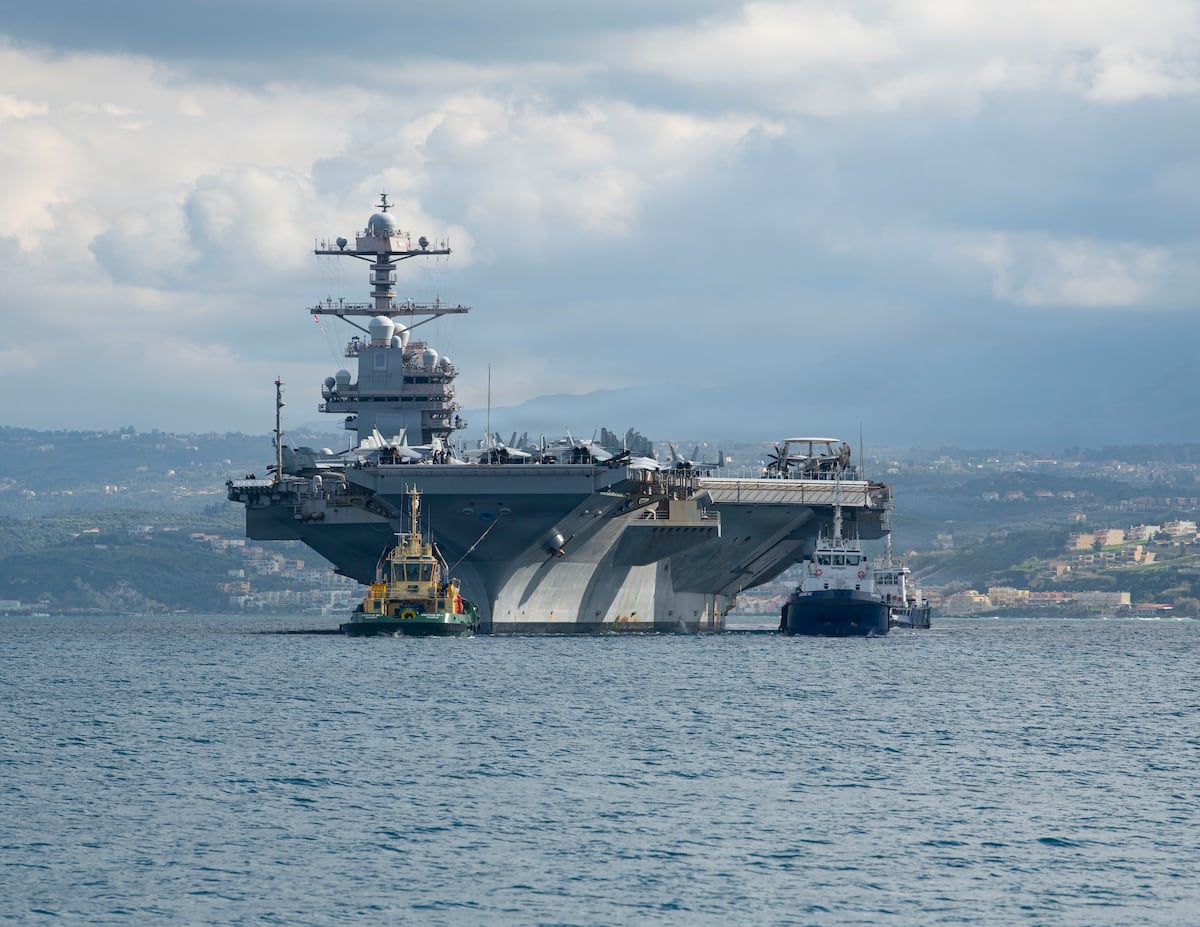
A review of two future carriers signals renewed scrutiny of the Navy’s most expensive ships
The U.S. Navy is reassessing the next aircraft carriers in its Ford-class pipeline, reopening one of the most consequential questions in American naval planning: how much carrier capability the service can afford, and how central those ships should remain in a force facing tighter budgets and changing operational demands.
Speaking at the Sea-Air-Space symposium in Washington, recently ousted Navy Secretary John Phelan said the service is reviewing the cost and design of CVN-82, the future USS William J. Clinton, and CVN-83, the future USS George W. Bush. The review, he said, covers costs, designs, and systems to ensure the ships still “make sense” given their share of the Navy budget and the service’s evolving view of force design.
The remarks are notable less because they announce a formal program cancellation or redesign and more because they openly acknowledge the strategic pressure surrounding supercarriers. Aircraft carriers remain among the Navy’s most visible symbols of power projection, but they are also among its most expensive assets to build, operate, sustain, and defend. Reexamining two planned ships suggests the Navy is again testing whether its future fleet architecture can absorb those costs without constraining other priorities.
The cost issue is not just construction
Phelan said the service is looking not only at what it would take to build the ships, but also at what it would cost to sustain and maintain them. That distinction matters. Procurement figures often dominate public debate, but lifetime operating and support costs can shape the real affordability of a class more than the sticker price alone.
The lead ship, USS Gerald R. Ford, cost roughly $13 billion to manufacture, according to the report. That scale alone makes carrier decisions different from most other naval acquisitions. Even modest design changes, schedule shifts, or sustainment burdens can ripple through shipbuilding plans and wider force-structure tradeoffs.
The Navy’s fiscal 2026 budget submission requested $612 million in advanced procurement funding for the Clinton. Congress, according to the report, lists the Bush for procurement in 2034, while the Clinton is slated for delivery in 2040. Those dates mean the Navy still has time to evaluate what it wants these ships to be, but it also means choices made now will define fleet composition well into the 2040s.

Why the review matters strategically
Carrier debates are rarely only about platforms. They are about strategic assumptions. A supercarrier embodies a view of maritime power centered on concentrated, mobile airpower that can be brought to crisis zones without reliance on host-nation bases. But today’s operating environment is forcing harder questions about vulnerability, concentration of value, and whether the Navy should distribute capability more broadly across the fleet.
Phelan’s comments linked the carrier review directly to force design and future needs. That phrasing implies a broader examination than mere cost control. It raises the possibility that the Navy is weighing the relative value of incremental carrier improvements against alternative investments elsewhere in the fleet, whether in submarines, surface combatants, unmanned systems, munitions, or other enabling capabilities.
The Ford class was designed to deliver more sortie generation, improved systems, and modernized architecture over the earlier Nimitz class. But in a budget-constrained environment, superiority on paper is not the same as affordability in practice. If the Navy must spend a very large share of its shipbuilding and sustainment resources on a small number of capital ships, it can narrow room for adaptation elsewhere.
The Ford class remains central, but not unquestioned
Nothing in the review as described suggests the Navy is abandoning the Ford class. Rather, it appears to be testing whether future ships in the class should proceed unchanged and whether their design, systems, and cost structure still fit the Navy’s priorities. That is a subtler but still important development. Mature programs often develop an air of inevitability. A review of this kind breaks that assumption and signals that even the Navy’s flagship procurement efforts are open to renewed scrutiny.
This is happening at a moment when the service is under pressure to justify large legacy investments while demonstrating readiness for new forms of conflict. Carriers remain central to U.S. maritime strategy, but they must now compete within a wider planning framework that emphasizes resilience, distributed operations, and cost discipline.
The mention of sustainment is especially revealing. A carrier is not just a hull to be delivered; it anchors a decades-long commitment involving maintenance, crew, modernization, escorts, and industrial-base support. If the Navy is questioning whether future ships “make sense,” it is effectively asking whether that entire chain of obligations still produces the right strategic return.

What could change and what may not
At this stage, the review does not establish a specific outcome. The Navy could reaffirm the program, make targeted design or systems adjustments, alter procurement timing, or seek other ways to improve affordability. The report does not indicate that officials have settled on a path.
Still, the fact of the review itself is meaningful. Major naval platforms often continue through inertia unless a service or Congress explicitly intervenes. By raising the question publicly, Phelan underscored that the Navy sees enough tension between carrier cost and future force design to justify a harder look.
That conversation is likely to extend beyond technical performance. It will touch on industrial-base stability, congressional preferences, strategic signaling, and the Navy’s own internal balance between legacy dominance and emerging operational concepts. Carriers are not easy programs to shrink or reshape because they sit at the intersection of strategy, politics, budgets, and shipbuilding employment.
A test case for future naval modernization
The review of CVN-82 and CVN-83 may ultimately become a test of how seriously the Navy is willing to align expensive procurement choices with its evolving understanding of warfighting and budget limits. If the service concludes that the ships should proceed largely as planned, it will need to defend that choice as fiscally and strategically coherent. If it seeks changes, it will need to show how those modifications preserve capability while freeing room for other priorities.
Either way, the message is clear: future aircraft carriers are no longer being treated solely as predetermined pillars of fleet structure. They are being weighed against what else the Navy needs, what it can sustain, and what kind of force it believes it must build for the decades ahead.
This article is based on reporting by Defense News. Read the original article.
Originally published on defensenews.com