A bigger Saildrone platform moves into a more contested mission set
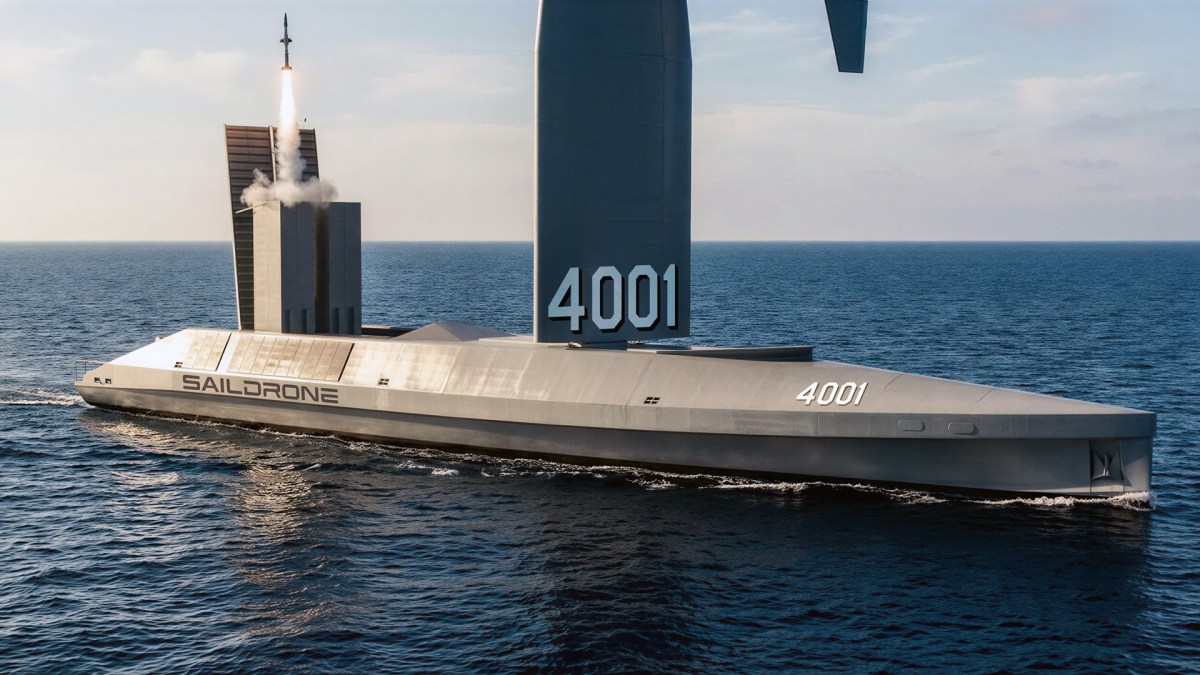
Saildrone is best known for smaller uncrewed surface vessels used for surveillance and maritime awareness, but its new Spectre design marks a clear move into a much heavier military role. According to details released around the Navy competition, Spectre is a 170-foot drone boat developed through a collaboration between Saildrone, Lockheed Martin, and Fincantieri.
That partnership matters. Saildrone brings experience in long-endurance autonomous vessels, while Lockheed Martin and Fincantieri contribute the kind of systems integration and naval industrial depth needed for a platform aimed at more demanding fleet missions. The result is a concept that pushes beyond persistent sensing into armed and specialized warfare applications.
The vessel is described as capable of speeds approaching 35 miles per hour and optimized for anti-submarine warfare. That alone places it in a different category from the small solar-powered and surveillance-focused craft that helped establish Saildrone’s profile with the U.S. Navy and other operators.
Missiles and sonar point to a modular combat role
Spectre’s most notable feature is its payload flexibility. Saildrone says the design can carry optional payloads including two Lockheed Mk 70 vertical launching system containers. Those launchers are described as capable of firing a range of weapons, including Tomahawk cruise missiles and SM-6 missiles used for air defense and surface strike roles.
That is a significant escalation in ambition for an uncrewed surface vessel derived from a company better known for maritime monitoring. It suggests the Navy’s medium-sized unmanned ship effort is being treated not simply as a scouting or logistics concept, but as a possible contributor to strike, air-defense support, and undersea warfare missions.
The company also says Spectre can take other payloads, including twin-line towed sonar arrays such as the TB-29 and Lockheed’s Joint Air-to-Ground Missile Quad Launcher. Total capacity is described as two 40-foot containers, five 20-foot containers, or a mixture of the two, reinforcing the idea that the same hull could be reconfigured for different operational needs.
That modularity is central to the pitch. Rather than fielding a single-purpose autonomous ship, Saildrone and its partners are presenting a platform that could be adjusted for sensing, missile carriage, or combinations of both depending on tasking.
The Navy already has a history with smaller Saildrone craft
The new concept does not arrive in a vacuum. The Navy’s work with smaller Saildrone vehicles dates back to 2021. In the Middle East, Saildrone’s 33-foot Voyager has been used in Task Group 59 experimentation centered on unmanned systems and teaming. In the U.S. 4th Fleet area, Saildrone vessels have also been involved in Operation Windward Stack, an effort focused on integrating uncrewed systems into missions tied to drug trafficking interdiction and illegal fishing enforcement.
Those earlier deployments helped validate the company’s endurance-focused operating model in real maritime environments. But Spectre indicates that operational credibility from surveillance missions is now being leveraged into a bid for more traditional naval warfare functions.
That shift tracks with a broader defense trend. Uncrewed platforms are no longer being discussed mainly as tools for presence and data collection. Increasingly, the debate is about whether they can carry valuable sensors, extend missile magazines, and assume riskier roles without putting crews aboard.
What Spectre signals about the unmanned fleet debate
The Spectre proposal highlights two unresolved questions for the Navy. The first is whether medium unmanned ships should serve primarily as adjuncts to crewed warships or evolve into distributed combat nodes in their own right. A vessel that can tow sonar arrays and potentially carry Tomahawk or SM-6 missiles points strongly toward the second vision.
The second question is industrial. The teaming arrangement shows that newer autonomy firms may still need established defense primes and shipbuilders to compete credibly for larger Navy programs. Spectre is not just a Saildrone story; it is also a case study in how newer defense technology firms are pairing with incumbents to pursue programs that require both software-led autonomy and conventional naval integration.
Whether the Navy ultimately embraces this specific design, Spectre captures the current direction of travel. The service appears interested in uncrewed ships that do more than watch. It is looking at vessels that can sense, carry weapons, and support undersea warfare, all while fitting into a broader distributed force architecture.
- Saildrone, Lockheed Martin, and Fincantieri unveiled the 170-foot Spectre for the Navy’s medium unmanned ship competition.
- The vessel is described as optimized for anti-submarine warfare and able to carry modular payloads including sonar and missile launch systems.
- The design builds on Saildrone’s earlier Navy work with smaller surveillance-focused unmanned surface vessels.
This article is based on reporting by twz.com. Read the original article.

Originally published on twz.com