A sharper U.S. posture in a critical waterway
President Donald Trump said on April 23 that he has ordered the U.S. Navy to attack any Iranian boats placing mines in the Strait of Hormuz, marking a significant escalation in U.S. rhetoric and potentially in naval rules of engagement around one of the world’s most strategically important chokepoints.
According to The War Zone, Trump issued the statement on Truth Social and said there should be “no hesitation” in engaging Iranian small boats involved in mine-laying. He also claimed that U.S. mine-clearing forces are already operating in the Strait and ordered that effort to continue at “a tripled up level.”
The context: seizures, gunfire, and uncertainty
The comments came amid a fast-moving confrontation. The report says the United States boarded another Iranian-linked vessel in the Indian Ocean hours before Trump’s post. It also says that, a day earlier, Iran’s Islamic Revolutionary Guard Corps fired on at least three ships and seized two of them in the Strait of Hormuz.
That sequence matters because it shifts the situation from general regional tension to an active maritime crisis. The Strait of Hormuz is not just another transit route. It is one of the most closely watched shipping corridors in the world, and any mining threat carries immediate implications for military traffic, commercial shipping, and global energy markets.
Iran’s small-boat fleet is central to the threat picture
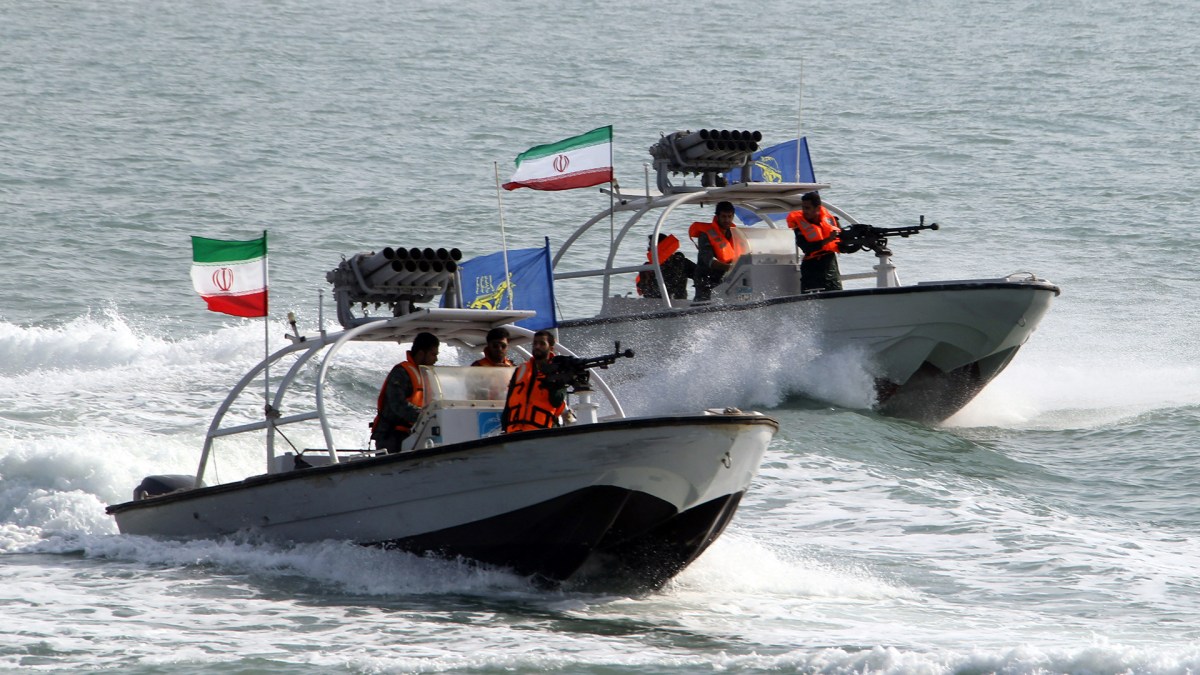
The War Zone notes that the IRGC has invested in small boats for decades. Those craft are not incidental assets. They are a core part of Iran’s asymmetric naval strategy and can be armed with short-range anti-ship missiles, artillery rockets, and other weapons. The report also notes that such boats can be used to lay naval mines.
That makes Trump’s order notable for its specificity. He did not speak in broad terms about Iranian naval units. He focused on the small craft that have long been associated with harassment, swarming tactics, and irregular maritime operations in the Gulf. If enforced literally, such an order would lower the threshold for kinetic action in crowded waters where identification, intent, and timing can all be contested.
Mine warfare is slow, dangerous, and hard to reverse
Trump’s statement also drew attention because of his claim that U.S. mine “sweepers” are already clearing the Strait.
The War Zone says it is unclear what, if any, such activities are currently taking place. The article contrasts the president’s language with a report from
The Washington Post, which said the Pentagon informed Congress that it could take six months to fully clear the Strait of Hormuz of mines deployed by the Iranian military, and that such an operation would likely wait until the war ends.
That gap is important. Clearing mines is labor-intensive, slow, and dangerous even in favorable conditions. It is not the sort of task that can be meaningfully summarized by political messaging alone. If mines have in fact been placed in significant numbers, the military challenge is substantial. If they have not, then public statements about sweeping and tripling operations still shape expectations and raise the perceived risk environment for commercial traffic.
A crisis with strategic and political weight
The report also notes that the status of peace talks remains unclear, despite Trump having announced a ceasefire extension two days earlier. That ambiguity adds another layer to the episode. Naval signaling, ship seizures, mine threats, and uncertain diplomacy are all interacting at once.
For military planners, the key issue is deterrence and control. For shipping companies, it is survivability and insurance. For policymakers, it is whether the United States is moving toward a more direct and sustained maritime confrontation with Iran. Trump’s statement does not answer all of those questions, but it does narrow the range of plausible interpretations: Washington is signaling a willingness to use force quickly against mine-laying threats in the Strait.
The immediate test is whether the order remains declaratory or becomes operational. In the Strait of Hormuz, that difference can determine whether a crisis stays contained or broadens fast.
This article is based on reporting by twz.com. Read the original article.
Originally published on twz.com