A stealth drone built around vertical operations
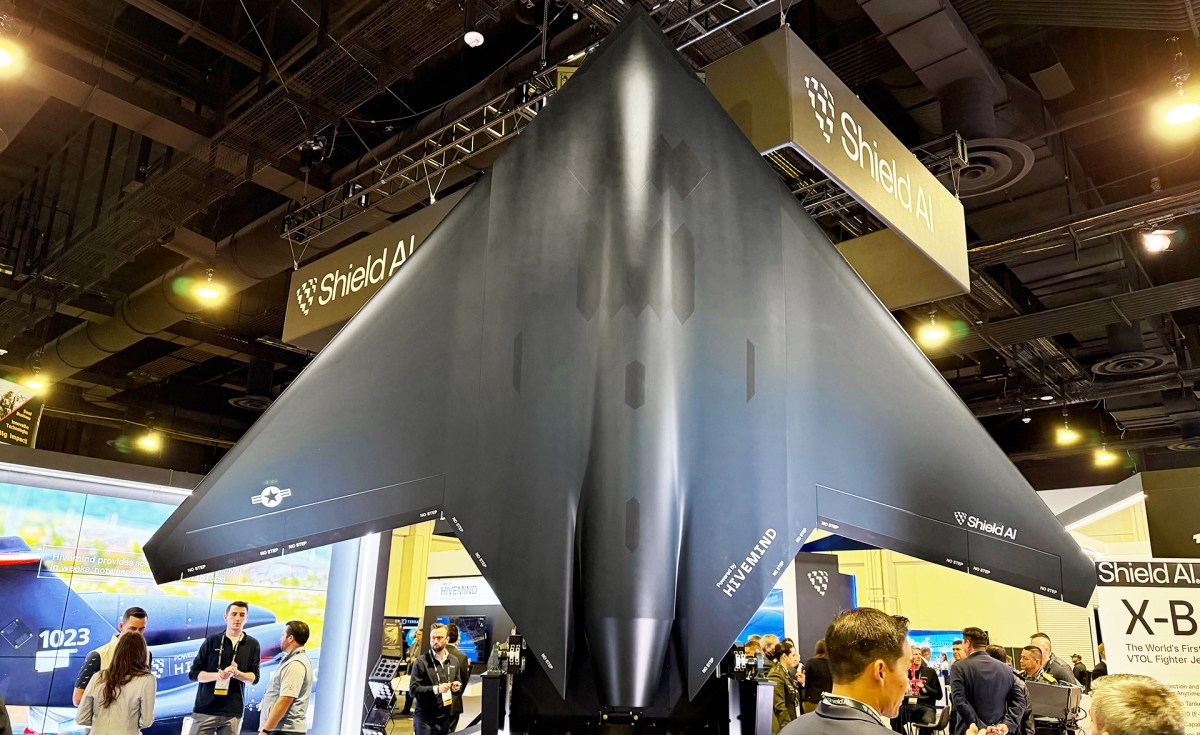
Shield AI and GE Aerospace have revealed new details about X-BAT, an autonomous jet-powered stealth drone concept designed to take off vertically and land vertically, tail first, after completing a mission. The aircraft is being described as an autonomous VTOL fighter-style drone, and its developers plan to begin vertical takeoff and landing testing before the end of 2026.
The update came during the Sea-Air-Space 2026 exposition near Washington, D.C., where officials from Shield AI and GE Aerospace’s Edison Works spoke with reporters. The companies also displayed a roughly half-size model that showed significant changes from the earlier design. Those design changes are the central development: X-BAT now appears to have moved away from a cranked-kite planform and toward a more arrowhead-shaped configuration with a straight leading edge and more dramatic sweep.
That shape matters because uncrewed combat aircraft live at the intersection of stealth, range, speed, payload, and runway independence. A vertical takeoff aircraft does not need the same basing footprint as a conventional runway aircraft. A stealthy autonomous aircraft, if it works as intended, could operate from more distributed locations and reduce risk to human pilots.
A major redesign
The War Zone report says the previous X-BAT design used a cranked-kite-like arrangement. The newer model instead shows a distinctive arrowhead profile. The report compares the general planform direction to designs seen on aircraft such as Boeing’s X-45C Phantom Ray UCAV prototype and China’s GJ-11 Sharp Sword.
Armor Harris, identified as X-BAT’s chief designer, said the team has taken an iterative development approach and made design improvements based on test data. That is an important statement because X-BAT’s requirements are unusually demanding. A vertical takeoff and tail-first landing profile for a jet-powered aircraft is far more complex than simply building a conventional drone with autonomous software.
For a combat aircraft, shape is not cosmetic. The planform influences aerodynamic performance, internal volume, radar signature, and how the aircraft handles across a mission profile. The new shape appears, according to the source report, better optimized for higher-speed flight. The article does not provide test results or performance numbers, so the redesign should be understood as an engineering signal rather than proof of final capability.
Borrowing thrust-vectoring hardware from an experimental F-16
One of the most striking details concerns the aircraft’s thrust vectoring system. GE Aerospace said the engine nozzle is the Axisymmetric Vectoring Exhaust Nozzle, or AVEN, from a specialized thrust-vectoring F-16 that had been tested out of Edwards Air Force Base. The source report characterizes the acquisition of that nozzle as a notable reuse of past experimental hardware for a new autonomous aircraft project.
Thrust vectoring is central to the X-BAT concept because the aircraft must transition between vertical and forward flight and control itself during tail-first landing. In a conventional jet, control surfaces and aerodynamic flow do most of the work once the aircraft is moving fast enough. In vertical operations, especially near hover or during transition, the engine exhaust direction can become a primary control mechanism.
The use of an existing experimental nozzle also shows how military aviation development can recycle hard-won test data and hardware from earlier programs. Experimental aircraft often produce technologies that do not immediately become operational systems. Years later, those pieces can become useful when a new aircraft concept makes the old investment relevant again.
Why autonomy changes the equation
X-BAT is being developed as an autonomous aircraft, which separates it from earlier vertical-landing jet concepts built around pilots. Autonomy is not only about removing a cockpit. It can affect the aircraft’s size, mission risk, and how it is deployed. Without a pilot onboard, a vehicle can be used in missions where commanders might be unwilling to risk a crewed aircraft.
That said, autonomy also creates a high bar for reliability. A tail-sitting jet drone must control propulsion, attitude, navigation, and mission behavior in flight regimes that leave little room for error. A failed landing sequence could destroy the aircraft. A flawed mission autonomy system could reduce military usefulness even if the airframe performs well.
The source material does not describe the autonomy stack in detail, nor does it provide the aircraft’s range, payload, sensor suite, weapons integration, or unit cost. Those omissions are important because the military value of X-BAT will depend on the full system, not only its visual design or vertical flight capability.
A broader shift in combat aircraft design
X-BAT fits into a wider defense trend: air forces and defense companies are exploring uncrewed aircraft that can complement or, in some missions, substitute for crewed fighters. The appeal is clear. Autonomous aircraft can be smaller, potentially cheaper, and more expendable than crewed platforms, while also operating in contested environments.
The vertical takeoff element adds a second trend: distributed operations. Modern air bases are vulnerable to missile attacks, and aircraft that need long prepared runways may be easier to target at scale. A stealthy VTOL drone could, in principle, operate from a wider range of sites. The source report does not say where X-BAT would be based or how it would be supported in the field, but the design concept directly addresses runway dependence.
What is known now
- Shield AI and GE Aerospace revealed new X-BAT details at Sea-Air-Space 2026.
- The aircraft is a jet-powered autonomous stealth drone intended for vertical takeoff and tail-first landing.
- A roughly half-size model showed a redesigned arrowhead-shaped planform.
- VTOL testing is planned before the end of 2026, according to the source report.
- GE Aerospace said the thrust-vectoring nozzle comes from a specialized experimental F-16.
The X-BAT program remains ambitious and unproven in public. But the new model and disclosed thrust-vectoring detail suggest that Shield AI and GE are moving from concept art toward hardware-driven testing. The next meaningful milestone will be whether the aircraft can demonstrate controlled vertical takeoff and landing, because that capability sits at the center of everything the design promises.
This article is based on reporting by twz.com. Read the original article.
Originally published on twz.com