Saildrone Moves Into Larger Naval Uncrewed Vessels
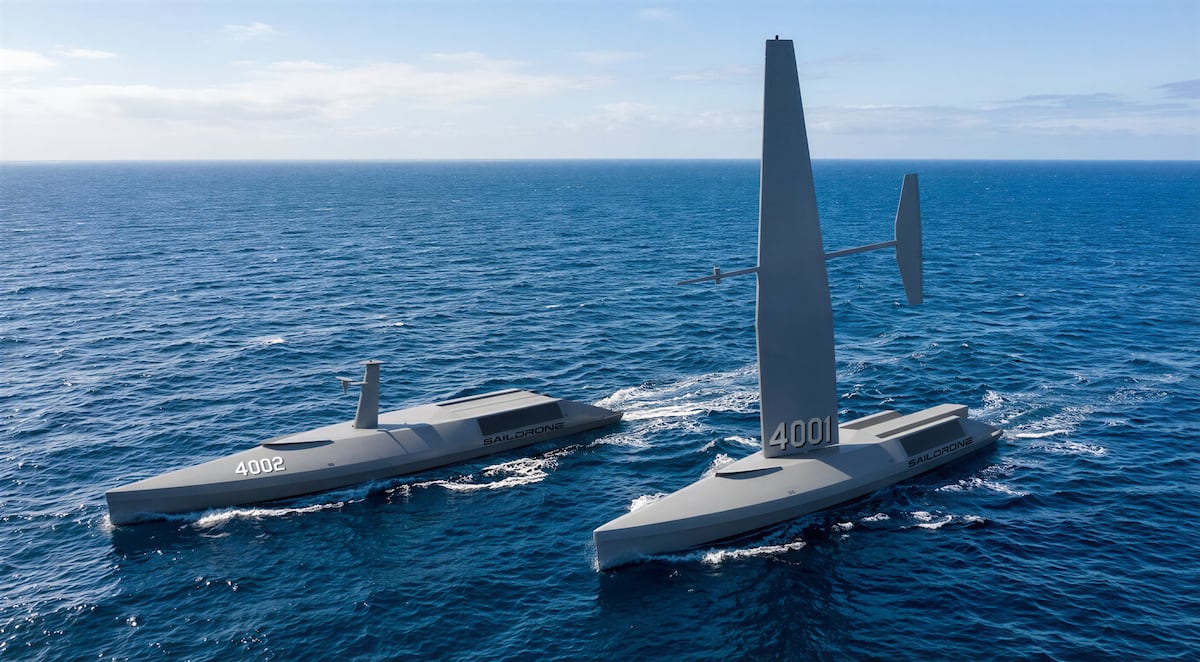
Saildrone has introduced a new class of uncrewed surface vessel aimed at anti-submarine warfare, marking a significant expansion of the company’s maritime defense ambitions. The vessel, called Saildrone Spectre, is 54 meters long, weighs 250 metric tons, and is designed to reach speeds of up to 30 knots.
The company described Spectre as its most capable platform to date. Unlike Saildrone’s smaller and better-known autonomous vessels, Spectre is intended for demanding naval missions where endurance, acoustic discretion, and speed all matter. Anti-submarine warfare is one of the most technically challenging maritime missions because vessels must detect, track, and respond to submarines while minimizing their own detectability.
Winged and Wingless Configurations
Saildrone founder and CEO Richard Jenkins presented two versions of the vessel at the Sea-Air-Space Exposition: one with Saildrone’s distinctive wing system and one without it. Jenkins said this was the first time the company is offering a Saildrone vessel without a wing.
The shift is notable because Saildrone’s wing has been central to the company’s identity, enabling long-duration autonomous operations at sea. For Spectre, however, Saildrone is acknowledging that some military roles may prioritize stealth and speed over the longest possible endurance.
Jenkins said the wing remains useful for very long missions, but other roles require different tradeoffs. In anti-submarine work, a vessel may need to be quieter, faster, or configured for mission systems where the wing is not essential.
Lockheed Martin Joins as Mission Integrator
Saildrone is partnering with Lockheed Martin on the new vessel class. Paul Lemmo, a Lockheed Martin vice president and general manager, said the company is supporting mission autonomy as the mission integrator.
That relationship points to Spectre’s intended role as more than a remote-controlled vessel. The goal is to field an autonomous or highly automated platform that can operate as part of a broader naval system, adding more assets to the maritime battlespace without requiring a crew aboard every platform.
Lemmo described Spectre as a lower-priced way to put more players on the field. Saildrone said each vessel is priced at around $40 million, a figure that positions the platform below many traditional crewed naval assets while still representing a major defense system.
Certification, Shipbuilding, and Schedule
Saildrone said the design has received approval in principle from the American Bureau of Shipping, indicating compliance with High Speed Naval Craft class certification. The company also said two years of design and testing have de-risked the vessel’s design and performance.
Construction is expected to begin soon at Fincantieri shipyards in Wisconsin. According to the company, those facilities can manufacture five Spectre vessels per year. The first sea trials are planned for early 2027.
Why It Matters
Spectre reflects a broader defense trend toward uncrewed maritime systems that can extend naval reach, reduce risk to personnel, and add capacity in contested waters. Anti-submarine warfare has traditionally depended on expensive crewed ships, submarines, aircraft, sensors, and trained operators. A lower-cost uncrewed vessel could change how navies distribute sensing and tracking missions across the ocean.
The platform is still in the pre-trial stage, so its operational value will depend on how well it performs at sea, how reliable its autonomy proves to be, and how effectively it integrates with existing naval systems. But Saildrone’s move into a larger, faster, anti-submarine vessel shows that the uncrewed surface vessel market is moving beyond surveillance and ocean monitoring toward more specialized military roles.
This article is based on reporting by Defense News. Read the original article.
Originally published on defensenews.com