The Marine Corps wants a rifle-level answer to the drone problem
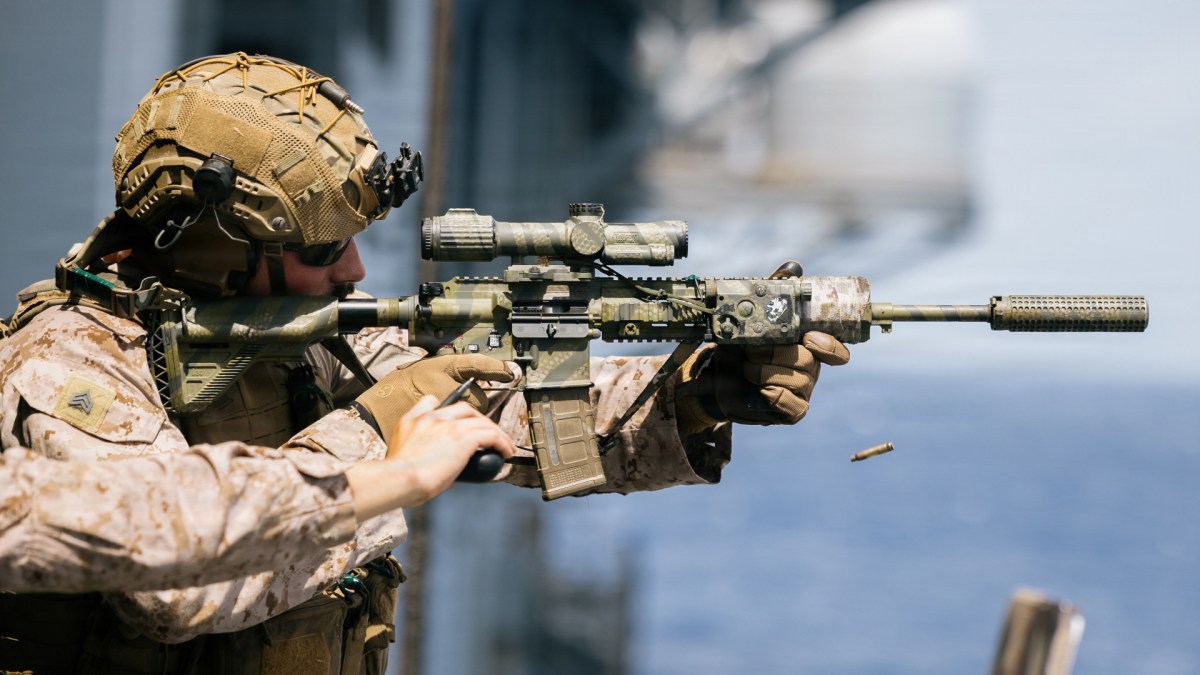
The U.S. Marine Corps is moving to buy specialized 5.56x45 mm anti-drone ammunition intended for standard service weapons, a sign of how urgently small uncrewed aircraft are reshaping battlefield requirements. The round in question, identified in the supplied report as Drone Round’s L Variant, is designed to break into multiple segments to improve the odds of hitting small, fast-moving aerial targets.
The concept is simple and practical. Instead of requiring every unit to rely on dedicated counter-drone systems, the Marine Corps wants ordinary riflemen armed with M4 carbines and M27 rifles to have an immediate, drop-in option for close-range defense against drones, especially first-person-view attack systems.
That reflects the battlefield lesson now visible across multiple conflicts, and especially in Ukraine: small drones are cheap, abundant, and lethal enough that every formation may need some organic ability to swat them down.
Why this procurement is notable
Marine Corps Systems Command says the service intends to pursue a sole-source contract with Drone Round, with an award projected for December 2026. The justification cited in the supplied report is that the L Variant is the only kinetic munition currently available that meets the Corps’ minimum requirements for immediate counter-small-UAS defense.
Two characteristics stand out. First, the round is described as drop-in compatible with current-issue Marine 5.56 weapons, including the M27, M4, and M4A1. Second, the report says it requires no additional new-equipment training or specialized occupational skill to use effectively. In procurement terms, that makes it attractive because it reduces both integration time and operational friction.
For a service trying to adapt quickly, those advantages matter as much as raw performance. A technically impressive counter-drone tool is less useful if it requires a new platform, extensive retraining, or a separate logistics chain.
The broader shift in infantry warfare
This purchase effort also highlights a larger change in how militaries think about air defense. Traditionally, air defense has been layered around specialized missiles, guns, radar networks, and electronic warfare systems. Small drones are forcing a partial redistribution of that mission down to the squad and individual level.
That does not mean rifle-fired anti-drone ammunition will replace dedicated counter-UAS systems. It will not. But it could fill an important gap at the shortest ranges, where reaction time is measured in seconds and the nearest Marine may be the only one able to engage before impact.
The rise of FPV drones has made that scenario much more plausible. These systems are often inexpensive, maneuverable, and difficult to defeat with traditional high-cost interceptors. That creates demand for defensive tools that are likewise cheap, plentiful, and easy to field.
Cost, scale, and immediacy
The supplied report frames the round as an immediate capability boost rather than an experimental future concept. That is important. Counter-drone demand has moved so fast that many armed forces are no longer waiting for perfect solutions. They are adopting tools that can be fielded now, then refining doctrine later.
- The Marine Corps wants a 5.56 round that fragments into multiple projectiles.
- The ammunition is intended for existing M4 and M27-family weapons.
- The service says no weapon modifications or specialized training are required.
- The goal is to improve organic defense against small drones, including FPV threats.
If the procurement moves ahead as planned, it will mark another step in the normalization of counter-drone capability at the lowest tactical levels. The message is clear: in modern combat, the rifle squad is no longer just watching the sky. It is expected to fight into it.
This article is based on reporting by twz.com. Read the original article.
Originally published on twz.com