A simple material is becoming a serious military signal
One of the clearest signs of how warfare is changing is not a new missile, radar, or autonomous vehicle. It is netting. Photographs from a recent logistics exercise in South Korea appear to show mesh protection installed on a floating ship-to-shore platform, a detail that would have seemed minor a few years ago but now points to a broad shift in military priorities. As small drones become cheaper, more precise, and more available, even basic physical barriers are being treated as practical battlefield defenses.
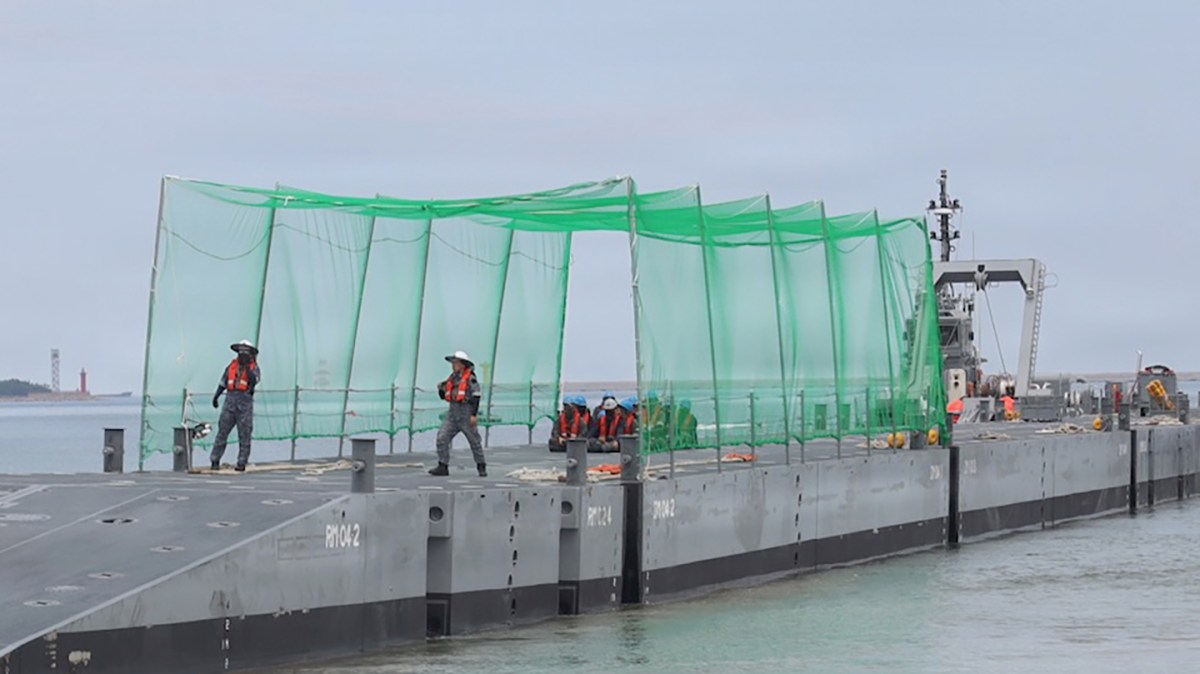
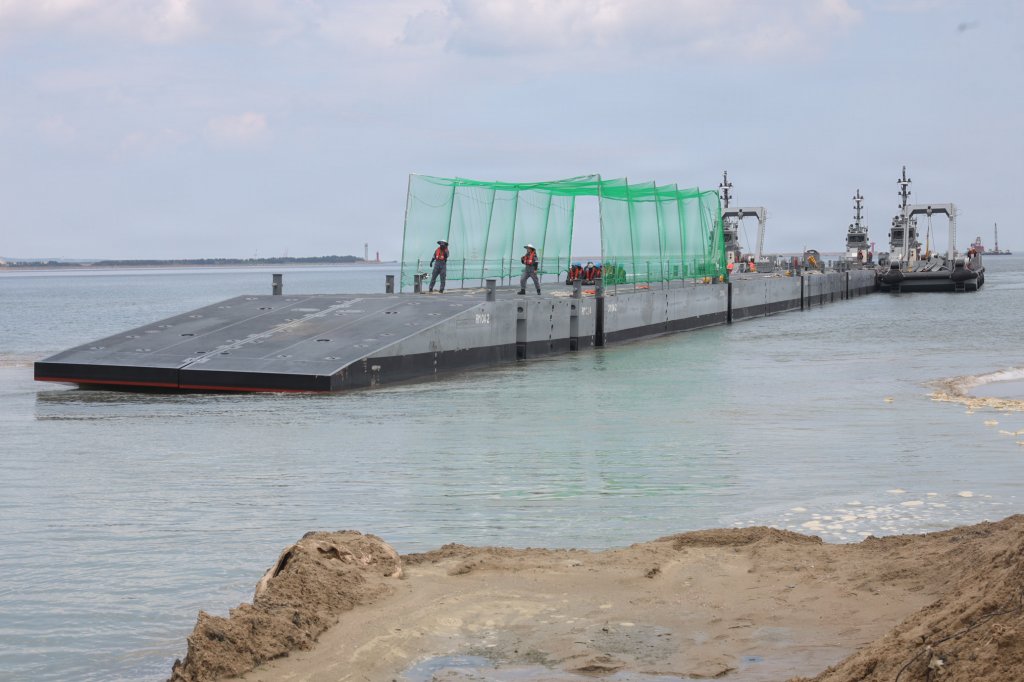
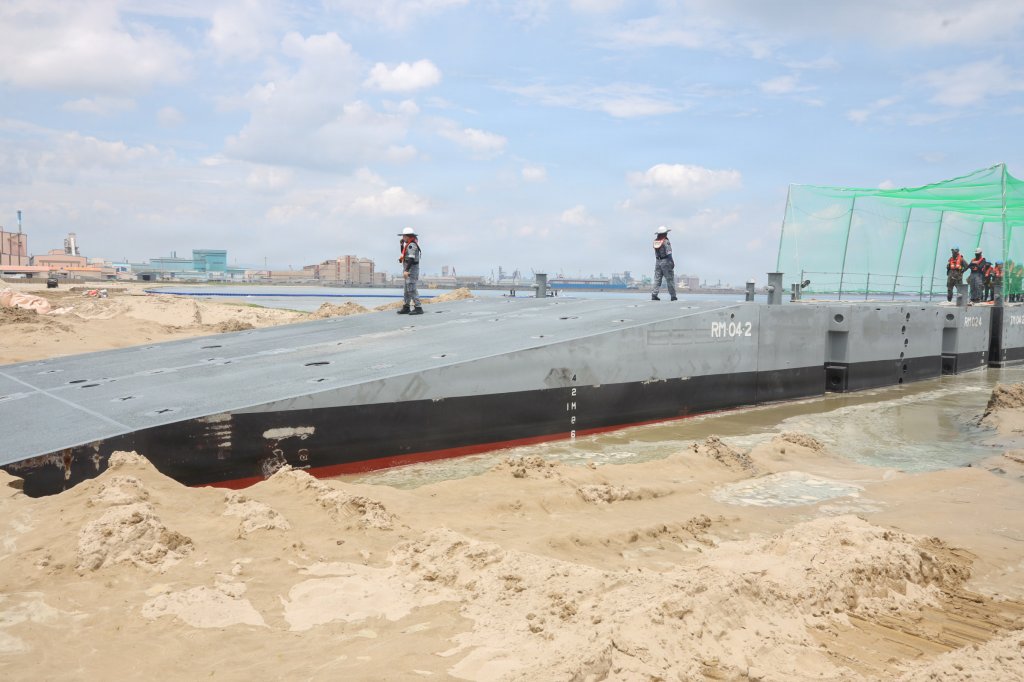
The images, highlighted by The War Zone, were posted through the Pentagon’s image distribution system after Combined Joint Logistics Over-the-Shore 26 at Dogu Beach in Pohang on July 9, 2026. They show Republic of Korea service members operating an Improved Navy Lighterage System platform used to move cargo and troops. On part of that floating structure is what appears to be anti-drone netting covering a section of the platform.
No official statement in the cited report confirms the installation’s exact purpose. The publication notes that the mesh could theoretically serve another role. But its shape and placement are consistent with an increasingly recognizable defensive adaptation: using nylon or metal mesh to interfere with incoming small drones, especially first-person-view attack drones or multicopters dropping munitions. The image matters not because it proves a finished doctrine, but because it suggests the threat has become normal enough to influence ordinary logistics setups.
Drone warfare is pushing defenses downward and outward
Military innovation is often associated with exquisite technology, yet many of the fastest changes on today’s battlefields involve improvised or low-cost countermeasures. Small drones have altered that equation. They are difficult to detect, often hard to jam reliably in cluttered environments, and inexpensive enough to be used in large numbers. Their spread has forced armies to think about protection not only for tanks and command posts, but also for trucks, supply dumps, ferries, temporary shelters, engineering equipment, and the basic connective tissue of military operations.
That is where netting enters the picture. The logic is straightforward. A drone that strikes mesh may get tangled before reaching its intended target, detonate farther away from troops, or fail to deliver a payload accurately. Even partial protection can matter if the aim is to reduce casualties, protect stored cargo, or disrupt the final seconds of an attack. In some cases, the barrier does not need to be perfect; it only needs to be disruptive enough to degrade the drone’s effectiveness.
The War Zone notes that similar measures have been seen in Ukraine and elsewhere, including recent use by Dutch forces. That geographic spread is important. It suggests this is no longer an ad hoc adaptation confined to one conflict. Instead, anti-drone netting is becoming part of a broader international pattern in which militaries absorb lessons from active war zones and translate them into training, logistics, and infrastructure planning.
Why a logistics platform matters
The South Korean example is especially notable because it involves a logistics exercise rather than a combat engagement. Logistics-over-the-shore operations are inherently exposed. They depend on moving people, vehicles, and supplies through temporary or semi-temporary maritime structures that can be difficult to harden without sacrificing speed and flexibility. A floating cargo platform is not just a piece of support equipment; it is a concentration point where troops and materiel become briefly predictable and vulnerable.
That makes it a plausible target for low-cost drones. In a conflict environment, an adversary would not necessarily need to destroy the platform outright. Damaging equipment, detonating near personnel, or interrupting unloading cycles could be enough to create outsized operational consequences. A small disruption at a transfer node can ripple outward into fuel shortages, delayed resupply, slower maneuver, and reduced tempo on shore.
Seen in that light, adding netting to such a platform reflects a change in military thinking. Protection is no longer reserved for high-value strategic systems. It is extending into the mundane but essential hardware that keeps armed forces moving. That is one of the most consequential shifts produced by the drone era: vulnerability has spread across the full logistics chain, so defensive attention has had to spread with it.
Useful, but far from perfect
The report is careful not to oversell the photographed setup. The protective mesh appears to cover only part of the floating platform, likely the section where cargo or a vehicle would be positioned. Other parts of the platform remain exposed, as do nearby areas and the connecting ship elements. For highly maneuverable FPV drones, the open ends of the netted section could limit its effectiveness. A determined operator might still be able to attack from an uncovered angle.
That limitation is precisely why the image is so interesting. It shows militaries balancing real constraints rather than unveiling a complete solution. Netting adds weight, complexity, and possible interference with movement. On a floating logistics structure, crews still need access, visibility, and rapid loading and unloading. A fully enclosed cage might offer more protection but make the platform less usable. The result is a compromise: partial coverage that offers some shielding while preserving function.
Such compromises are becoming common across modern force design. Counter-drone defense is increasingly layered, mixing electronic warfare, kinetic interceptors, camouflage, dispersion, physical barriers, and procedural changes. Netting sits at the low-tech end of that spectrum, but that does not make it unimportant. In many environments it may be one of the few countermeasures that is cheap, scalable, and immediately deployable.
What this says about military adaptation
South Korea’s apparent use of anti-drone mesh during training also signals something about the pace of adaptation. Militaries are not waiting for drone threats to remain confined to headline combat zones. They are increasingly building assumptions about drone exposure into peacetime exercises, engineering practices, and equipment preparation. Once a defensive measure appears in a training context, it often means the threat has moved from theoretical discussion into routine planning.
That is strategically significant for a country like South Korea, where any major contingency would place a premium on rapid coastal movement, dispersed logistics, and survivable support operations. The lesson drawn from recent wars is that rear areas are no longer reliably rear. Small drones can compress the distance between frontline and support zone, making units responsible for transport and transfer almost as conscious of aerial threat as maneuver forces themselves.
The photographed platform does not, by itself, prove a finalized South Korean doctrine for countering drones. What it does show is that the visual vocabulary of modern military protection is changing. Mesh barriers, once associated mainly with local improvisation, are increasingly visible in formal exercises and professionalized settings. They are becoming part of the standard toolkit through which forces buy time, reduce exposure, and blunt attacks that are inexpensive for an adversary to launch.
The low-cost defense era
For defense planners, the biggest lesson may be that the economics of protection are shifting. A small attack drone can threaten equipment worth millions of dollars or disrupt operations with far-reaching consequences. Meeting that threat exclusively with expensive interceptors is unlikely to be sustainable. Physical barriers such as netting will not solve the drone problem, but they fit a new operational reality in which affordable, rapidly deployable defenses matter as much as sophisticated ones.
The South Korean logistics images capture that transition in a single detail. A floating platform designed to move cargo now appears to be dressed for a threat from above. That is a concise picture of modern war’s diffusion: the battlefield is broader, the targets are more ordinary, and the answers are often improvised, layered, and unglamorous.
If the anti-drone interpretation is correct, then the significance of the photos lies less in the hardware itself than in what it represents. Drone warfare is no longer changing only the front line. It is changing how militaries think about ramps, docks, bridges, transport nodes, and every other place where people and supplies briefly gather. In that environment, a sheet of netting is not a minor accessory. It is evidence that the protection of logistics has entered a new phase.
This article is based on reporting by twz.com. Read the original article.
Originally published on twz.com