A Historic Procurement Turn for NATO
NATO appears to be moving toward Saab’s GlobalEye as the successor to its aging E-3A Sentry airborne warning and control aircraft, a choice that would mark the alliance’s first common airborne surveillance backbone not built by Boeing since 1982.
According to Defense News, NATO’s Support and Procurement Agency selected Sweden’s Saab and Canada’s Bombardier for the replacement effort, citing reporting from La Lettre and separate confirmation by Germany’s DPA. The award has not yet been formally announced, and Saab has said no contract has been concluded. Still, the reported decision is politically and industrially significant.
Why the E-7 Plan Unraveled
The replacement path had once seemed to favor Boeing’s E-7A Wedgetail. In November 2023, NATO awarded the replacement contract to Boeing without a competitive tender, arguing that the E-7 was the only available system able to meet requirements in time.
That logic weakened after the United States itself backed away. The U.S. Air Force removed the E-7 from its fiscal 2026 spending plan in June 2025, according to the report, citing delays, cost overruns, and doubts about survivability in contested environments. Washington instead shifted emphasis toward space-based surveillance and additional E-2D Hawkeye aircraft.
That reversal had consequences in Europe. By November 2025, the Netherlands and other European partners had scrapped a planned six-aircraft Wedgetail buy. Dutch officials explicitly linked the move to the U.S. withdrawal and to the strategic importance of investing more heavily in European industry.

What GlobalEye Offers
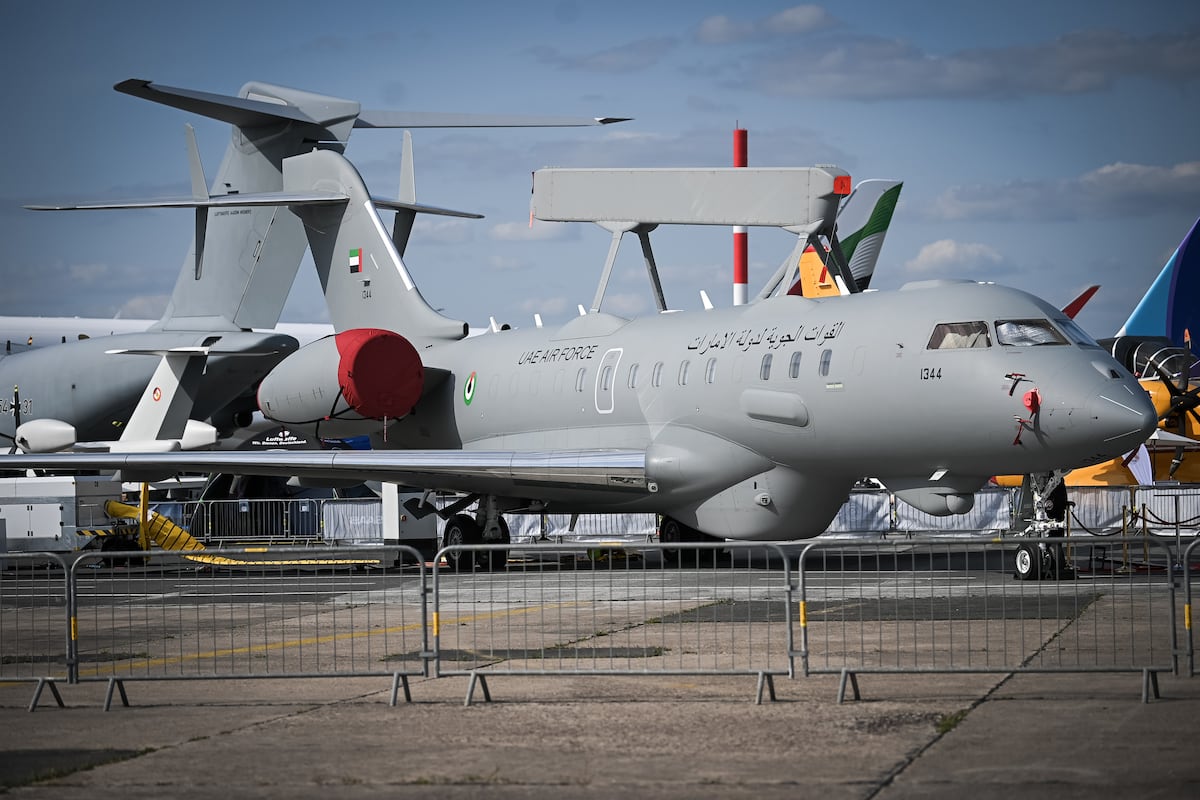
GlobalEye combines Saab’s Erieye Extended Range active electronically scanned array radar with a Bombardier Global 6000 or 6500 business jet airframe. Defense News reports detection ranges of more than 550 kilometers across air, sea, and land domains.
That multi-domain pitch is central to the aircraft’s appeal. NATO’s current AWACS fleet is a Cold War-era asset built for a different surveillance environment. A replacement needs to do more than track aircraft. It needs to operate as part of a broader sensor architecture shaped by drones, maritime competition, missile threats, and distributed command structures.
The reported procurement scale is also substantial. NATO’s agency is said to be considering between 10 and 12 aircraft at roughly 550 million euros per unit, implying a purchase price above 5 billion euros before training, sustainment, and infrastructure are added.
A Signal About European Defense Industrial Priorities
If confirmed, the selection would amount to more than a platform swap. It would reflect a wider European defense mood: less confidence in depending automatically on American industrial choices and more interest in fielding systems anchored in European suppliers.
That sentiment has been building. France signed for two GlobalEye aircraft in December 2025 with options for two more, and Saab’s leadership has pointed to interest from Poland and Germany. Canada is also weighing a possible purchase.
Seen in that context, NATO’s move would not be an isolated procurement anomaly. It would fit a broader trend in which European governments are seeking both capability and leverage through regional industrial participation. The Wedgetail’s problems may have opened the door, but political appetite for strategic autonomy helped push it wider.
What Still Needs to Happen
The report stops short of claiming the deal is complete. Saab’s media relations leadership told AeroTime that no contract had yet been formally concluded and that NATO still has the award to announce. That leaves room for procedural delay even if the direction of travel now looks clearer.
There is also the practical question of schedule. Saab has said GlobalEye can meet NATO’s 2031 operational target, or possibly do so earlier. Meeting that date will matter because the current E-3A fleet is old, expensive to sustain, and increasingly ill-suited to future operating environments.
For NATO, timing and credibility now matter as much as selection. A reported award without a signed contract is still just a step. But it is a meaningful one, especially given how decisively the alliance once appeared committed to the E-7 path.
The Broader Military Meaning
The deeper lesson is that airborne early warning and control is no longer just an issue of replacing one aircraft with another. It sits at the intersection of procurement politics, industrial policy, and the changing character of surveillance in contested theaters.
NATO’s prospective GlobalEye choice therefore carries three messages at once. Operationally, it points to demand for more flexible multi-domain sensing. Industrially, it rewards a European-led offering after Boeing’s position weakened. Strategically, it shows how quickly alliance procurement assumptions can shift when U.S. choices change.
If the contract is finalized, NATO will be making a clean symbolic break with a system lineage that has defined alliance airborne surveillance for decades. That alone would make the move notable. In today’s political and defense-industrial context, it could prove even more consequential than the aircraft choice itself.
This article is based on reporting by Defense News. Read the original article.

Originally published on defensenews.com