The Pentagon wants faster decisions against small drones
The U.S. Department of Defense is turning to AI-enhanced target recognition in an effort to improve how troops, vehicles, and ships engage small drones. The project, known as C-UAS Close-In Kinetic Defeat Enhancement, centers on aided target recognition, or AiTR, using AI, machine learning, and computer vision to identify threats more quickly than a human operator can on their own.
The near-term objective is straightforward: shrink the time between seeing a drone and shooting it down. Just as importantly, the Pentagon wants systems that can distinguish real threats from non-threats such as birds, a problem that becomes more pressing as low-cost drones proliferate and visual clutter complicates engagement decisions.
The Defense Innovation Unit solicitation sets out a phased plan that begins with remote weapons stations and eventually reaches small arms carried by dismounted troops.
Phase one starts with the CROWS turret
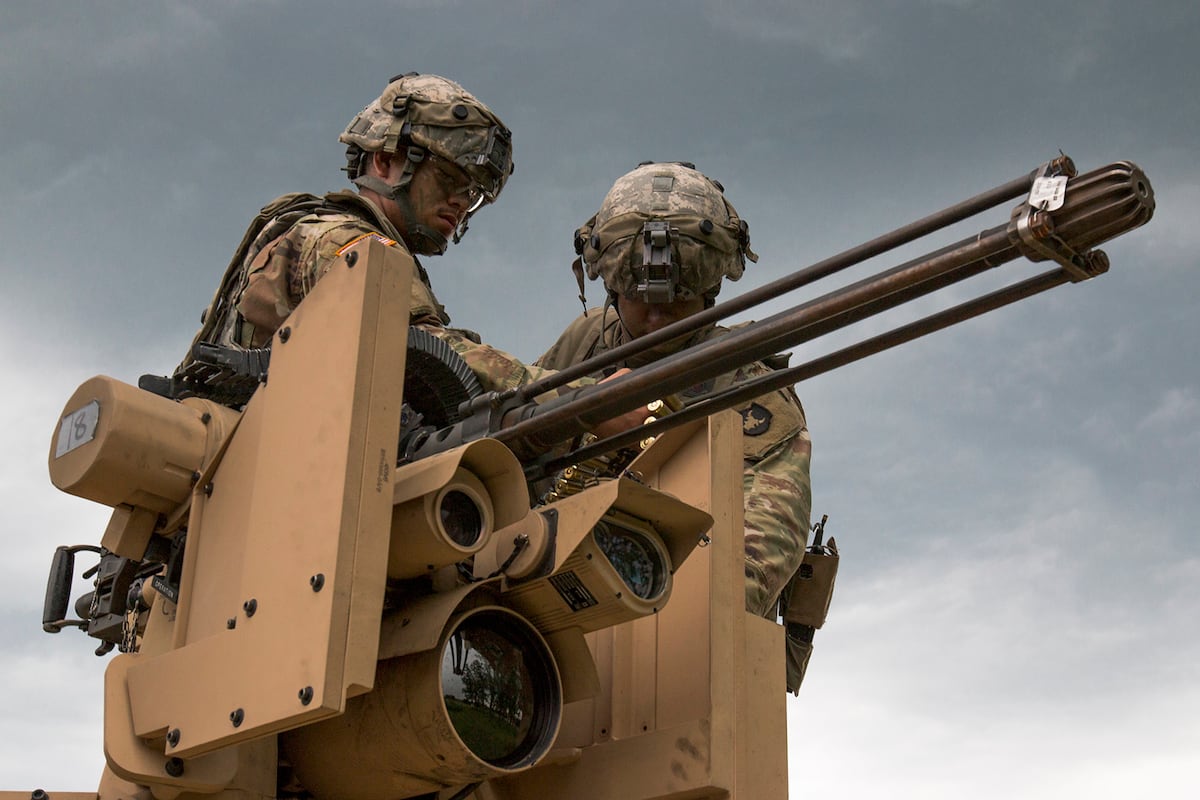
The first phase is aimed at remote weapons stations, specifically the Common Remotely Operated Weapon Station, or CROWS, which is widely fitted to military vehicles. According to the solicitation, the system is intended to accelerate the engagement timeline with an initial focus on unmanned aircraft systems and a secondary focus on vehicular and man-sized targets.
Prototype systems must demonstrably improve the ability of current remote weapons stations to detect, track, and engage Group 1 and Group 2 drones, defined here as targets weighing 55 pounds and under. The solicitation says detection should occur at ranges greater than 600 meters, with engagement at a minimum of 100 meters. The system should also work against drones moving at speeds of at least 30 meters per second, or roughly 67 miles per hour.
Those numbers show the Pentagon is not looking for an abstract demo. It wants a system that operates under concrete performance thresholds relevant to real tactical engagements.
The project scales beyond vehicles
The second phase broadens the concept to both moving and stationary platforms in ground and maritime environments. In that phase, the solicitation calls for the ability to hit a Group 1 drone, under 20 pounds, moving at 7 meters per second at a range of 50 to 200 meters.
The weapons must be able to engage targets across demanding firing angles, from minus 10 degrees depression to 90 degrees elevation directly overhead. Contractors are also told to provide a live-fire capable prototype suitable for land and maritime environments rather than only a laboratory demonstration.
That requirement reflects one of the most common weaknesses in defense technology pitches: systems that perform well in controlled settings but are less convincing once recoil, motion, weather, and background clutter enter the equation. The Pentagon appears to be trying to screen for that early.
The most ambitious phase targets individual weapons
The third phase is the most striking. It seeks to add aided target recognition to small arms used by dismounted troops. The solicitation says desired solutions include systems capable of deflecting or self-aiming standard-issue rounds to increase hit probability against manually selected transient targets, while integrating networked sensor and small-arms fire-control systems.
If achieved, that would push drone defense much closer to the individual soldier rather than reserving advanced assistance for vehicle- or ship-mounted systems. The requirement also says the system must be adaptable to legacy small arms, scalable across calibers and configurations, and able to preserve baseline weapon performance if the added technology degrades or fails.
That fallback requirement is critical. In combat, a digital aid cannot be allowed to render a weapon ineffective if it malfunctions. The solicitation explicitly preserves that principle.

Why this fits the battlefield now
Counter-drone warfare has changed rapidly because small unmanned systems are cheap, numerous, and increasingly difficult to defeat efficiently. Traditional air defense is often too expensive or too cumbersome for the smallest threats, while human visual recognition alone can be too slow or error-prone when seconds matter.
AI-assisted recognition offers a more scalable answer in theory. A system that can quickly identify whether an airborne object is a threat, keep it tracked, and support precise engagement could reduce reaction time and waste fewer rounds on false targets.
The solicitation’s emphasis on distinguishing drones from birds shows how practical this challenge has become. The problem is not only hitting what matters. It is also avoiding engagement decisions triggered by harmless clutter.
What success would look like
If the program produces credible prototypes, success would likely mean several things at once.
- Remote weapons stations would gain faster, more reliable drone engagement support.
- Ground and maritime platforms would get adaptable close-in kinetic defense options.
- Dismounted troops could eventually receive more capable fire-control assistance against fleeting drone targets.
Even then, human operators would still matter. The solicitation describes aided target recognition, not a fully autonomous kill chain. The AI’s role is to accelerate detection, classification, and engagement support in situations where time and visibility are against the operator.
What to watch next
The solicitation deadline is May 15, which means the Pentagon is moving quickly to gather candidate systems. The more important question is whether industry can produce rugged, live-fire-capable tools that work across vehicles, ships, and infantry weapons without creating new reliability or safety problems.
That is a high bar, but the operational need is obvious. Small drones have become one of the defining tactical threats of the current era. The U.S. military is now signaling that software-assisted targeting, not just new interceptors, will be a key part of the answer.
If this effort succeeds, the result will not simply be better sensors. It will be a broader shift in how kinetic counter-drone defense is executed, extending AI support from mounted systems down to the individual service member on the ground.
This article is based on reporting by Defense News. Read the original article.
Originally published on defensenews.com