Poland becomes the first SAFE borrower
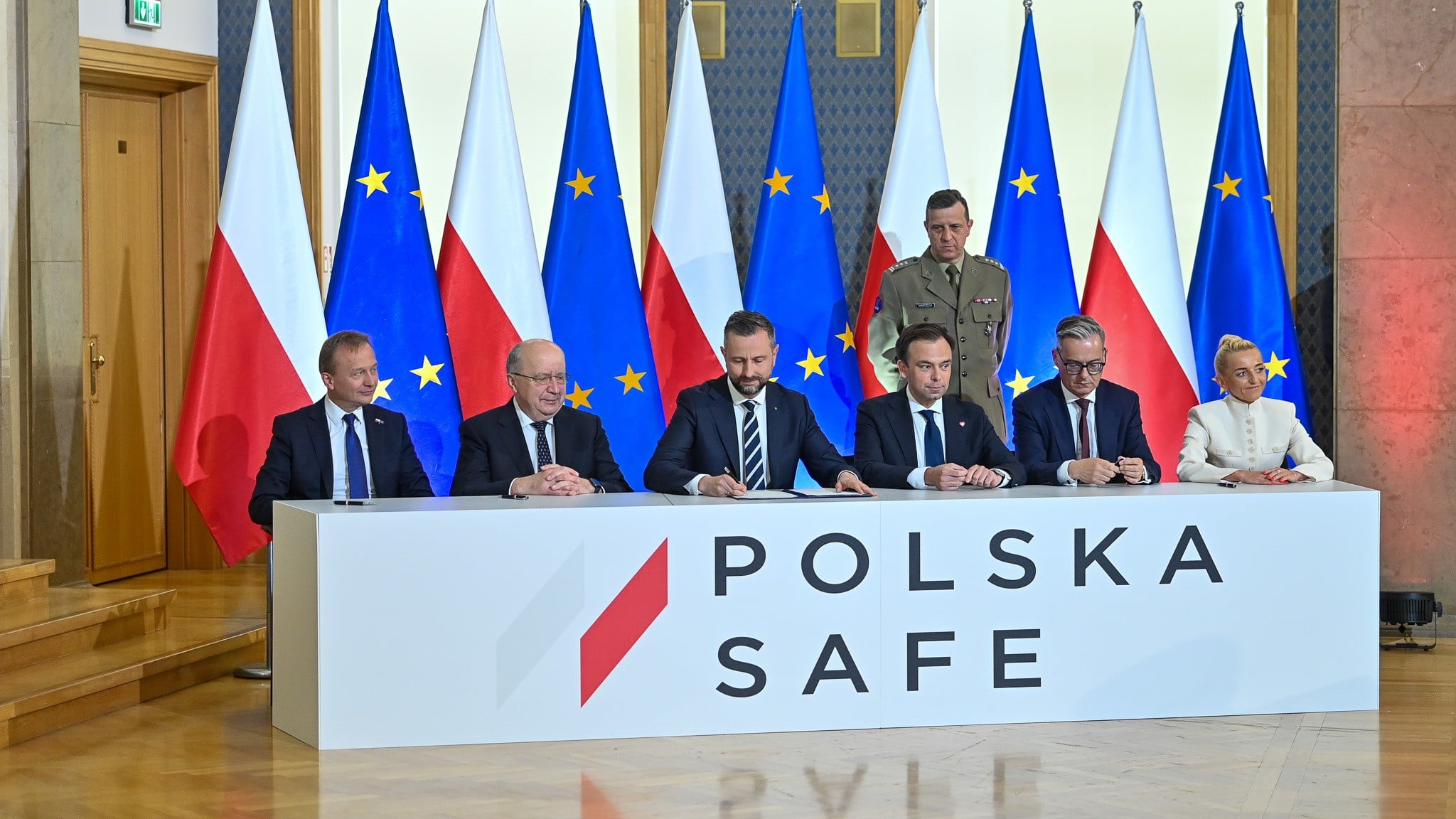
Poland has become the first country to sign agreements under the European Union’s Security Action for Europe, or SAFE, instrument, clearing the way for Warsaw to begin receiving €43.7 billion in defense funding by the end of May. The signing, held Friday with senior Polish and EU officials present, marks the first operational step in one of Europe’s most ambitious new defense-financing mechanisms.
For Poland, the agreement is not just about access to money. It is a political marker. Prime Minister Donald Tusk described the moment as a turning point for both Poland and the European Union, tying the agreement to a broader reassessment of European security responsibilities. The message from Warsaw was straightforward: Europe is moving from rhetoric about defense readiness to financing structures that can support it at scale.
What SAFE is designed to do
SAFE was created on May 29, 2025, as a loan-based instrument in which the European Union raises capital on international markets and then re-lends it to member states. That structure matters because it allows countries to borrow using the stronger collective credit standing of the EU rather than relying only on national borrowing conditions.
For smaller member states in particular, that can substantially reduce financing costs. The loan structure is also unusually long-term. SAFE loans come with a 45-year repayment horizon and a 10-year grace period on principal, meaning participating governments pay only interest during the first decade. That gives states more room to accelerate procurement and industrial investment without taking the full budgetary hit immediately.
In practice, SAFE is intended to solve a problem Europe has faced for years: many governments have acknowledged the need for stronger defense spending, but not all have had equally affordable ways to finance it. Poland’s move shows the mechanism is now real, bankable, and politically usable.
Why Poland moved first
Poland’s early participation is consistent with its role on NATO’s eastern flank and with its long-running push to modernize both its armed forces and defense industry. European Commissioner for Defence and Space Andrius Kubilius said at the signing that Poland is a leader in Europe when it comes to defending Poland, NATO’s eastern flank, and Europe as a whole.
The agreement also followed what the source describes as a politically turbulent domestic process, suggesting that even a country strongly committed to defense expansion still had to work through internal hurdles before finalizing the deal. That is important context for the rest of Europe. SAFE may offer attractive terms, but national politics will still shape how quickly member states can turn approval into signed borrowing.
The symbolism of Poland going first is difficult to miss. Warsaw has consistently argued that Russia’s threat environment requires Europe to build capacity faster and at greater scale. By locking in the first SAFE agreement, it is now not only making that argument but also demonstrating the financing path.
A wider European queue is already forming
Poland is not alone. Other countries identified in the source as taking part in SAFE loans include Romania, France, Hungary, Italy, Belgium, Lithuania, and Portugal. Their planned participation shows that the instrument is not a one-off arrangement tailored to a single state, but part of a larger EU-wide push to translate shared security concerns into shared funding tools.
That may prove one of the most consequential aspects of SAFE. The mechanism does not replace national defense policy, and it does not create a unified European military procurement system on its own. But it does create common financial architecture, which is often the missing precondition for larger strategic shifts. Once borrowing becomes easier and more predictable, procurement and industrial planning can move faster.
Tusk explicitly linked the agreement to a change in policy and strategy inside the European Union, saying Europe has learned from history and is preparing to assume greater responsibility for its own security in cooperation with the United States. That framing suggests SAFE is being presented not as a break with NATO, but as part of a stronger European contribution within the broader transatlantic security model.
What this means now
The immediate meaning of the signing is simple: Poland now has a path to billions in defense financing under a newly established EU framework. The broader meaning is that Europe has begun to operationalize long-term defense borrowing at the union level.
If more states complete their own SAFE agreements, the program could become one of the clearest signs yet that Europe is reorganizing not just its defense posture but also the financial tools behind it. Poland’s first-mover status therefore matters beyond the size of its allocation. It is the first proof that SAFE is no longer a policy concept. It is now an instrument governments can sign, use, and build around.
This article is based on reporting by Breaking Defense. Read the original article.
Originally published on breakingdefense.com